Real estate investors have been quietly rotating into mobile home parks for the past decade. But 2026 looks different — not because the story changed, but because the data got harder to ignore. If you’ve been asking why invest in mobile home parks, this guide breaks down the updated case: what’s driving demand, what’s constraining supply, and what the numbers actually show about NOI resilience and returns.
The State of Mobile Home Park Investing in 2026
The manufactured housing sector has matured significantly since the early 2000s, when mobile home parks were largely overlooked by institutional capital. Today, national occupancy sits at roughly 94% — up from about 86.5% a decade ago. Average monthly lot rents have climbed to $752, up approximately 7% year-over-year. Transaction volume in the sector rose 66% in the first half of 2025, signaling that capital is flowing in at an accelerating pace.
Meanwhile, cap rates have compressed to a national average of around 5.9%, down 40 basis points from Q4 2024. That compression reflects institutional validation — buyers are willing to accept lower yields because they see mobile home parks as a durable, low-risk income stream. If you’re evaluating whether this asset class belongs in your portfolio, the macro setup has never been more compelling.
For a broader overview of the sector, see our guide: Are Mobile Home Parks a Good Investment in 2026?
Why the Demand Side Has Never Been Stronger
The fundamental driver behind mobile home park investing is simple: more than 20 million Americans live in manufactured housing communities, and the affordability gap between manufactured homes and site-built homes continues to widen.
As of 2026, the average new manufactured home costs roughly $130,000 — compared to $425,000+ for the median site-built home. For households earning between $35,000 and $65,000 annually, manufactured housing isn’t just a preference — it’s one of the only paths to stable, non-subsidized shelter.
Several new tailwinds are reinforcing this demand in 2026:
- Tariffs on construction materials: New tariffs on lumber, steel, and other building inputs are driving the cost of site-built homes even higher, making manufactured housing comparatively more affordable and accelerating demand.
- VantageScore 4.0 adoption: Broader credit score recognition is expanding the pool of qualified manufactured home buyers, supporting occupancy growth in well-managed communities.
- Rising rental costs: With multifamily rents remaining elevated in most markets, more renters are evaluating lot-rent communities as a lower-cost alternative with more permanence.
Lot rent — the core revenue driver in mobile home park investing — also benefits from a structural stickiness that apartment rent simply doesn’t have. When a resident moves a manufactured home onto a site, moving that home costs anywhere from $5,000 to $15,000+. That cost anchors residents in place, creating tenant turnover rates of just 2–3% per year versus 47% for apartments.
The Supply Constraint That Makes This Asset Unique
New supply is essentially nonexistent. The manufactured housing sector adds approximately 0.04% new communities per year — meaning only about 20 new communities enter the market annually out of a national stock of roughly 45,000. Compare that to apartments, where new supply runs at 3.8% of stock per year (with 588,000 units delivered in 2024 alone).
Why can’t new mobile home parks be built? A combination of factors:
- Zoning barriers: Most municipalities have downzoned or outright prohibited new mobile home park development over the past 30–40 years.
- NIMBY resistance: Community opposition to new manufactured housing developments remains intense in most markets.
- Infrastructure costs: Building new utility infrastructure (water, sewer, roads) for a ground-up community is capital-intensive and rarely pencils at current land prices.
This supply constraint is permanent — not cyclical. It means that existing mobile home park operators face minimal competitive pressure from new entrants, which directly supports lot rent growth and NOI stability year after year.
NOI Resilience: How Mobile Home Parks Perform When Markets Turn
Perhaps the most compelling data point for investors evaluating the risk side of mobile home park investing is NOI performance during downturns. The chart below tells the story:
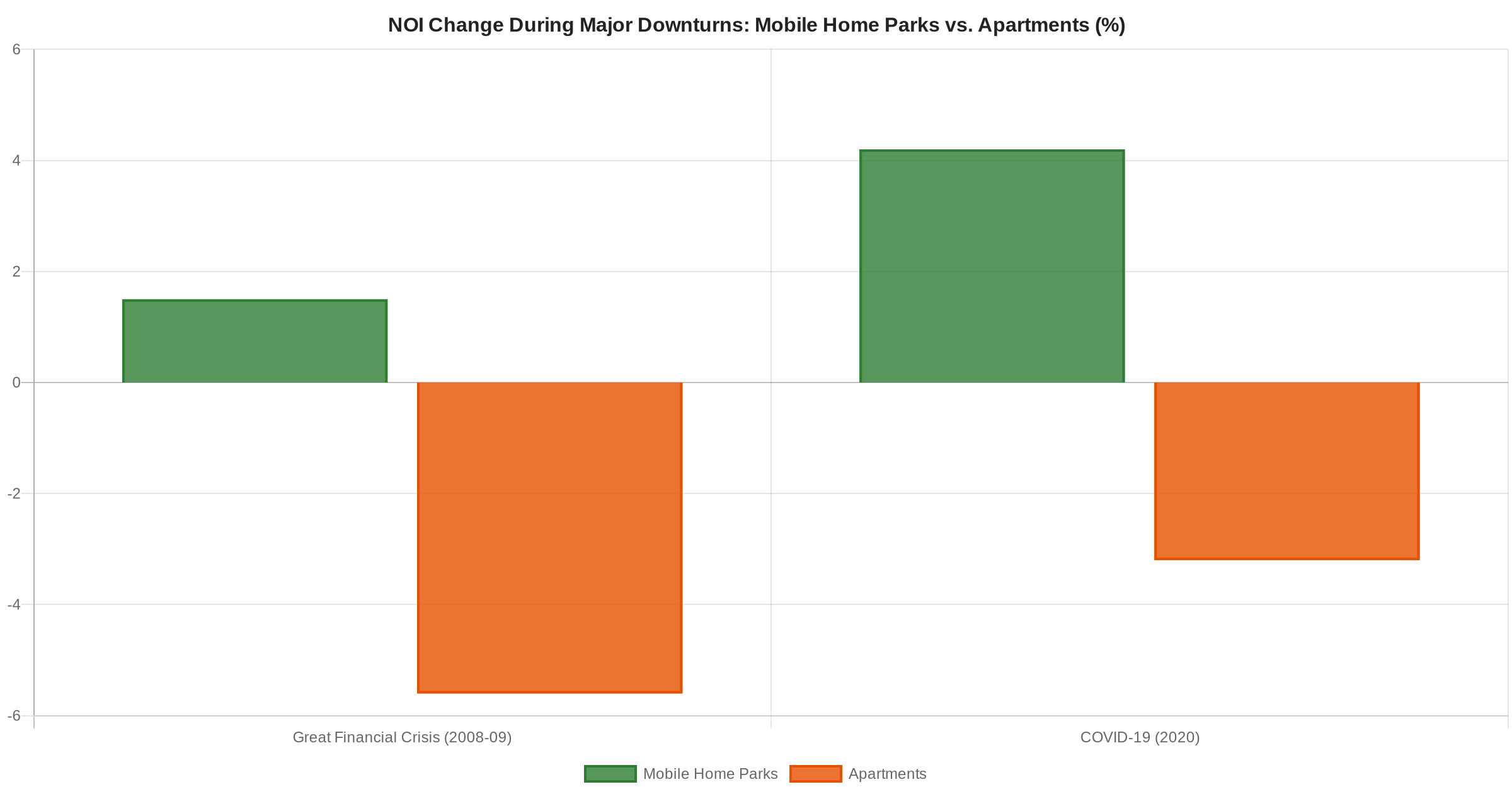
During the Great Financial Crisis (2008–2009), mobile home park NOI grew approximately +1.5%, while apartment NOI declined -5.6%. During COVID-19 (2020), mobile home parks posted +4.2% NOI growth versus apartments at -3.2%.
This counter-cyclical performance makes sense when you understand the demand driver: affordable housing demand increases during recessions as households downsize and consolidate. The residents who call mobile home parks home don’t stop paying lot rent when the economy tightens — they may even be joined by new residents who can no longer afford alternatives.
For a deep dive into recession performance data, read: How Mobile Home Parks Perform During a Recession
Two decades of hard-won lessons distilled into one free guide. Whether you’re evaluating your first deal or your fiftieth, these insights will sharpen your approach.
What’s Changed Since 2020: New Tailwinds for the Asset Class
A lot of content about mobile home park investing was written during the 2018–2021 period. Here’s what’s materially different in 2026:
- Lot rent has room to grow: At $752/month nationally, manufactured housing lot rent is still dramatically below apartment rents in most markets — meaning operators have significant runway to push rents toward market without displacement risk.
- Institutional capital validated the thesis: Sun Communities, Equity LifeStyle Properties, and UDR-backed deals have compressed cap rates and validated valuations. This exit environment benefits current owners.
- New home shipments rising: An estimated 103,000+ manufactured homes shipped in 2024, up approximately 15% — signaling that manufacturers are scaling up production in response to demand. More homes available means faster infill for parks with vacant lots.
- Regional concentration matters more: Southeast markets — particularly North Carolina, Tennessee, Georgia, and South Carolina — are outperforming the national average on rent growth, in-migration, and occupancy. Investors focused on these markets have been rewarded with above-average appreciation and strong cash flow.
The Institutional Validation Argument
When Blackstone, Brookfield, and REIT giants began acquiring mobile home parks at scale, it wasn’t because they needed affordable housing exposure — it was because the unit economics were too good to ignore. Per-unit replacement cost for a mobile home park lot runs roughly $75,000 versus $210,000 for an apartment unit. The revenue-per-dollar-invested ratio is simply superior.
The manufactured housing REIT sector — including Sun Communities (SUI) and Equity LifeStyle Properties (ELS) — has historically outperformed broader REIT indices on total return, driven by exactly the supply-demand dynamics described above. Individual operators in the private market can often acquire assets at higher initial yields than public REITs, then benefit from the same NOI tailwinds.
For a current breakdown of cap rate benchmarks by region and deal quality, see: Mobile Home Park Cap Rates Explained: What’s a Good Cap Rate in 2026?
Key Metrics Every Mobile Home Park Investor Needs to Know
If you’re approaching mobile home park investing for the first time, these are the metrics that define deal quality:
- Cap rate: Generally 5.5–7.5% for stabilized communities in target markets. Value-add plays may offer 6–9% going-in caps with upside through rent increases and infill.
- Lot rent vs. market: The gap between current rents and market rents is your value-add runway. A community at $450/month in a market where competitors charge $600/month has significant upside.
- Occupancy: Target 80%+ occupied on a stabilized deal. Below 70% indicates either a turnaround play or a structural problem — both require deep due diligence.
- Utility structure: City water and city sewer are strongly preferred. Parks with well/septic or lagoon wastewater systems carry higher operational risk and capital exposure.
- Home ownership mix: Tenant-owned homes (TOH) are preferable to park-owned homes (POH). TOH communities have lower capital requirements and higher tenant stability.
Is Investing in Mobile Home Parks Right for You?
Mobile home park investing is not passive if you’re an operator. Managing a community — even a well-run one — requires attention to utility systems, resident relations, local regulatory compliance, and ongoing capital maintenance. The operational intensity is lower than multifamily, but it’s not zero.
For investors who want the economic exposure without the operational responsibility, passive positions through syndications offer a path to participate in mobile home park returns without day-to-day management. Either way, the underlying asset thesis — scarce supply, affordable housing demand, sticky tenants, counter-cyclical NOI — holds regardless of how you access it.
The case for investing in mobile home parks in 2026 comes down to this: it’s an asset class with a permanent structural advantage (no new supply), a growing demand base (affordability crisis), and a track record of positive NOI through every major economic disruption of the last 20 years. That combination is rare in real estate.
10 video modules, a 55-page master checklist, and 9 ready-to-use templates that walk you through every step of evaluating a mobile home park deal — from the first site visit to closing day.
Frequently Asked Questions About Investing in Mobile Home Parks
Why do mobile home parks have such low tenant turnover?
Because manufactured homes are expensive to move — typically $5,000 to $15,000+ for transport and reinstallation. Once a home is set on a lot, residents tend to stay for years or even decades. This anchors cash flow in a way that apartment landlords can’t replicate.
What returns can investors expect from mobile home park investing?
Stabilized acquisitions in quality markets typically produce 6–9% cash-on-cash returns with additional upside through lot rent growth and exit appreciation. Value-add plays with occupancy or rent upside can produce higher returns, though they carry more execution risk.
Is new supply really not a concern for mobile home parks?
Correct — and this is one of the most underappreciated aspects of the asset class. Only about 20 new manufactured housing communities are permitted annually across the entire United States, versus thousands of new apartment complexes. Zoning restrictions, political opposition, and infrastructure costs have effectively closed the door on new supply for decades.
How do mobile home parks perform during recessions?
They have historically outperformed other real estate asset classes during downturns. During the 2008–2009 financial crisis, mobile home park NOI grew +1.5% while apartment NOI fell -5.6%. During COVID-19, mobile home park NOI grew +4.2% while apartment NOI declined -3.2%. Affordable housing demand tends to rise when economic conditions worsen.
What’s the minimum investment to get into mobile home park investing?
For direct acquisition, expect a minimum of $500,000 to $1M+ in equity for a 50-100 lot community. Passive syndication positions typically require $50,000 to $100,000 as a minimum LP commitment, depending on the operator and deal structure. For a detailed breakdown, see our guide: How Much Money Do You Need to Invest in a Mobile Home Park?
Get the top 20 lessons from two decades of mobile home park investing — free.