How Mobile Home Parks Perform During a Recession (And Why Investors Pay Attention)
-
 Andrew Keel
When the economy starts showing cracks — rising unemployment, tightening credit, declining consumer confidence — most real estate asset classes feel the pressure. Apartment vacancy rises. Office buildings sit empty. Retail centers bleed tenants. But mobile home parks tend to behave differently, and understanding why matters to anyone evaluating where to put capital when economic headwinds pick up.
This post breaks down how mobile home parks perform during a recession, what historical data actually shows, and why operators and investors continue to view this asset class as one of the most recession-resistant in real estate.
Why Affordable Housing Demand Holds Up in a Recession
The core driver of mobile home park resilience is simple: people always need somewhere to live, and during a recession, affordability becomes the dominant filter.
Mobile home parks serve working-class households living at or near their financial limits in good times. In a downturn, two things happen simultaneously: households that were renting apartments or buying starter homes get squeezed out of those options, and demand for affordable alternatives — like mobile home park lot rentals — increases.
This is the counter-cyclical demand dynamic that makes mobile home parks uniquely interesting. When unemployment rises, more people need affordable housing, not less. The pool of potential residents actually expands during recessions, not contracts.
Compare this to Class A apartments, which depend on professional-class renters with stable, above-median incomes. During a downturn, that renter cohort shrinks and vacancy climbs. Mobile home parks operate in a fundamentally different demand environment.
What Happened to Mobile Home Parks During Past Recessions
Historical performance data supports this thesis. During the 2008–2009 financial crisis — one of the worst recessions in modern U.S. history — mobile home park occupancy rates held remarkably steady compared to other commercial real estate sectors.
A few structural reasons stand out:
- Residents own their homes. In the tenant-owned home model that most stabilized mobile home parks operate under, residents own the structure and rent only the land. Moving a manufactured home is expensive — often $5,000 to $10,000 or more — and logistically difficult. This creates an unusually sticky resident base. Even when times get hard, most residents do not leave unless absolutely forced to.
- Lot rents are low relative to income. The average mobile home park lot rent across the U.S. is substantially below median apartment rents. A household paying $400–$600 per month for lot rent is paying a fraction of what apartment dwellers pay — and that cushion matters enormously when incomes drop.
- There is virtually no new supply. Unlike apartments, which developers build aggressively during up-cycles, new mobile home parks are rarely built. Zoning restrictions, local opposition, and economics make new development nearly impossible in most markets. The fixed supply side means occupancy rates are insulated from the oversupply problems that hammer other asset classes during downturns.
Operators who were active through 2008 consistently report that their mobile home park portfolios outperformed other real estate holdings — not because residents were immune to the downturn, but because the product was simply too affordable and too necessary to abandon.
The “Last Resort” Housing Misconception
A common misconception is that mobile home parks are “last resort” housing — a place people end up when all else fails. The reality is more nuanced.
Many mobile home park residents are long-term, stable community members who have chosen affordable homeownership as a deliberate lifestyle choice, not because they had no other options. They own their homes, maintain their lots, and build equity at a price point that works for their income.
That said, the affordability positioning does mean that during a recession, mobile home parks benefit from more household demand, not less. Families who lose homes to foreclosure, renters priced out of rising markets, and workers forced into lower-paying jobs all need affordable housing options — and mobile home parks are often at the top of that list.
This is why occupancy tends to stay high even when broader economic conditions deteriorate.
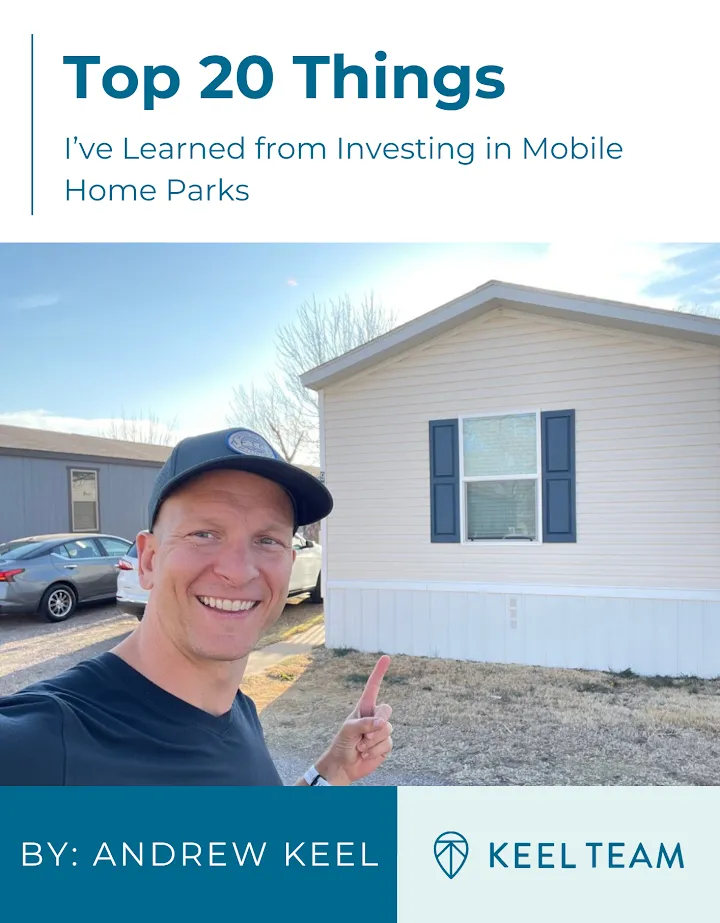
📘 Free eBook: Top 20 Things I’ve Learned from Investing in Mobile Home Parks
After years of acquiring and operating mobile home parks across the Southeast, we’ve distilled our biggest lessons into one practical, no-fluff resource. Download it and shortcut your learning curve.
Lot Rent Collections During Economic Stress
One of the most practical questions operators ask when evaluating recession risk is: what happens to rent collections?
The answer depends on the market and operator practices, but experienced mobile home park operators generally report that collections hold better than comparable multifamily properties for several reasons:
- Eviction consequences are severe for residents. Because residents own their homes, a mobile home park eviction means losing housing — and potentially the home itself. Residents prioritize lot rent. It frequently gets paid before car payments, credit cards, and other obligations.
- Government assistance programs help. During recessions, emergency rental assistance and housing voucher programs expand. Mobile home parks qualify for many of these programs, which props up collections even when residents experience income disruption.
- Low rent-to-income ratios provide cushion. A resident earning $35,000 per year and paying $500 per month in lot rent is spending roughly 17% of gross income on housing — well within a manageable range even with reduced income.
None of this means mobile home parks are immune to collection issues during a severe downturn. But the structural protections — resident home ownership, low rent burdens, and the sticky nature of manufactured housing — create a meaningful buffer that most other asset classes lack. For more, see our mobile home park syndication explained.
How Mobile Home Park Values Hold in a Downturn
Valuation in mobile home parks is primarily a function of net operating income (NOI) and cap rate. Understanding mobile home park investments at this level clarifies why values tend to hold reasonably well during recessions.
If occupancy stays high and collections hold, NOI stays stable. And because mobile home parks have become an increasingly recognized institutional asset class, cap rate compression has been a persistent trend over the past decade — meaning valuations have generally held firm even as economic conditions fluctuated.
The primary valuation risks in a recession are:
- Credit market tightening causing cap rate expansion, which compresses values
- Significant collection deterioration if local unemployment spikes sharply
- Park-owned home portfolios, where the operator absorbs vacancy losses directly on the balance sheet
Well-run mobile home parks with tenant-owned homes and high occupancy entering a downturn are well-positioned to weather valuation pressure. Operators who fill vacant lots proactively before a downturn hits are in the strongest position — any remaining vacancy gets absorbed more easily when affordable housing demand spikes.
What Smart Operators Do to Protect Performance
Experienced mobile home park operators do not just wait and hope their assets perform during a recession. They take deliberate steps to protect performance:
- Keep occupancy high going in. A mobile home park at 95% occupancy entering a recession has a massive cushion. One at 70% does not.
- Minimize park-owned homes. Tenant-owned homes shift maintenance costs and vacancy risk to residents. Park-owned homes mean the operator absorbs that risk directly.
- Keep rents affordable relative to local wages. Mobile home parks that have pushed rents too aggressively face collection risk when incomes drop. Sustainable lot rent growth — not aggressive rent spikes — is the durable strategy.
- Build cash reserves. Operating reserves sufficient to cover 3–6 months of reduced collections protect the asset through volatility.
- Know your local economy. A mobile home park in a single-employer manufacturing town carries more recession exposure than one in a diverse, multi-employer metro market.
This is why understanding lot rent dynamics and local market fundamentals matters not just at acquisition, but as an ongoing operational discipline throughout a hold period.
How Mobile Home Parks Are Holding Up in 2026
As of mid-2026, the economic backdrop is doing something interesting: it’s providing a real-time test of the recession-resilience thesis. Interest rates have remained elevated longer than most analysts projected in 2023, credit card delinquency rates hit a 12-year high in early 2026, and consumer confidence indicators have softened meaningfully in key demographic cohorts.
The result, so far, tracks with the historical pattern. Operators we speak with across the Southeast and Midwest report stable-to-improving occupancy. Markets where affordable housing supply is chronically constrained — which describes most of the markets where well-located mobile home parks exist — are seeing consistent demand. The counter-cyclical dynamic that drove mobile home park performance through 2008–2009 appears to be operating on schedule.
What’s different in 2026 is the regulatory layer: a handful of states have enacted rent control provisions specific to manufactured housing communities. Operators in those states face a more constrained environment. Operators in states like North Carolina, Tennessee, and South Carolina — where no such restrictions exist — are positioned to capture the full upside of the demand surge. For a state-by-state breakdown, see our analysis of the rent control wave and which states are safe for investors.
The Bottom Line: Not Recession-Proof, But Recession-Resilient
Mobile home parks are not immune to economic downturns. No real estate asset is. But the structural characteristics of this asset class — affordable, necessity-based housing with sticky residents, constrained supply, low rent-to-income ratios, and demand that often increases when economic conditions worsen — make mobile home parks among the most resilient commercial real estate investments available.
For investors evaluating where to allocate capital in an uncertain economic environment, mobile home parks have consistently demonstrated that they perform differently than most alternatives. That is not marketing language — it is a function of who lives there, why they stay, and what they are paying.
If you are serious about understanding how mobile home park investments hold up through economic cycles, start with the fundamentals of how these assets are evaluated, underwritten, and operated. Our mobile home park investments overview is a good place to begin. For more, see our complete guide to mobile home park investing. For more, see our how to invest in mobile home parks.
Frequently Asked Questions
Are mobile home parks recession-proof?
No real estate asset is fully recession-proof, but mobile home parks are among the most recession-resilient. Their core demand driver — affordable, necessity-based housing — actually strengthens during downturns. When unemployment rises and household incomes contract, demand for lower-cost housing options increases. Combined with the sticky nature of manufactured housing residents (who own their homes and face significant costs to relocate), occupancy and collections tend to hold up far better than most commercial real estate categories.
What happened to mobile home park occupancy during the 2008 recession?
Mobile home park occupancy held remarkably steady during the 2008–2009 financial crisis compared to other commercial real estate sectors. While apartment vacancies climbed and office and retail properties bled tenants, well-operated mobile home parks maintained strong occupancy because residents had few affordable alternatives and faced high relocation costs. Operators who were active through that period consistently report that their mobile home park holdings outperformed their other real estate investments.
Do mobile home park values drop during a recession?
Values can compress in a severe recession due to cap rate expansion caused by credit market tightening. However, if occupancy holds and collections remain stable — which is typical for well-run mobile home parks — the NOI doesn’t shrink much. That income stability acts as a floor on valuations. The parks most exposed to value decline are those with high park-owned home ratios (where the operator absorbs vacancy risk directly) or those in markets with sharply rising unemployment.
How do mobile home park lot rent collections hold up during economic downturns?
Collections tend to hold better than comparable multifamily properties for several structural reasons. Mobile home park residents prioritize lot rent highly because eviction means losing housing — and potentially the home they own. Lot rents are typically low relative to resident income (often 17–25% of gross income), providing cushion when earnings drop. Government emergency rental assistance programs also tend to expand during recessions, supporting collections even when residents face income disruption.
Why do passive investors prefer mobile home parks ahead of potential recessions?
Passive investors in mobile home park syndications value the counter-cyclical demand profile: more households need affordable housing precisely when economic conditions deteriorate. Combined with the long-term supply constraints (new mobile home parks are rarely built due to zoning opposition), the asset class offers a defensive position without sacrificing returns. For investors evaluating where to position capital in an uncertain economic environment, mobile home parks offer a combination of income stability and capital preservation that is difficult to find elsewhere in real estate.
📘 Want to Go Deeper? Get Our Free eBook
Top 20 Things I’ve Learned from Investing in Mobile Home Parks — a practical guide covering everything from due diligence to operations to what we wish we had known before our first acquisition. No fluff, just hard-won lessons.
Have questions about mobile home park investing? Reach out here — we are happy to talk through the fundamentals with anyone who is genuinely curious about this asset class.
Related Mobile Home Park Investing Resources

Andrew Keel
View The Previous or Next Post





Subscribe Below 👇