Frequently Asked Questions
We’ve curated the top questions we get asked by new and current investors. If there are any questions that are not answered below, please contact us HERE
How do I invest with the Keel Team?
Keel Team provides both accredited and non-accredited investors with whom we have an existing relationship access to tax-advantaged mobile home park investments with an emphasis on downside mitigation and social stewardship. Our syndications mainly focus on acquiring existing value-add mobile home parks and bringing them back to life. The first step to investing with the Keel Team is to fill out the contact form on our website. It is quick and easy and can be found on our website KeelTeam.com by clicking the “CONTACT” menu link in the header navigation.
Once you have submitted your information, you will have the opportunity to schedule an introductory phone call with one of our investor relations team members. After that, we look for opportunities to develop a relationship. For existing relationships, if we have any active raises occurring that are a good fit for your investor profile, our investor relations team member will let you know on the call and will walk you through getting access to the investor portal. Otherwise, we typically will send out an email whenever there is a new investment opportunity. It will have the high-level details including whether it is a 506(b) syndication (for both accredited and non-accredited investors that we have pre-existing relationships with) or a 506(c) syndication (for accredited investors only).
If you respond to our initial capital raise email requesting the full investment offering details and we determine you are an eligible investor, someone from our team will send you the full underwriting package complete with: a video walk through of the opportunity, the PowerPoint slides of the offering, the full underwriting spreadsheet complete with photos and next steps. The investment process concludes with signing the subscription documents and wiring funds to the partnership LLC’s bank account. After closing, our investor relations team will assist you in getting logged into our investor portal where you can access all of the documents for the investment along with our quarterly reports ongoing. Our investor relations team will be there to help every step of the way.
What is an accredited investor?
Often we get asked, “What is an accredited vs. a non-accredited investor?” We get asked this because only accredited investors can invest in 506(c) syndications. We do both 506(b) and 506(c). The Securities and Exchange Commission sets the definition of an accredited investor.
The definition is subject to change but as of the time of this writing, an accredited investor is someone who meets one of the following 3 requirements:
- Income: You can be considered an accredited investor if you have a sustained annual income of at least $200,000 as a single investor, or $300,000 total if combined with a spouse’s income.
- Professional: If you hold a valid Series 7, 65, or 82 license OR are a “knowledgeable employee” of certain investment entities.
- Net Worth: Excluding the value of your primary home, if you have a net worth of $1 million or more, by yourself or combined with your spouse, you qualify to be an accredited investor.
A few reminders – part of the 506(c) syndication investment process will be verifying that you are an accredited investor, so “fake it til you make it” does not apply. Lastly, I am not an attorney or investment advisor. This information is purely for educational purposes. Please consult your legal and financial counsel for any questions, guidance, or advice.
How does the Keel Team underwrite opportunities?
When we first got started in mobile home park investing back in 2017 our due diligence checklist was 50 line items in length. Now, that same due diligence list has grown to over 350 line items! We’ve learned something from EVERY deal that we’ve closed (or passed on) and this is why investing with us is such a privilege. We’re not shy about the fact that we’ve made mistakes. We’ve learned from them and they’ve made us better, more aware MHP investors.
Every deal we source gets underwritten and evaluated at least 3 times. There is the initial ‘back of the napkin’ quick evaluation that usually happens on the first phone call with the seller. After that we do a more conclusive ‘complete’ underwriting after we get all of the necessary due diligence documents from the seller (rent rolls, trailing 12-month financial documents, bank statements, tax returns, etc.) and financing quotes from willing lenders. Once this ‘complete underwriting’ is done and all the boxes are checked we complete our due diligence and remaining on-site visits and then complete our final ‘debrief’ underwriting. The debrief underwriting takes into account all the quotes from contractors that we got back during due diligence, changes to our capex budget from our on site inspections and collections issues the seller might be trying to gift to us, after closing.
Another important factor we take into account on every deal is the market comparables. We literally drive to every other mobile home park property within a 50 mile radius. This exercise is very important and tells us a lot about the subject property’s value add. We are getting rent comp data through knocking on tenants doors, which otherwise might’ve been hard to come by, through just calling the mom & pop owners who don’t always answer their phone. We are tracking the property condition of each market comp, along with the utilities setup, occupancy rates and sizes. Not only does this information help us from a due diligence standpoint, these comps usually end up being some of our best leads for future off-market direct to owner acquisitions.
We also usually get the following 3rd party inspection reports on every mobile home park property we purchase:
- Phase 1 Environmental Study
- Cost Segregation Study Report (in order to maximize the tax depreciation benefits)
- Survey
- UCC filing (personal property lien search)
Is mobile home park investing recession resilient?
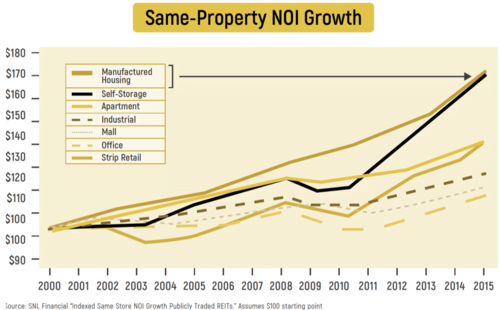
It can be. Based on previous market cycles mobile home park investing has proven to be very recession resilient. Check out the NOI growth numbers in the graph below. Even during recessionary times like 2008-2011 mobile home parks had positive NOI growth vs. all the other asset classes listed. Why is that? Well in my opinion it’s because of the affordable housing crisis going on in the U.S. right now and the fact that the supply of mobile home park lots is actually shrinking every year compared to other asset classes where new supply is coming online every day (think apartments).
However, the low income mobile home park tenants are also the most fragile and can be the first to lose their jobs in a recession. Because of this it is very important to understand your market and the tenant base in each so you can react quicker if say a local employer announces layoffs. This happened to us and we were able to act quickly and get with the local Chamber of Commerce to find out who was hiring and get this information into the hands of our tenants within days of the layoff announcements. Time kills deals and we are in the camp of people who think that you make your own luck with hard work and massive action.

How does mobile home park investing compare to other real estate assets in regards to return on investment?
Because of the stigma, many investors stay away from mobile home parks. This can artificially boost returns and provide an investment “moat” because of the higher cap rates (cap rate = NOI / purchase price) we are typically able to pay for the same income stream.
How do you determine the value of a mobile home park?
Mobile home parks and all commercial real estate are typically valued off the income they generate. For us, in this current market cycle (2023) we are typically underwriting deals to a stabilized 10 cap or higher. Meaning that after the first couple of years we believe that we can get the income up high enough that the purchase price we are initially paying would be at a 10 cap valuation.
We are buying VALUE ADD mobile home parks so upon acquisition the cap rate usually doesn’t look great. Our model takes into account what we can do with the property to increase the income after a couple of years owning it. Since we are usually buying from mom and pop owners, we sleep well at night knowing that we can run these properties better than they could and the value add is somewhat easy to identify to our trained eyes.
What type of banks will loan on mobile home parks?
Many banks lend on mobile home parks, from the local credit union on your downtown street corner to the big Wall Street lenders that bundle loans into commercial mortgage backed securities. The lender offering the best terms currently is the United states federal government through their subsidiaries Fannie Mae and Freddie mac. Our business model revolves around what type of debt we can put on these mobile home park assets. Typically we buy with a local bank or credit union and plan to refinance into agency debt once we get the property to check all the boxes these government lenders require.
What are the typical bank financing terms for the purchase of a mobile home park investment?
Terms from local banks (as of 2023) are usually 70-75% LTV, 20-25 year amortization, 6.5-7.5% interest rates and a 5 year fixed rate and a 10 year balloon.
Typical terms from a government lender like Fannie Mae (in 2023) typically look like 65-70% LTV, 30 year amortization with a year or two of interest only, 5.5-6.5% interest rates and a 10 year fixed rate and balloon.
Do you have any debt that is at risk due to the rising interest rates and uncertainty in the market?
We don’t have any debt at risk at this stage, as we don’t take on bridge debt or variable rate debt. Our Debt Service Coverage Ratio is usually better because we don’t buy stabilized properties, only value-add where the income typically goes up after we buy it due to our business plan.
Are mobile home parks easy to manage and operate?
No, they are unfortunately not. This is affordable housing and mobile home parks can be extremely management intensive. This is why the deal terms may not look like what investors are used to seeing in the multifamily apartment syndication space. Even with a fully tenant-owned home community there are several boxes that need to be checked and if you aren’t on the ball with those, it can literally cost you thousands of dollars.
For example, we are constantly saving mobile homes in our communities from being bought and moved out. We do this by being very “hands on” with our residents and knowing what their future plans are well ahead of time so we can try and “broker” the sale of their home to create a win-win situation. When a mobile home gets moved out it can cost the park upwards of $50,000 in some places to refill that vacant lot.
What kind of mobile home parks are you targeting for new acquisitions?
Keel Team is targeting C-grade all-age mobile home communities throughout the landlord friendly states primarily in the central United States. We are looking for mobile home parks with 50 or more lots and public utilities. Our ideal purchase is a cash-flowing mobile home park, within an MSA, that is around 70% occupied so we can instantly add value through infilling mobile homes on the vacant lots.
We also really love parks that include water/ sewer and trash in the rent before we buy it because this easy value-add component of installing sub meters and billing back the tenants for their usage results in conserving water and it also reduces our expenses.
If a tenant that owns their mobile home doesn’t pay their rent, what does that collection process look like for the landlord?
First off, this is a really sad situation and we try a few different ways to avoid an eviction and help our residents get back on their feet. These include: developing payment arrangements, contacting the local rental assistance programs and helping to get our tenants qualified, helping our tenant sell their home to pay off their past due balance. Sometimes all of this effort just doesn’t get anywhere and we are forced to escalate it to the eviction process.
In most states, first we must evict the tenants (this usually takes 30 days or so) and then we must basically “evict” their mobile home through the abandonment process (this usually takes about 30 more days). All in all, within about 60-75 days we can usually take over ownership of their mobile home and get a new title in our name. Once we have that title we can begin to make repairs and try to sell the home again to recoup some of our expenses incurred through the process.
Is lot rental income the only revenue source in a mobile home park investment?
No, lot rental income is not our only source of income but it is our most substantial and reliable. Many of our mobile home parks have extra income from application fees, late fees, water/ sewer utility fee recapture and trash pickup expense recapture. We also have some parking spaces and storage garages we rent out in our MHP’s. We always try to implement cable and internet contracts in our parks so our tenants get the advantage of a bulk discount and we get extra commission income for those that sign up. We have also implemented carport rentals, storage shed rentals and landscaping services for additional income in certain properties where this made sense.
How did you get started in this business? How long have you been in the business?
Andrew Keel got his start in real estate investing back in 2014 through flipping single family houses around central Florida. He got into manufactured housing as a “Lonnie dealer” in 2015, flipping individual mobile home trailers around central Florida and then meeting and getting mentored by a mobile home park owner in Ocala, FL.
He got his first MHP deal done through a JV structure with a passive investor he met at the MHU boot camp in Orlando FL. His first MHP deal was a 67-lot park in Edwardsville, IL and we still own it to this day! We closed on it June 30, 2017 and this is a case study on keelteam.com. We refinanced into long term debt through Fannie Mae back in 2019. (Check out the details here: https://www.keelteam.com/case-study)
How often do you pay out distributions?
We typically pay out quarterly distributions.
We do typically hold back distributions for the first 6 months of ownership. We basically skip the first quarterly distribution of every new project to stay cash heavy but we always plan to do a catch up distribution at month 6.
What is your typical deal structure?
Every deal is structured differently. Our general approach is to acquire underperforming mobile home parks, improve operations through hands-on management, and refinance to hold them long-term rather than sell. Specific deal structures and return targets are discussed directly with prospective investors who meet applicable standards.
What is your minimum investment amount?
$100,000 USD
Do I need to be an accredited investor to invest with you?
Not always, we syndicate sometimes through 506(b) syndications and this allows us to raise funds from up to 35 non-accredited investors that we have a pre-existing relationship with. However we also do some deals as 506(c) syndications and these rules REQUIRE that all investors prove their accredited status. Please note that contacting us does not establish a pre-existing relationship or entitle you to purchase, or to participate in any current or future offering of securities by us and/or our affiliates.
What is your exit plan with each project?
We don’t have a crystal ball so we can’t guarantee the end result (this depends on interest rates and other things outside of our control) however we are a younger group with a BUY & HOLD philosophy. We prefer to buy right and then fix up the property to add value, then we desire to refinance out the initial invested capital and then hold onto the cash flowing asset long term and fully depreciate it for tax purposes. There would likely be a sale at some point, if and when we get a “GODFATHER OFFER” (as the famous MHP investor Sam Zell says) but our ideal plan would be to keep it.
When last did you do a 1031 and how frequently do you do them?
We did a 1031 in 2017. We’ve only sold one property since then and we didn’t 1031 because of the partnership dynamics, however we plan to do one whenever possible in the future.
What is the background and experience of everyone on the GP team?
Andrew Keel has been syndicating MHP deals since 2017 and he has been in the real estate business since 2015. Andrew started flipping and wholesaling single family houses around central Florida while working a full-time W2 job in corporate America. Read Andrew’s Story Here. He got into MHP’s through doing “LONNIE DEALS” where he would buy a mobile home in an existing park and fix it up and then he would sell it on contract to an end buyer that would also pay lot rent to the park. Andrew did 19 of these deals which fully offset his monthly expenses and allowed him to drop the single-family flipping business in 2016 and go into MHP investing full time.
Jon Carcone at 4 Brothers Commercial started in single family real estate investing as well. He grew a HUGE flipping and wholesaling operation based out of the Washington DC/ Arlington, Virginia area. He scaled this business for 9 years (started it in 2009) and then started the 4 Brothers commercial wing in 2018, and subsequently met Andrew Keel shortly thereafter, where they started partnering on all the commercial deals together.
How are Jon Carcone and Andrew Keel associated? How did they become partners?
The main GP’s, Andrew Keel and Jon Carcone, met back in 2019 as they both had MHP’s under contract in the same town just outside Grand Forks, ND (Crookston, MN was the town). They decided to partner and syndicate that deal as a portfolio vs. them each buying them separately. This helped them each gain scale and acquire better financing terms.
That first deal was a test to see how well they worked together and it went really well. Andrew’s strengths are on the operations and capital raising side of the business, while Jon’s strengths are in finding off market, direct-to-seller deals at discounted prices. That Crookston portfolio crushed expectations from a return (ROI) standpoint and they’ve done over $100 million in real estate deals since then through their partnership. They prioritize buying for their own Buy & Hold portfolio but also “wholesale” commercial real estate deals that don’t exactly fit their BUY BOX.
Are the GP’s investing their own capital in each deal?
Yes, they typically invest at least $100,000 into each deal and they also sign recourse on the acquisition financing which NO passive investor (limited partner) is required to do. This is their skin in the game.
What are your target markets/ locations you look to invest in?
We are chasing yield and cash flow so we aim for secondary markets throughout the Midwest. We look for a steady population – not huge growth markets but not shrinking either. Markets like Des Moines, Iowa or Sioux falls, South Dakota and Indianapolis, Indiana are ideal for our model. There are many mom & pop owned properties in these states.
What is the bottleneck?
Finding good deals is our bottleneck.
What are the typical Value-Add components in a mobile home park deal you purchase? How can you increase the value of the mobile home park after you purchase it?
It all comes down to the income at the end of the day- how can we squeeze more dollars out of the asset compared to the prior owners? We ask ourselves this on every due diligence trip. If the property is a 6 cap property, every recurring monthly dollar of NOI (income) we can create adds $200 to the value of the property. The ‘commercial real estate math’ behind this looks like this:
- $1 x 12 months = $12 in Net operating income/ .06 (6 cap value)= $200 in added value to the property when we sell or refinance.
These are some of the value add improvements we make:
- Billing back for water/ sewer and trash (many mom & pop owned MHP’s include these services with the monthly lot rent that each tenant pays)
- Raising rents after capital improvements that make the property a better and safer place to live
- Filling vacant lots/ increasing occupancy with new and used homes that we bring in
- Rehabbing vacant mobile homes on the property already
- Implementing a cable/ internet program for the property (this is a win-win as the tenants get a reduced rate due to the bulk pricing and the park owner gets a cut/ commission of those tenants that sign up)
- Installing LED street lights vs halogen power sucking lights that many MHP’s still have (also creates a more green, environmentally friendly commercial property)
- Pave the roads (this is a resident favorite)
- Trim trees and take care of other deferred maintenance left by the prior owners
- Fix water leaks
- Install new signage and fencing
- New website and online profiles with google for more visibility (SEO and ‘google my business’ profiles)
- Adding storage units/ shed rentals and carport rentals for additional income and a cleaner look
- Cutting unnecessary expenses like full time on-site managers making $65k+/ year
What happens if a tornado comes through and rips up the entire trailer park?
We carry loss of business income insurance on all of our mobile home park acquisitions so we will likely still be able to cover our liabilities. More than likely in this type of disaster scenario we would be ok but we would definitely be dragged down by the extra operational focus and time on site needed to recover from such an event. However, the monetary risk would be somewhat hedged due to our insurance.
Interested in learning more?
Get in touch with us today to learn more about mobile home park investing!