If you’ve been researching real estate investing in 2026, you’ve probably come across mobile home parks as an alternative asset class. But with so many options competing for your attention — multifamily, industrial, self-storage, short-term rentals — the natural question is: are mobile home parks actually a good investment?
The short answer is yes, for the right investor. But that answer deserves context. In this post, we break down the real data on mobile home park returns, cap rates, risks, and structural advantages — so you can make an informed decision based on facts, not hype.
What Makes Any Real Estate Asset Class Worth Investing In?
Before diving into mobile home parks specifically, it helps to define what “good investment” actually means. Most experienced real estate investors evaluate asset classes across four dimensions:
- Cash flow consistency: Does it generate reliable income, even during downturns?
- Capital preservation: Does it hold value over time?
- Supply/demand dynamics: Is there structural demand that supports long-term occupancy?
- Risk-adjusted returns: What are you giving up (liquidity, complexity) for what you’re getting?
On all four dimensions, mobile home parks have a compelling story. Let’s look at each one.
The Data Behind Mobile Home Park Returns
Mobile home parks have consistently outperformed other real estate asset classes during economic stress — not because of luck, but because of structural features built into the business model.
The most striking data point is NOI (Net Operating Income) resilience during market downturns. While other real estate asset classes saw income shrink during the Global Financial Crisis and the COVID-19 pandemic, manufactured housing communities held steady — and in many cases, grew:
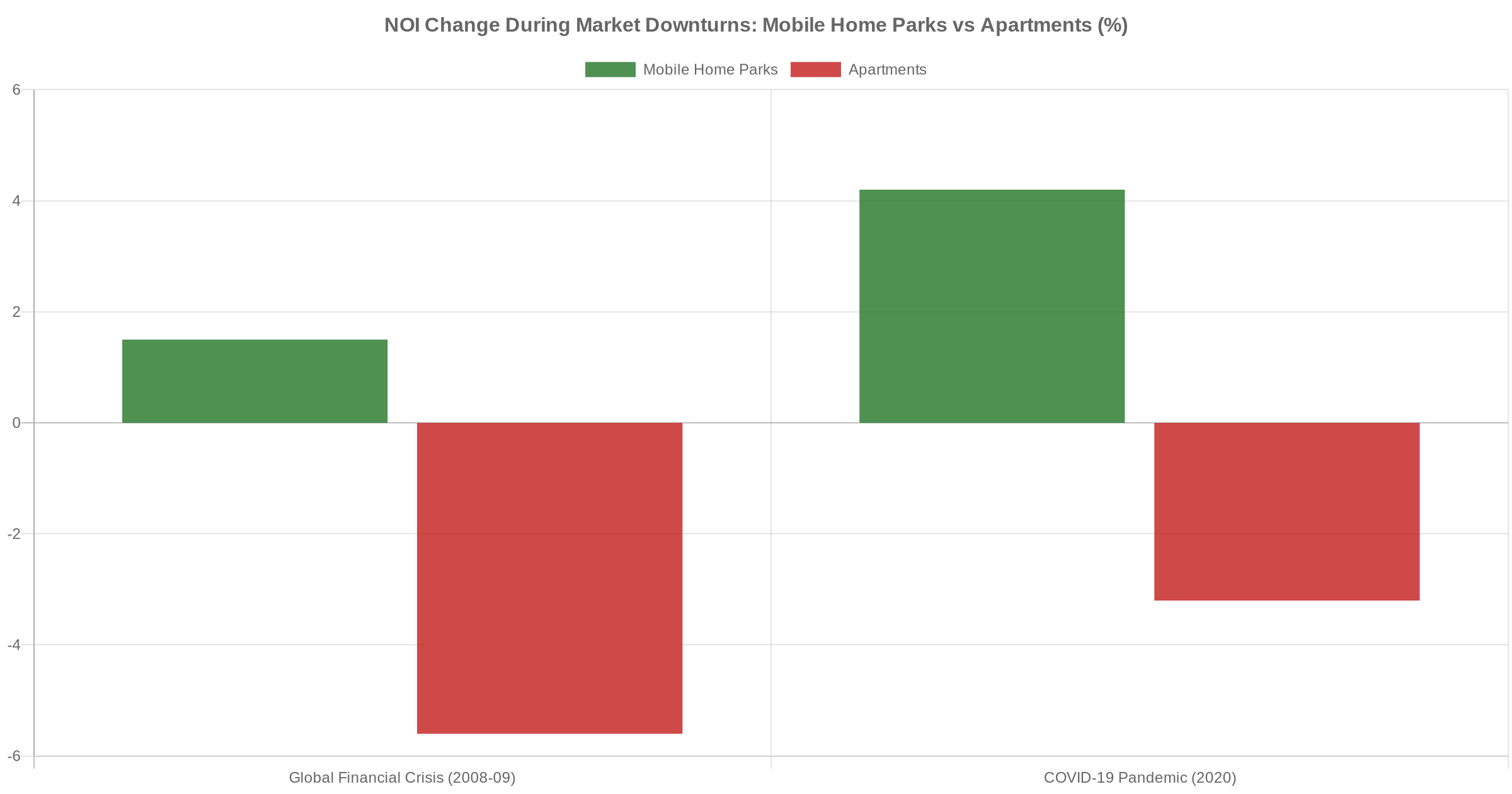
This data reflects a core truth about the asset class: affordable housing demand is counter-cyclical. When the economy tightens, demand for lower-cost housing options increases. Mobile home parks don’t fight economic headwinds — they benefit from them.
Beyond downturns, the day-to-day economics are compelling. Tenant annual turnover in mobile home parks runs around 2.2% — compared to roughly 47% in traditional apartment communities. Why? Because mobile home residents typically own their home and rent only the land. Moving is expensive and disruptive. Once someone is settled, they tend to stay for years or decades.
Mobile Home Park Cap Rates: What to Expect in 2026
Cap rates for mobile home parks vary significantly based on park size, location, utility infrastructure, and occupancy, but the general range in 2026 is:
- Class A stabilized parks (city water/sewer, 90%+ occupancy): 5.0%–6.5%
- Class B parks with value-add potential: 6.5%–8.5%
- Turnaround situations (high vacancy, private utilities): 8%–11%+
That cap rate spread is important context. On the surface, a 6% cap rate doesn’t look dramatically different from multifamily. But the underlying risk profile is different. A mobile home park at 6% typically has lower turnover, lower per-unit CapEx requirements, and structural supply constraints that don’t exist in multifamily.
For a deeper look at how to evaluate cap rates in this asset class, see our post on mobile home park cap rates explained.
The Supply Constraint Advantage
One of the strongest arguments for mobile home parks as an investment is something you can’t find in most other asset classes: virtually zero new supply.
Approximately 45,000 mobile home park communities exist in the United States. In a typical year, roughly 20 new ones are approved and built — that’s a new supply rate of about 0.04% of existing stock. By comparison, apartment developers deliver new supply equal to roughly 3.8% of existing stock annually.
Why so little new supply? Zoning. NIMBY opposition. The political difficulty of approving new manufactured housing communities in any jurisdiction in America. It’s not just hard to build new mobile home parks — in most markets, it’s effectively impossible.
That constraint is a permanent moat. It means existing, well-located mobile home parks are genuinely irreplaceable assets with durable demand. Supply-constrained real estate, almost by definition, tends to hold value and generate reliable income over time.
Two decades of hard-won lessons distilled into one free guide. Whether you’re evaluating your first deal or your fiftieth, these insights will sharpen your approach.
The Risks You Need to Know (An Honest Assessment)
Any honest analysis of mobile home parks as an investment has to include the risks. Here are the ones that matter most:
Regulatory Exposure
Several states are actively passing new tenant protection legislation targeting manufactured housing communities — including right-of-first-refusal requirements, stricter notice periods for rent increases, and just-cause eviction proposals. Markets like NC, TN, and GA are generally landlord-friendly compared to coastal states, but regulatory risk is real and worth monitoring. Operators who already run ethical, community-focused parks tend to weather regulatory changes better than those relying purely on rapid rent increases.
Utility Infrastructure Risk
Parks with private water or sewer systems — septic, lagoons, or privately owned utilities — carry significant operational and regulatory risk. The cost of upgrading private utility infrastructure to public connections can run into the millions. This is why experienced buyers focus almost exclusively on parks with city water and city sewer. It’s a non-negotiable filter for most serious operators.
Liquidity
Mobile home parks are less liquid than publicly traded assets. Transaction volume in the manufactured housing space runs around $2.5–3.2 billion annually, compared to $146 billion in apartments. If you need to exit quickly, that’s harder to do. For long-term investors comfortable with 5–10 year hold periods, this is a manageable tradeoff. For investors who may need capital on short notice, it’s a real constraint to consider.
Operational Complexity
Mobile home parks aren’t passive unless you’re investing as a limited partner in a syndication. Active ownership requires real operational skills: tenant relations, utility management, park-owned home programs, local regulatory knowledge. Under-capitalized or inexperienced operators struggle. The parks that perform best are run by operators who treat them as businesses, not passive assets. If you’re evaluating a deal, use a structured due diligence process before committing capital.
How Mobile Home Parks Compare to Apartments
The most common comparison for mobile home park investors is multifamily apartments. Here’s a side-by-side on the metrics that matter most:
- Tenant turnover: Mobile home parks ~2.2%/year vs. apartments ~47%/year
- New supply (% of stock): Mobile home parks ~0.04%/year vs. apartments ~3.8%/year
- NOI during GFC: Mobile home parks +1.5% vs. apartments -5.6%
- NOI during COVID: Mobile home parks +4.2% vs. apartments -3.2%
- Per-unit cost: Mobile home park lots ~$75K vs. apartment units ~$210K
- Transaction volume: Mobile home parks ~$3B/year vs. apartments ~$146B/year (liquidity gap)
For a full head-to-head breakdown, see our post on mobile home park investing vs apartment investing.
Who Should Consider Investing in Mobile Home Parks?
Mobile home parks are well-suited for investors who:
- Have a long investment horizon (5–10+ years) and don’t need near-term liquidity
- Want inflation-resistant income — lot rents are renewable monthly and typically increase annually
- Are drawn to supply-constrained assets with structural demand tailwinds
- Value downside protection over maximum upside in any given year
- Can access quality deals — either through operator relationships, direct sourcing, or by investing as a limited partner in a syndication alongside experienced operators
This isn’t the right asset class for everyone. Investors seeking highly liquid holdings, short hold periods, or exposure to fast-appreciating markets may be better served elsewhere. But for investors focused on durable cash flow and preservation of capital through multiple economic cycles, mobile home parks have consistently earned their place in a diversified portfolio.
Are Mobile Home Parks a Good Investment in 2026?
Yes — with the caveats.
The structural tailwinds remain strong: 17.7 million Americans live in manufactured housing, new supply is virtually zero, and affordable housing demand is only growing as home prices and apartment rents remain elevated. The recession performance data from 2008 and 2020 speaks for itself.
The risks — regulatory evolution, illiquidity, utility infrastructure, operational complexity — are real but manageable with proper due diligence and experienced operators. The investors who struggle with this asset class tend to be those who underestimate execution difficulty or skip proper pre-acquisition analysis.
The investors who succeed treat mobile home parks as businesses, not as passive mailboxes. And when done right, the combination of low tenant turnover, no new supply, and affordable housing demand creates the kind of durable, defensible cash flow that’s increasingly hard to find anywhere else in real estate.
10 video modules, a 55-page master checklist, and 9 ready-to-use templates that walk you through every step of evaluating a mobile home park deal — from the first site visit to closing day.
Frequently Asked Questions
Are mobile home parks recession-proof?
Not entirely recession-proof, but demonstrably recession-resistant. During both the 2008 Global Financial Crisis and the 2020 COVID pandemic, manufactured housing community NOI remained positive while apartment NOI declined. The primary reason: affordable housing demand increases during economic downturns as renters downsize and look for lower-cost options.
What kind of returns can I expect from a mobile home park investment?
Returns vary based on asset quality, location, and deal structure. Active investors buying stabilized Class A parks typically target 6–8% cash-on-cash returns and total returns of 12–18% IRR over a 7–10 year hold, depending on value-add execution. Value-add turnaround deals can target higher returns but carry greater execution risk.
What’s a good cap rate for a mobile home park in 2026?
In today’s market, stabilized mobile home parks with city utilities and strong occupancy typically trade in the 5.0–6.5% cap rate range. Value-add opportunities with room to raise occupancy or rents can be found in the 6.5–8.5% range. Cap rates above 9% often signal operational, infrastructure, or market challenges worth investigating carefully.
How do mobile home parks compare to buying rental properties?
Mobile home parks offer lower per-unit acquisition costs, lower per-unit maintenance (since residents own their homes), and economies of scale that single-family rentals can’t match. The tradeoff is higher upfront complexity: you’re buying an operating business, not a single asset. Operators who can execute at scale generally find the risk-adjusted economics significantly more favorable than managing a scattered single-family portfolio.
Can I invest in mobile home parks without buying one outright?
Yes. Many investors access this asset class through syndications as limited partners (LPs), where an experienced operator handles acquisition, operations, and eventual sale. As an LP, you contribute capital and receive a share of cash flow distributions and proceeds from sale. This approach offers passive exposure to the asset class without requiring operational expertise. For a deeper look at how this works, explore our posts on cap rates and due diligence.
Get the top 20 lessons from two decades of mobile home park investing — free.