Mobile Home Park Investing vs. Apartments & Single-Family (2026)
Andrew Keel
[wpbread]
Ask ten real estate investors where they put their money and you’ll hear three familiar answers: apartments, single-family rentals, and—increasingly—mobile home parks. Over the past decade, mobile home park investing has moved from an overlooked corner of commercial real estate to a widely studied asset class. So how does it actually compare with the two most popular property types? Let’s look at them side by side on the factors that matter most—purely as an educational comparison.
Want to learn more?
If you’re weighing mobile home parks against other kinds of real estate, our team is glad to answer questions and share what we’ve learned about the asset class. Reach out to start a conversation.
The Core Difference: You Own the Land, Not the Homes
The single biggest distinction in mobile home park investing is the ownership structure. In a typical mobile home park, the community owns the land, roads, and utility infrastructure, while residents own their own homes and pay lot rent for the space. Contrast that with an apartment building, where the owner maintains every unit, appliance, roof, and HVAC system, or a single-family rental, where the owner is responsible for the entire house.
That structural difference ripples through everything else—expenses, tenant turnover, and risk—which is exactly why the comparison is worth understanding carefully.
1. Operating Expenses and Margins
Apartments and single-family rentals are maintenance-heavy. When you own the physical dwelling, you’re on the hook for turnovers, appliances, plumbing, roofing, and capital repairs. In a mobile home park where residents own their homes, the operator maintains the common infrastructure but not the individual residences. As a result, expense ratios in mobile home parks are frequently lower than in multifamily, which can support stronger operating margins. Lower expense ratios don’t guarantee better outcomes—but they give a well-run mobile home park a structural head start.
2. Tenant Turnover and Stability
Turnover is one of the quiet profit-killers in real estate. Every time an apartment or rental house empties out, the owner faces lost rent, cleaning, repairs, and re-leasing costs. Mobile home parks tend to flip this dynamic. Because moving a manufactured home is expensive and disruptive, residents often stay for years—frequently far longer than apartment tenants. That stickiness tends to mean steadier occupancy and fewer make-ready expenses over time.
Want to learn more?
We enjoy helping people understand how the mobile home park asset class compares to other real estate. If you’d like to explore the topic further, get in touch and we’ll help you learn more.
Single-family rentals and apartments both depend heavily on local job markets and can feel the pinch when the economy softens or new supply floods a submarket. Manufactured housing serves the affordable end of the market—the largest source of unsubsidized affordable housing in the country—and demand for affordability tends to hold up, or even grow, in downturns. Meanwhile, very few new mobile home parks are being built due to zoning restrictions, which constrains supply and supports existing communities. Limited new supply plus durable demand is a combination many find appealing to study.
4. Scalability
Scaling single-family rentals is slow and management-intensive—each house is a separate roof in a separate location. Apartments scale better by concentrating units under one roof. Mobile home parks can offer some of the best of both: dozens or hundreds of income-producing lots on a single parcel, with a lighter maintenance footprint per unit. For those studying portfolio efficiency, that density is notable.
5. How People Access the Asset Class: Syndication
Here’s where many people find the concept clicks. You don’t have to buy and operate a mobile home park yourself to understand or participate in the asset class. Through a mobile home park syndication, an investor can participate passively alongside an experienced operator as a limited partner, while the sponsor handles acquisition, management, and the eventual sale. This is the same structure used across commercial real estate, and it’s what makes passive mobile home park investments a topic of interest for busy professionals who want to understand real estate without becoming landlords.
What About the Risks?
No asset class is bulletproof, and an honest comparison means weighing the downsides too. Older mobile home parks can carry deferred maintenance in their private roads, water lines, and utility systems—big-ticket items that a careful operator budgets for. Some communities depend on a single large employer or a narrow local economy. And regulation matters: rent-control ordinances, zoning changes, and utility rules vary by state and municipality and can affect a mobile home park’s economics. These risks are largely managed through disciplined due diligence—which is why, in this asset class, the operator matters as much as the property.
Mobile Home Parks vs. Apartments vs. Single-Family: The Snapshot
Maintenance burden: Highest for single-family and apartments; lowest for mobile home parks (residents own their homes).
Tenant turnover: Higher in apartments and rentals; notably lower in mobile home parks.
Recession resistance: Strong for affordable manufactured housing; more cyclical for market-rate apartments and homes.
New supply: Ongoing for apartments and homes; highly constrained for mobile home parks.
Passive access: Available across all three via syndication, but mobile home parks pair passive structure with lower operational drag.
None of this makes apartments or single-family rentals “bad”—each has a place, and every property must be judged on its own merits. But it’s easy to see why so many people are studying mobile home parks: durable demand, low turnover, lean operations, and constrained supply are a rare combination worth understanding.
Want to learn more?
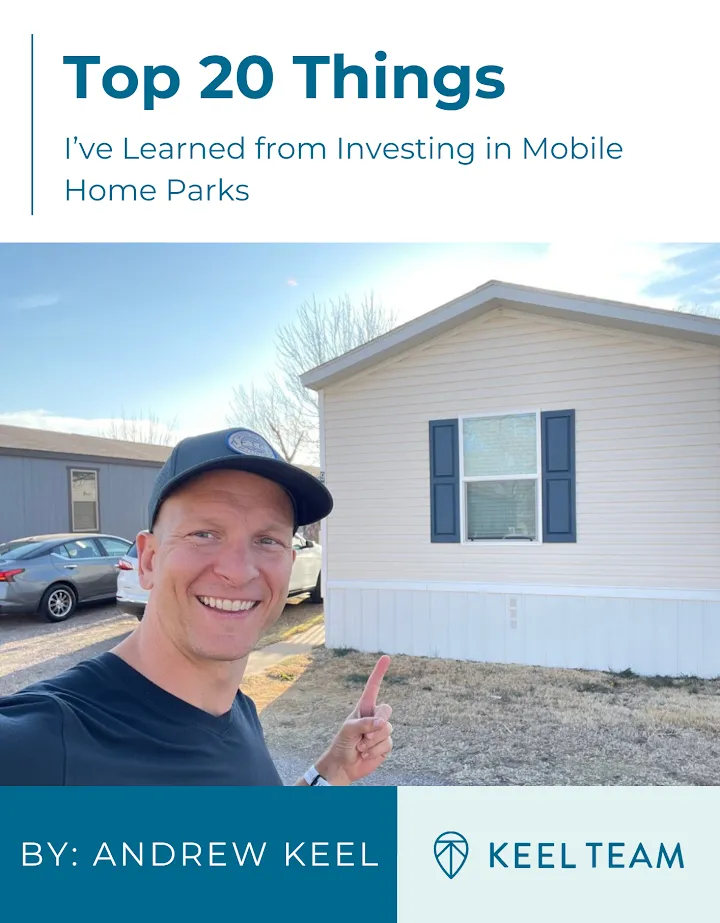
If you’d like to keep learning about mobile home park investing, download our free educational eBook. And if you have questions about how the asset class compares to others, reach out any time—we’re always happy to help people learn more.
This article is for educational and informational purposes only. It is not investment, tax, or legal advice, and it is not an offer to sell or a solicitation of an offer to buy any security. Any such offer is made only through official offering documents to qualified investors. All investments carry risk, including the potential loss of principal. Consult your own advisors before investing.
Andrew Keel
Andrew is a passionate commercial real estate investor, husband, father and fitness fanatic. His specialty is in acquiring and operating manufactured housing communities. Visit AndrewKeel.com for more details on Andrew's story.