If you want to build wealth through mobile home park investing, understanding how to manufacture value — not just wait for it — separates average operators from exceptional ones. Mobile home parks are uniquely positioned for value-add strategies that can dramatically increase net operating income (NOI), and therefore the underlying value of the asset, in ways that most other real estate classes simply can’t match.
In this guide, we’ll walk through seven proven value-add strategies that experienced mobile home park operators use to lift NOI, stabilize assets, and maximize exit returns — whether you’re an active owner-operator or a passive investor evaluating a deal where the sponsor is executing a value-add business plan.
Why Mobile Home Parks Are Uniquely Suited for Value-Add
Most mobile home parks were built decades ago under mom-and-pop ownership. Owners often set lot rents well below market, deferred infrastructure maintenance, left lots vacant, and paid utility costs that tenants should be covering. These inefficiencies aren’t liabilities — they’re opportunities.
Because mobile home park value is determined by cap rate applied to NOI, every dollar you add to net operating income multiplies in value. At a 6% cap rate, increasing annual NOI by $50,000 adds over $833,000 to the asset’s value. That leverage is why value-add mobile home park strategies are so powerful.
Strategy 1: Bring Lot Rents to Market Rate
The single biggest value-add lever in most mobile home parks is closing the gap between current lot rents and what the market actually supports. Many parks acquired from long-term owners have rents $50–$200 per month below what comparable communities in the same market are charging.
The math is compelling. A 100-lot mobile home park where rents are $100/month below market represents $120,000 per year in unrealized income — and at a 6% cap rate, that’s $2 million of unrealized value sitting on the table.
Smart operators raise rents methodically: typically 5–10% annually, with proper legal notice as required by state law. They communicate improvements alongside rent increases to maintain resident goodwill and reduce turnover. The goal is reaching market rate over 2–4 years, not overnight.
Strategy 2: Fill Vacant Lots Through Infill
Vacant lots are the most visible inefficiency in a mobile home park. Every empty lot represents rent revenue lost — and in many cases, the infrastructure (water, sewer, electrical) is already in the ground waiting to generate income.
Infill — the process of bringing in new manufactured homes to fill vacant lots — is one of the most impactful but also most operationally complex strategies. Successful infill requires:
- Access to affordable manufactured home financing for residents (chattel loans)
- Relationships with manufactured home dealers and transporters
- Attractive lease terms or rent-to-own structures for new residents
- Strong management to maintain community standards as new residents arrive
A mobile home park that goes from 70% to 90% occupancy on a 100-lot property has added 20 rent-paying residents. At $500/month lot rent, that’s $120,000 in additional annual revenue — before accounting for the cap rate multiplier on asset value.
Strategy 3: Implement Utility Submetering or RUBS
Many older mobile home parks pay master-metered utilities — especially water and sewer — and pass none of those costs to residents. This is both a massive expense burden and a behavioral problem: when utilities are “free,” consumption is high.
Transitioning to individual submeters (or a Ratio Utility Billing System, known as RUBS) shifts utility costs to residents and dramatically improves NOI. The transition requires:
- State law compliance (rules vary on how you can implement and charge for utilities)
- Infrastructure investment to install submeters if they don’t exist
- Proper lease amendments and resident communication
Operators who successfully convert a mobile home park from master-metered to resident-paid utilities commonly see $75,000–$150,000+ in annual expense reduction, which at a 6–7% cap rate adds over $1 million in asset value.
Two decades of hard-won lessons distilled into one free guide. Whether you’re evaluating your first deal or your fiftieth, these insights will sharpen your approach.
Strategy 4: Reduce Operating Expenses Through Professional Management
Mom-and-pop mobile home parks frequently overpay for services, lack vendor relationships, and operate without systems. Professional management — either in-house or through a third-party operator — often reduces operating expenses by 10–20% while improving resident experience.
Key expense reduction areas include:
- Maintenance and landscaping contracts: Negotiating volume rates across a portfolio
- Insurance optimization: Right-sizing coverage and eliminating redundancies
- Property tax appeals: Many mobile home parks are over-assessed; formal appeals can reduce annual tax burden significantly
- Administrative systems: Software platforms that reduce staff time and manual processes
Reducing operating expenses has the same NOI impact as increasing revenue — and both flow through to asset value at the same cap rate multiplier.
Strategy 5: Convert Park-Owned Homes to Resident-Owned
Some mobile home parks have a mix of lot rentals and park-owned homes (POHs) — homes the operator owns and rents out as a landlord. While POHs generate higher per-door revenue, they also come with high maintenance burdens, vacancy risk, and management complexity.
Experienced operators typically pursue a strategy of selling park-owned homes to residents over time — often on seller-financed terms — converting the property to a pure lot-rental model. This:
- Reduces maintenance liability (the resident now owns the home)
- Increases resident stability (owners move less than renters)
- Improves the NOI quality that appraisers and lenders look for
- Generates lump-sum capital that can fund other improvements
A mobile home park that converts from 30% POH to 5% POH over a 3-year hold period is fundamentally a different, more valuable, and more defensible asset at exit.
Strategy 6: Add or Improve Community Amenities
Amenity upgrades are rarely the highest-ROI value-add play, but in competitive markets they can support premium lot rents and reduce turnover. Common improvements include:
- Playground equipment and recreational areas
- Community laundry facilities
- Improved lighting and security
- Community bulletin boards and common area landscaping
The key is targeting amenities that reduce resident turnover — because turnover is one of the highest hidden costs in mobile home park operations. Each resident who leaves costs an operator months of lost rent plus the marketing and administrative cost of finding a replacement.
Strategy 7: Enforce Community Standards and Curb Appeal
One of the lowest-cost, highest-impact value-add strategies is simply enforcing consistent community standards. Mobile home parks with strong curb appeal attract higher-quality residents, support higher rents, and are dramatically easier to finance and sell.
Standards-based management includes:
- Clear lease rules on home condition, lot maintenance, and prohibited storage
- Consistent enforcement without exceptions (inconsistent enforcement leads to disputes)
- Programs that help residents maintain their homes (paint programs, landscaping days)
- Addressing derelict or abandoned homes promptly
A mobile home park that looks well-maintained and cared-for commands a premium at every level: higher rents, better resident quality, and a higher exit multiple.
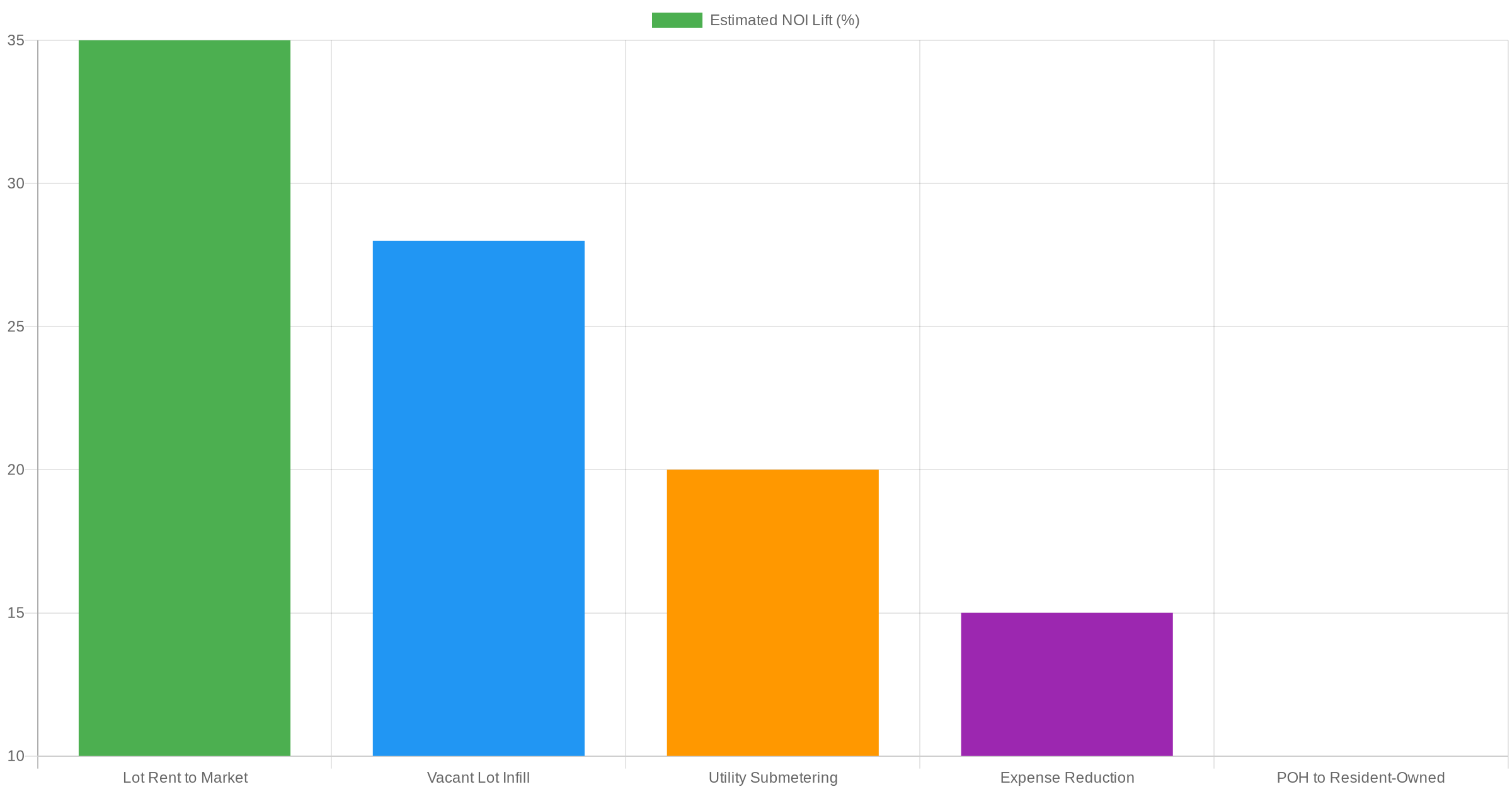
How These Strategies Stack Together
The power of mobile home park value-add investing is that these strategies are additive. An operator who closes a $200/month rent gap, fills 15 vacant lots, converts to resident-paid utilities, and reduces operating expenses by 12% simultaneously might double the property’s NOI over a 3–5 year hold — and double the asset’s value along with it.
This is why understanding how to calculate net operating income for a mobile home park is so foundational for investors evaluating value-add business plans. You need to understand where the NOI comes from today and where the operator believes it can go — and critically, whether that trajectory is realistic given the market and the asset.
When compared to apartment investing, mobile home parks offer a particularly compelling value-add case: lower tenant turnover once stabilized, lower per-unit capital requirements, and a resident base that is far less likely to leave because moving a manufactured home is expensive and disruptive.
What to Evaluate Before Underwriting a Value-Add Deal
If you’re evaluating a mobile home park deal with a value-add thesis — whether as an active buyer or a passive investor — there are critical questions to answer before accepting the underwriting:
- Is the rent gap real and defensible? What do comparable mobile home parks in the same submarket actually charge?
- What’s blocking infill? Is there financing available for new residents? Is manufactured home delivery feasible at this location?
- What does state law say about utility billing? Some states restrict how operators can bill for utilities.
- How long will it take? Most value-add mobile home park business plans take 3–5 years to execute fully. Is the hold period aligned with the strategy?
- What is the operator’s track record? Value-add execution requires operational sophistication. A plan is only as good as the team behind it.
For more on evaluating the full picture — from infrastructure to lease terms to market comparables — explore our comprehensive mobile home park investments resource hub.
Conclusion
Mobile home park value-add investing rewards operators who know what they’re looking for and have the systems to execute. The strategies outlined above — from closing rent gaps to utility conversion to infill — aren’t speculative. They’re operational fundamentals that experienced mobile home park investors have used to build significant wealth over decades.
For passive investors, understanding these strategies is equally important: it’s how you evaluate whether a sponsor’s projected returns are grounded in reality, and whether the asset they’re acquiring has genuine upside or just a compelling story.
10 video modules, a 55-page master checklist, and 9 ready-to-use templates that walk you through every step of evaluating a mobile home park deal — from the first site visit to closing day.
Get the top 20 lessons from two decades of mobile home park investing — free.