How Much Money Do You Need to Invest in a Mobile Home Park?
-
 Andrew Keel
One of the first questions anyone asks when exploring mobile home park investing is simple: how much money do I actually need? The honest answer is: it depends on how you want to participate. Whether you’re looking to buy a mobile home park outright, partner in an acquisition, or invest as a passive limited partner, the capital requirements vary dramatically.
This guide breaks down the realistic numbers across each path so you can figure out where you fit.
Buying a Mobile Home Park Outright: What Active Investors Need
If you’re pursuing direct ownership of a mobile home park, your capital requirement starts with the purchase price — but that’s only part of the equation.
Down Payment
Most mobile home park lenders require 20–30% down. On a $1 million park (small by today’s standards), that’s $200,000–$300,000 in equity before you factor in anything else. On a $3 million community — more typical for a 75–100 lot park in a decent market — you’re looking at $600,000–$900,000 in equity.
Agency lenders like Fannie Mae and Freddie Mac have specific mobile home park loan programs and may require 20–25% down with strong debt service coverage ratios. Local community banks often want 25–30% and may have stricter requirements on occupancy and utility infrastructure.
Closing Costs
Budget another 2–4% of the purchase price for closing costs. This includes loan origination fees, title insurance, environmental reports, surveys, attorney fees, and inspection costs. On a $2 million acquisition, that’s $40,000–$80,000 that doesn’t go toward equity — it’s just the cost of getting to the closing table.
Due Diligence Costs
Before you close on a mobile home park, you’ll spend money on professional due diligence. Expect to pay for:
- Phase I Environmental Assessment: $2,000–$4,000
- Survey: $3,000–$8,000 depending on acreage
- Utility infrastructure inspection: $1,500–$5,000+
- Third-party financial review: $1,000–$3,000
- Legal fees: $3,000–$10,000+
Budget $10,000–$30,000 in due diligence costs alone — and assume some of that is non-refundable if the deal falls through.
Reserves
Lenders and experienced operators alike will tell you: never close on a mobile home park without reserves. A general rule of thumb is 3–6 months of operating expenses set aside. If you’re taking on a value-add mobile home park with deferred maintenance or below-market rents, you may need significantly more.
For a 75-lot park generating $600,000 in gross revenue with $300,000 in operating expenses, six months of reserves is $150,000.
Total Capital Needed for Direct Ownership
Add it up for a $2 million mobile home park acquisition:
- Down payment (25%): $500,000
- Closing costs (3%): $60,000
- Due diligence: $20,000
- Operating reserves: $100,000–$150,000
- Total: $680,000–$730,000
That’s a meaningful number. It’s why many investors pursue syndications or partnerships instead of going it alone on their first mobile home park deal. If you want a deeper look at what the full buying process looks like, our complete guide to investing in mobile home parks covers the acquisition process from start to finish.
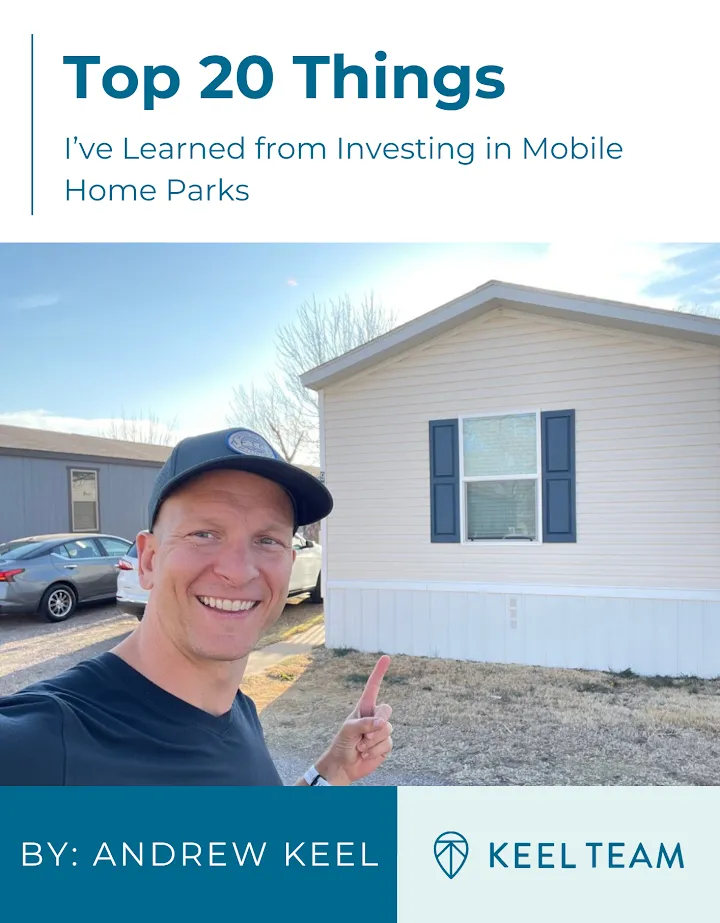
📚 Free eBook: Top 20 Things I’ve Learned from Investing in Mobile Home Parks
Before you write a check on anything, read what 10+ years of hands-on mobile home park investing actually teaches you. Download our free guide — no fluff, just real lessons from the field.
Partnering on a Mobile Home Park Deal
Some investors enter mobile home parks through joint ventures or co-GP arrangements — bringing either capital or operational expertise to a deal without shouldering the full equity requirement alone.
In a typical co-GP structure, one partner might source and manage the deal (the operating partner) while another brings the majority of the equity (the capital partner). Capital partners in these arrangements often put in $250,000–$1,000,000 and negotiate for a proportional equity share plus preferred returns.
These arrangements can lower the barrier to entry for well-capitalized investors who don’t want full operating responsibility, while giving operators access to deals that would otherwise be out of reach. That said, partnership structures carry their own complexity and require careful alignment on exit strategy, decision-making authority, and distributions.
Passive Investing in a Mobile Home Park Syndication
For many investors, the most accessible path into mobile home park investing is as a limited partner (LP) in a syndication. Instead of buying a mobile home park yourself, you invest alongside an experienced operator who sources, acquires, and manages the asset on your behalf.
Minimum Investment Amounts
Mobile home park syndication minimums typically range from $25,000 to $100,000, with $50,000 being a common floor for established operators. Some deals have higher minimums — $100,000 or more — particularly on larger assets or when operators are working with a smaller, more selective investor group.
What You’re Actually Buying
As a limited partner, you’re buying a membership interest in an LLC that owns the mobile home park. You receive:
- Preferred returns (typically 6–8% annually, paid from cash flow)
- A pro-rata share of profits on sale or refinance
- Pass-through tax benefits including depreciation
You don’t manage the asset, sign on debt, or deal with residents. Your job is to evaluate the operator and the deal — then let the professionals do the work.
To understand what kinds of returns passive investors actually see in mobile home park deals, check out our post on what returns to expect from passive mobile home park investments. And for a breakdown of the tax side of things, our guide on tax benefits for limited partners in mobile home park investments is worth a read.
Accreditation Requirements
Most mobile home park syndications raise capital under Reg D 506(b), which means they can accept up to 35 sophisticated non-accredited investors — but the vast majority of LP spots go to accredited investors. To qualify as an accredited investor, you need either:
- $1 million net worth (excluding primary residence), or
- $200,000+ in annual income ($300,000 with a spouse) for the last two years with reasonable expectation of the same going forward
If you’re not yet accredited, it’s worth building toward that threshold — or working with an operator who can evaluate your sophistication on a case-by-case basis.
The Real Question: Which Path Makes Sense for You?
Capital is just one variable. Here’s a quick framework:
| Path | Capital Needed | Time Required | Control |
|---|---|---|---|
| Direct Ownership | $500K–$1M+ | High (active operator) | Full |
| Co-GP / Joint Venture | $250K–$1M | Medium | Shared |
| LP / Passive | $25K–$100K+ | Low (review only) | None |
If you have $50,000 and want passive income with minimal time commitment, a mobile home park syndication as a limited partner is likely your best entry point. If you have $700,000+ and want to build an operating business you control, direct ownership may be worth pursuing — but go in with your eyes open about the operational complexity involved.
Don’t Underestimate the Hidden Costs
Whether you’re buying directly or investing passively, there are costs that first-time investors routinely underestimate:
- Property management: If you’re not self-managing, expect to pay 8–12% of collected rents to a third-party manager — plus additional fees for leasing and maintenance coordination
- Capital expenditures: Water lines break. Roads deteriorate. Budget for capex from day one, not as an afterthought
- Infill costs: If you’re buying a mobile home park with vacant lots, moving in new homes costs $15,000–$30,000+ per home including transport, setup, and tie-down
- Legal and accounting: Annual CPA fees for a mobile home park LLC typically run $2,000–$5,000+; legal costs for lease compliance, evictions, and entity maintenance add more
What’s Changed in 2026 for Mobile Home Park Investors
The capital environment for mobile home park investing has shifted meaningfully heading into 2026. Interest rates remain elevated compared to the historic lows of 2020–2021, which has modestly increased equity requirements and tightened underwriting — particularly for deals with higher leverage or lease-up risk. That said, cap rate compression has partially offset this, with well-located mobile home parks in the Southeast and Midwest still trading at competitive valuations.
For passive investors evaluating mobile home park syndications in 2026, the key difference is selectivity. Operators with seasoned portfolios, conservative underwriting, and proven exit histories are attracting the most LP capital. If you’re comparing deals, scrutinize the debt structure carefully — deals closed with variable-rate bridge loans in 2022–2023 may face refinancing headwinds, while fixed-rate agency-financed assets are generally better positioned. Bottom line: 2026 rewards patient, well-researched capital over speculation.
Bottom Line
There’s no single answer to “how much do you need” — but there are honest ranges. For direct mobile home park ownership, you’re realistically looking at $600,000+ all-in for a small-to-mid-size acquisition. For passive investing through a mobile home park syndication, $50,000–$100,000 is a reasonable entry point with many reputable operators.
The most important thing isn’t hitting an exact dollar threshold — it’s understanding what you’re getting into at each level and making sure your capital structure is built for the long hold, not just getting to closing. Mobile home park investing rewards patient, well-capitalized operators and investors. Going in undercapitalized is one of the most common mistakes we see.
If you’re curious about how mobile home park investments work at a deal level, our invest in mobile home parks guide is the best place to start. And if you want to learn more about mobile home park investing in general, feel free to reach out and we’ll set up a call.
Frequently Asked Questions
What is the minimum amount needed to invest passively in a mobile home park?
Most mobile home park syndications have minimum investments ranging from $25,000 to $100,000, with $50,000 being the most common floor for established operators. Some larger deals or more selective offerings may require $100,000 or more. Always confirm the minimum with the specific operator before applying.
Do I need to be an accredited investor to participate in a mobile home park syndication?
Most mobile home park syndications raise capital under Reg D 506(b), which allows up to 35 sophisticated non-accredited investors alongside an unlimited number of accredited investors. In practice, most operators reserve LP slots for accredited investors. Accredited status requires either $1 million in net worth (excluding your primary residence) or $200,000+ in annual income ($300,000 for joint filers).
What is the typical down payment required to buy a mobile home park outright?
Most mobile home park lenders require 20–30% down, depending on the lender type, property condition, and borrower experience. Agency lenders like Fannie Mae and Freddie Mac may accept 20–25% down with strong debt service coverage, while local community banks often require 25–30%. You also need to budget separately for closing costs, due diligence, and operating reserves.
Are there hidden costs beyond the purchase price when buying a mobile home park?
Yes — and first-time buyers routinely underestimate them. Beyond the down payment, budget for closing costs (2–4% of purchase price), due diligence expenses ($10,000–$30,000+), and operating reserves of at least 3–6 months of expenses. Ongoing costs include property management (8–12% of rents), capital expenditures, infill costs if you have vacant lots, and legal and accounting fees. Total all-in capital for a $2 million mobile home park can easily reach $700,000 or more.
How long do investors typically hold a mobile home park investment?
For direct owners, hold periods vary widely — some operators hold for 5–10 years, others longer. For passive LP investors in a mobile home park syndication, projected hold periods typically range from 5 to 7 years, though actual exit timing depends on market conditions, the business plan, and refinancing opportunities. Liquidity is limited during the hold period, so passive mobile home park investors should not count on early access to their capital.
📚 Want to Go Deeper? Get Our Free eBook
Download Top 20 Things I’ve Learned from Investing in Mobile Home Parks — a no-fluff guide packed with real lessons from over a decade of hands-on acquisitions, operations, and exits.

Andrew Keel
View The Previous or Next Post



Subscribe Below 👇