Tax Benefits of Investing in Mobile Home Parks as a Limited Partner
Andrew Keel
[wpbread]
One of the most underappreciated advantages of investing in mobile home parks as a limited partner isn’t the cash flow — it’s what the IRS doesn’t take from it. The tax benefits of investing in mobile home parks as a limited partner are substantial, and for many investors, they’re the deciding factor that pushes the return profile well ahead of traditional alternatives like stocks or bonds.
This post breaks down the key tax advantages that flow through to limited partners in a mobile home park syndication, how they work in practice, and what you should be discussing with your CPA before year-end.
What Is a Limited Partner in a Mobile Home Park Investment?
In a typical mobile home park syndication, capital is raised from passive investors — called limited partners (LPs) — who provide equity in exchange for a proportionate share of cash flow, appreciation, and tax benefits. LPs don’t manage the property, make operational decisions, or deal with tenants. That’s the sponsor’s job.
What LPs do get is a K-1 form each year that reflects their share of the partnership’s income, losses, depreciation, and deductions. This pass-through structure is the foundation of most mobile home park tax benefits for limited partners.
Real estate investors love depreciation because it’s a non-cash deduction — meaning you don’t spend money to claim it, but it reduces your taxable income. For mobile home parks, depreciation works a bit differently than most property types.
The IRS allows residential real property to be depreciated over 27.5 years and commercial real property over 39 years. In a mobile home park, the land — which is not depreciable — often represents a larger portion of the asset’s value than in multifamily real estate. The improvements (roads, utilities, pads, structures) are depreciable, and with a cost segregation study, some components can be depreciated over 5, 7, or 15 years instead of 39.
For LPs, this means receiving depreciation allocations via the K-1 that can offset taxable income generated by the investment — and potentially offset income from other passive investments as well. Learn more in our post on how depreciation works in mobile home park syndications.
Cost Segregation: Accelerating the Benefit
Sophisticated sponsors often commission a cost segregation study at acquisition. This engineering analysis reclassifies components of the property into shorter depreciation schedules, dramatically front-loading the depreciation benefit.
In a mobile home park, cost segregation can reclassify items like:
Interior roads and driveways (15-year property)
Utility connections and hookups (5–7 year property)
Landscaping and site amenities (15-year property)
Certain structural components of park-owned homes
The result is that a larger share of the depreciation hits in years one through five — exactly when LPs benefit most from sheltering early distributions.
Bonus Depreciation in 2026: Where Things Stand
Bonus depreciation allows investors to immediately deduct a percentage of qualifying short-life assets in the year they’re placed in service, rather than spreading deductions over the normal schedule. When combined with cost segregation, the first-year impact can be significant.
After the Tax Cuts and Jobs Act introduced 100% bonus depreciation in 2017, the percentage began phasing down. In 2026, it’s sitting at 20% under current law — a meaningful reduction from its peak, but still worth capturing. Our post on mobile home park bonus depreciation in 2026 covers the current rules and what may change.
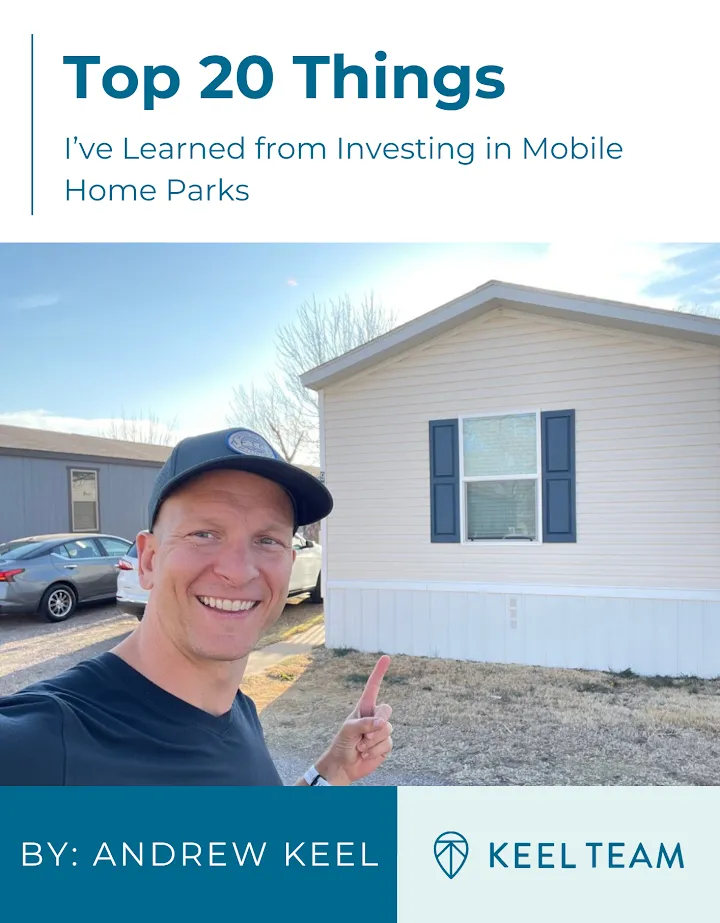
📚 Free eBook: Top 20 Things I’ve Learned from Investing in Mobile Home Parks
If you’re exploring mobile home park investing, this is the best place to start. Andrew Keel shares the most important lessons from years of acquiring and operating mobile home parks across the country.
Here’s where it gets nuanced — and where a CPA becomes essential.
The IRS classifies most limited partnership income and losses as “passive.” Under the passive activity rules (IRC Section 469), passive losses can generally only offset passive income — not W-2 wages or portfolio income like dividends and interest.
So if a mobile home park syndication generates a paper loss in year one due to depreciation, LPs can use that loss to offset:
Cash distributions from the same investment (to the extent they’re classified as passive income)
Passive income from other investments (rental properties, other syndications)
The gain recognized when the property is eventually sold
That last point is critical: suspended passive losses accumulate over the hold period and become fully usable when the investment is sold. For a 5–7 year hold in a mobile home park syndication, LPs often accumulate several years of paper losses that can be applied against the capital gain at exit — significantly reducing or eliminating the tax bill on that event.
The Real Estate Professional Exception
For LPs who also qualify as “real estate professionals” under IRS rules — meaning they spend more than 750 hours per year in real estate activities and real estate is their primary occupation — passive losses can be used to offset any income, including W-2 wages. This is a significant planning opportunity for some investors, though qualifying is genuinely difficult and requires careful documentation.
How K-1s Work for Mobile Home Park LPs
Each year, the partnership issues a Schedule K-1 to every limited partner. This form shows each LP’s allocated share of:
Ordinary income or loss — operating income or paper loss after depreciation
Depreciation — your share of the total deduction claimed by the partnership
Distributions — cash paid to you (note: distributions are not always immediately taxable events)
At-risk and passive activity information — needed to properly apply the passive loss rules
K-1s typically arrive in March or later, which is why LPs in syndications often need to file tax extensions while they wait. Build that into your planning calendar.
Capital Gains Treatment at Exit
When a mobile home park is sold after a multi-year hold, LPs typically receive proceeds taxed as:
Long-term capital gains — for appreciation above the adjusted cost basis (taxed at 0%, 15%, or 20% depending on your income bracket)
Depreciation recapture — the portion attributable to depreciation previously taken, taxed at a maximum 25% rate (Section 1250 recapture)
The combination of long-term capital gains rates plus the ability to apply accumulated passive losses at exit often results in a significantly lower effective tax rate than ordinary income — one of the structural advantages of real estate over most other asset classes.
What to Discuss With Your CPA Before Investing
Not every investor benefits equally from the tax advantages of mobile home park limited partner investments. Before committing capital, raise these questions with your CPA:
Do you have passive income from other sources to absorb potential passive losses?
What is your current marginal tax rate, and how does it affect the value of depreciation deductions?
Could you qualify as a real estate professional?
What is your expected tax situation at the time of projected exit?
How does this investment interact with your existing at-risk basis limitations?
The tax picture for mobile home park LP investing is genuinely compelling — but it’s not one-size-fits-all. A CPA familiar with real estate syndications will help you model the actual after-tax return for your specific situation.
The Bottom Line
The tax benefits of investing in mobile home parks as a limited partner — depreciation, cost segregation, bonus depreciation, passive loss carryforwards, and favorable capital gains treatment at exit — can meaningfully improve the after-tax return relative to what the headline numbers suggest. For investors in higher tax brackets, these benefits are often what makes the asset class genuinely superior to alternatives.
That said, the rules are complex and your individual situation matters. This post is for educational purposes only and is not tax advice. Always work with a qualified CPA or tax attorney before making investment decisions.
If you want to learn more about mobile home park investing and how passive investors approach this asset class, feel free to reach out and set up a call — we’re happy to answer questions and share what we’ve learned.
📚 Want to Go Deeper? Get Our Free eBook
Top 20 Things I’ve Learned from Investing in Mobile Home Parks — real lessons from real deals, written by an operator who has been in the trenches. No fluff, no theory. Just what actually matters.
Andrew is a passionate commercial real estate investor, husband, father and fitness fanatic. His specialty is in acquiring and operating manufactured housing communities. Visit AndrewKeel.com for more details on Andrew's story.