Marketing is the overlooked lever in mobile home park operations. Most operators focus heavily on acquisition and underwriting — but once you own a mobile home park, your ability to fill vacant lots and attract stable, long-term residents directly determines your NOI and, by extension, your asset’s value.
The good news: manufactured housing demand is as strong as it has ever been. National occupancy sits at 93–94.5%, and with virtually zero new mobile home park supply entering the market, existing communities have significant structural advantages. But that doesn’t mean residents find you automatically. You still need a coherent marketing strategy.
This guide covers the proven channels, tactics, and systems operators use to fill lots faster, attract quality residents, and keep them long-term.
Why Vacancy Is More Expensive Than Most Operators Realize
With national occupancy at 93–94% and affordable housing demand at record levels, it can be tempting to think residents will find you. But there is a meaningful difference between running at 91% and 97%. On a 100-lot community at $700 per month lot rent, that six-point gap is $50,400 per year in lost NOI — which translates to roughly $630,000 less in asset value at an 8% cap rate.
Marketing is not just about filling lots. It is about attracting the right residents — those who take care of their homes, pay consistently, and stay for years. The average tenant turnover in mobile home parks is approximately 2.2% per year, compared to around 47% in apartments. That low turnover is partly self-reinforcing: communities that attract quality residents have lower churn, better collections, and higher NOI. Good marketing accelerates that cycle.
Start with a Strong Digital Foundation
Before spending a dollar on advertising, your community needs a clean, findable digital presence. This is table stakes — and it costs almost nothing to do right.
Optimize Your Google Business Profile
A Google Business Profile (formerly Google My Business) is the single highest-ROI marketing investment for a mobile home park operator. It is free, takes about an hour to set up, and determines whether you appear when someone searches “mobile home park near me” or “affordable homes in [City].”
Make sure your profile includes accurate address, phone, and hours; high-quality photos of your community; a description emphasizing amenities and lot prices; and responses to all reviews — positive and negative. Communities with 20-plus reviews and active management fill lots measurably faster than those with no review presence.
Build (or Update) Your Community Website
Your community website does not need to be elaborate, but it needs to work well on mobile devices and include: current available lots and pricing, community rules and pet policy, photos or a virtual tour, and a clear contact form or phone number. A clean, updated website removes friction between an interested prospect and a signed lease.
List on the Platforms Where Your Residents Are Searching
Once your digital foundation is in place, actively list available lots where your target residents are actually looking.
Facebook Marketplace and Local Community Groups
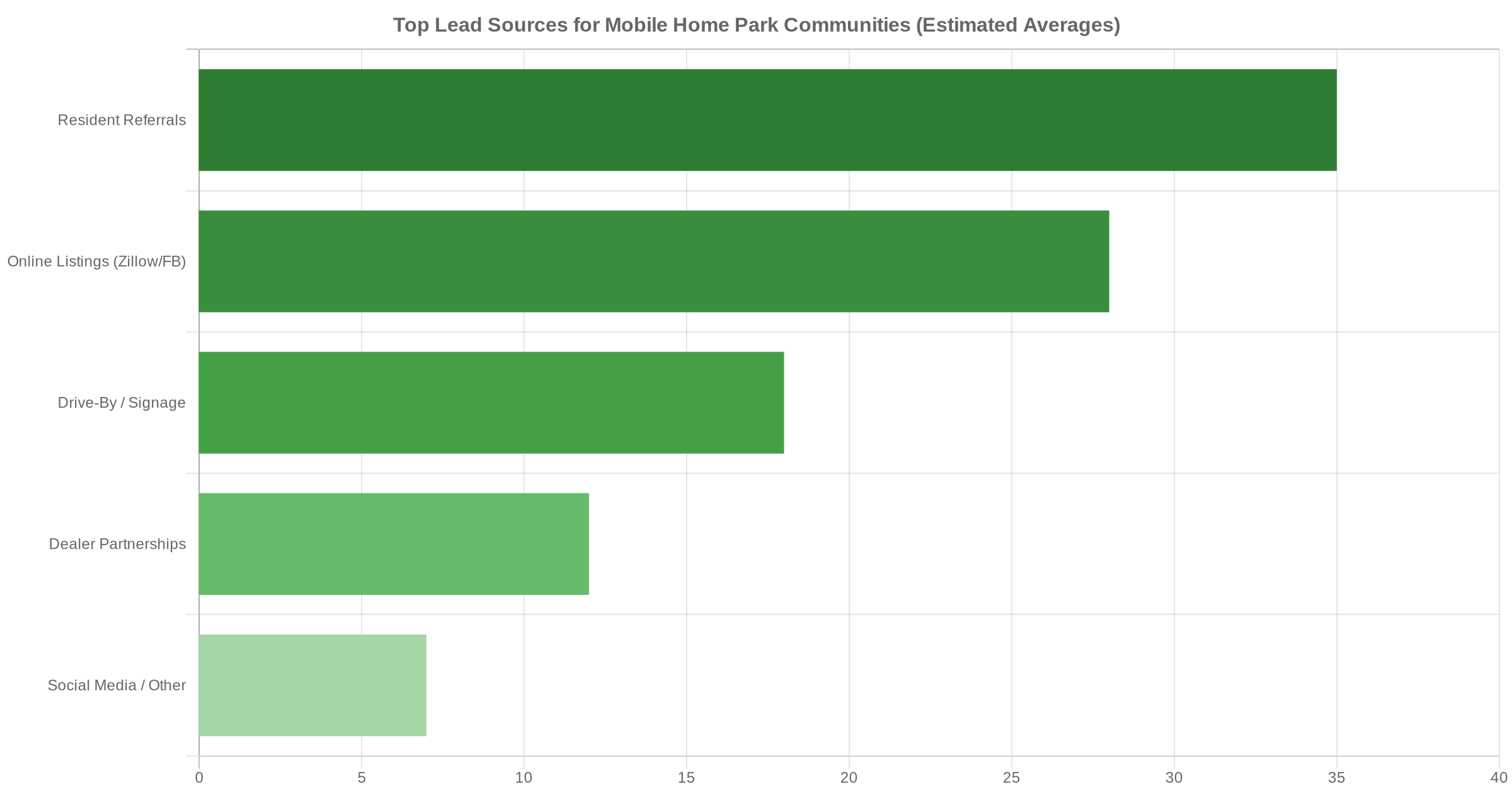
Facebook Marketplace is consistently one of the highest-performing lead channels for manufactured housing communities. It is free, widely used by people seeking affordable housing, and supports photos and detailed descriptions. Local community groups — those focused on housing, local classifieds, or neighborhood buy/sell/trade — are also worth posting in regularly at no cost.
MHVillage, Zillow, and Craigslist
MHVillage.com is the leading specialized platform for manufactured housing listings. Buyers and renters there are specifically looking for manufactured homes and lots — a far more targeted audience than general real estate sites. Zillow has expanded its affordable housing listings, and Craigslist remains a significant lead driver in many markets, particularly for park-owned homes or rent-to-own programs.
Build Relationships with Manufactured Home Dealers
One of the most effective — and most underutilized — strategies for filling vacant lots is building relationships with manufactured home dealers in your area. Dealers have a ready inventory of homes and a pipeline of qualified buyers actively looking for land to place them on.
A productive dealer relationship can mean dealers actively steering qualified buyers to your community, coordinated chattel financing that bundles home purchase with your lot lease, and faster lot fill than you could achieve through advertising alone. A dedicated dealer strategy is one of the fastest paths from 85% to 95% occupancy for operators running a value-add business plan.
Two decades of hard-won lessons distilled into one free guide. Whether you’re evaluating your first deal or your fiftieth, these insights will sharpen your approach.
Launch a Resident Referral Program
Word of mouth from existing residents is consistently one of the top sources of new resident leads. Current residents know your community better than any ad can convey, and their endorsement carries real weight with prospects.
A simple referral program works well: offer a one-time incentive — one month of reduced lot rent, or a $200 gift card — for any referral that signs a lease and clears your screening criteria. Announce it on your community bulletin board, in your newsletter, and through direct communication with current residents. Make it easy to participate.
Residents who refer others also tend to stay longer themselves. A referral program reinforces the community’s stability on both ends: it fills lots and improves retention simultaneously.
Community Presentation: You Cannot Market Your Way Out of a Poorly Maintained Property
Before investing in advertising, walk your community with fresh eyes. Would you want to live there? The physical condition of your community is your most powerful marketing asset — or your biggest liability.
Specific improvements that attract quality residents include: well-maintained common areas with regular mowing and litter control, clear professional entrance signage, a clean and functional community office or welcome area, clearly marked lot boundaries, and functioning shared amenities such as a mailbox area, laundry room, or playground. Communities that look cared for attract residents who care for their homes. The loop compounds over time.
Local and Grassroots Marketing Channels
Beyond digital channels, local grassroots outreach often reaches residents that paid ads miss:
- Local employers and HR departments: Large local employers — hospitals, manufacturers, distribution centers — often maintain employee housing boards or assistance resources. A flyer or formal partnership listing with their HR team can be a consistent lead source, particularly in smaller markets.
- Churches, community centers, and nonprofit organizations: Community bulletin boards remain active, especially in the markets where most mobile home parks operate. A clean, professional flyer posted in the right places generates calls from motivated, community-connected prospects.
- Road signage at the community entrance: A professional, well-maintained “Lots Available” sign with a phone number still works. Drive-by traffic matters — especially in suburban and semi-rural markets where residents are already exploring the area.
- Local apartment referrals: Some renters at nearby apartment complexes are open to transitioning to a manufactured housing community at lower cost. A relationship with local property managers can occasionally generate referrals.
How Occupancy Directly Affects Mobile Home Park Value
Every vacant lot you fill is not just incremental monthly revenue — it is a meaningful increase in your community’s appraised value. As detailed in our occupancy rate analysis, the math is straightforward:
On a 100-lot community at $700 per month lot rent and a 7.5% cap rate:
- At 88% occupancy (88 lots): Annual gross revenue = ~$739,200
- At 95% occupancy (95 lots): Annual gross revenue = ~$798,000
- The revenue difference is $58,800 per year
- At a 7.5% cap rate, that gap represents approximately $784,000 in additional asset value
Marketing is not an expense category in mobile home park investing. It is a value creation engine — and the operators who treat it seriously consistently outperform those who treat it as an afterthought.
Conclusion: Build a System, Not a One-Time Campaign
The most successful mobile home park operators do not run marketing campaigns — they build marketing systems. That means a maintained Google Business Profile with regular photo updates, active listings on MHVillage and Facebook Marketplace, an ongoing resident referral program, and consistent community presentation standards.
The underlying demand for affordable manufactured housing has never been stronger. Your marketing strategy determines whether that demand flows to your community or your competitor’s. Start with your digital foundation, add referral and dealer channels, and track your lead sources monthly so you know what is working. Over time, a well-marketed mobile home park fills faster, retains residents longer, and compounds into a significantly more valuable asset.
10 video modules, a 55-page master checklist, and 9 ready-to-use templates that walk you through every step of evaluating a mobile home park deal — from the first site visit to closing day.
Frequently Asked Questions
What is the best way to advertise a mobile home park?
The highest-impact channels are Google Business Profile (free), Facebook Marketplace (free), and MHVillage.com (the leading specialized platform for manufactured housing). Resident referral programs and relationships with local manufactured home dealers are also consistently effective for filling lots quickly.
How do you attract quality residents to a mobile home park?
Quality resident attraction begins with community presentation — a well-maintained, professionally managed community signals the standards to every prospective resident before they even make a call. Strong screening criteria, responsive management, and clear community rules reinforce the environment that long-term quality residents want to be part of.
How much does it cost to market a mobile home park?
Most effective marketing for mobile home parks is low cost or free. Google Business Profile, Facebook Marketplace, and Craigslist are all free. MHVillage listing fees are modest. Resident referral incentives — typically $150 to $300 per successful placement — are the primary variable cost. A full marketing program can often be run for under $500 per month for a community of 100 lots.
What platforms do prospective residents use to find manufactured homes and lots?
MHVillage.com is the leading specialized platform. Facebook Marketplace, Zillow, and Craigslist are the general platforms with the broadest reach. Google search — through your Google Business Profile — is how most people discover communities near them for the first time.
How does marketing improve a mobile home park’s investment value?
By driving occupancy. Each vacant lot that gets filled adds roughly 12–15 times that lot’s annual rent to the community’s value at a typical cap rate. Moving from 85% to 95% occupancy on a 100-lot community at $700 per month can create over $700,000 in asset value — entirely through operational execution, with no capital improvements required.
Get the top 20 lessons from two decades of mobile home park investing — free.