When passive investors evaluate mobile home park syndications, they tend to obsess over one thing: the operator. Track record, years of experience, team depth, communication style — all valid inputs. But most limited partners overlook an equally critical variable: the market.
Where a mobile home park is located determines its long-term performance ceiling. The best operator in the world cannot manufacture population growth, job creation, or rental demand. These are market conditions. And if you are building a passive income portfolio in the mobile home park space, geographic diversification is not optional — it is foundational risk management.
This post breaks down why market selection matters for passive investors, what to look for in a target market, and how experienced limited partners think about spreading geographic risk across their portfolio.
Why Markets Determine Floors and Ceilings
Mobile home parks are fundamentally land businesses. Lot rents grow when demand exceeds supply, and demand is almost entirely driven by local economic conditions.
A well-run mobile home park in a declining Rust Belt city will struggle to grow lot rents, fill vacant lots, or attract quality residents — no matter how talented the operator. Conversely, a modestly-run park in a fast-growing Sun Belt metro will often outperform expectations simply because underlying demand does the heavy lifting.
This is not a knock on operators. It is an acknowledgment that markets set the context within which operators work. For passive investors evaluating passive mobile home park investments, that means evaluating both dimensions — not one or the other.
The Five Market Factors That Drive Mobile Home Park Performance
When evaluating the geographic fundamentals behind a syndication opportunity, passive investors should focus on five core data points:
1. Population and Household Growth
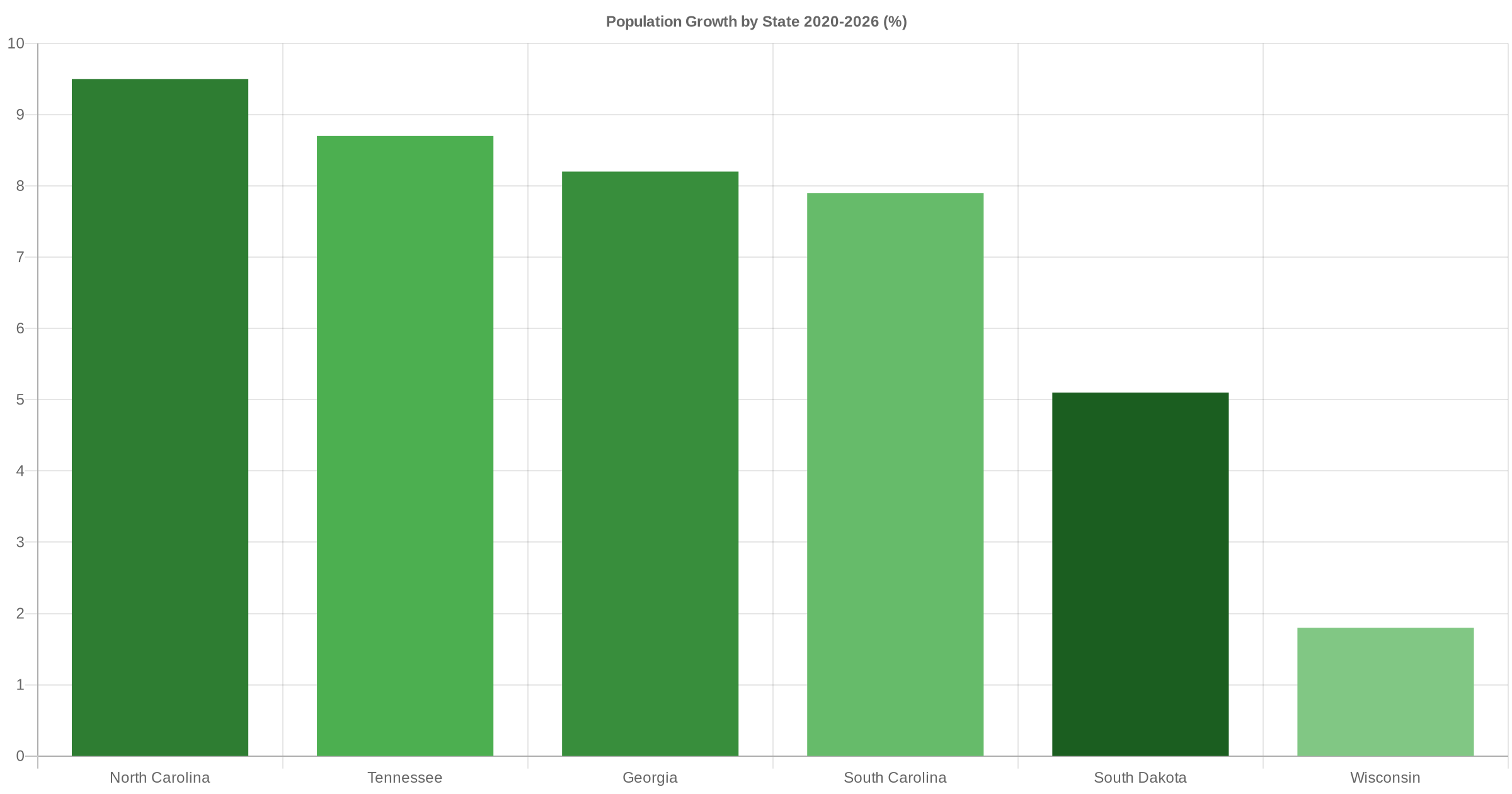
Net in-migration is one of the most reliable leading indicators of mobile home park demand. States and metros experiencing consistent population growth typically see tighter housing markets, rising rents, and stronger demand for affordable alternatives — which mobile home parks directly provide.
North Carolina, Tennessee, and Georgia have been among the fastest-growing states in the country over the past five years. That growth is translating directly into stronger performance for well-located mobile home parks in those markets, with lot rent increases outpacing national averages in many communities.
2. Median Household Income vs. Market Rents
Mobile home parks serve a specific demographic: working families and individuals who need affordable housing options. The strongest markets are those where:
- Median household incomes are sufficient to comfortably pay lot rent
- Market-rate apartment rents are significantly higher than lot rent
- The gap between renting and owning a single-family home is wide
This affordability gap is what keeps mobile home parks full. When single-family home prices rise and apartment rents climb, demand for mobile home park lot leases increases proportionally. Passive investors should look for markets where this structural affordability tension is durable — not temporary.
3. Employment Diversity
A metro dependent on a single employer or industry creates concentration risk. If that employer downsizes or exits, vacancy rates follow. The best markets for mobile home park investing have diversified employment bases — healthcare, logistics, manufacturing, government, and services — that provide resilient household income across economic cycles.
4. Landlord-Friendly State Laws
State-level regulations matter more than most passive investors realize. Some states have enacted strict tenant protections that limit rent increases, require extended notice periods, or constrain eviction timelines. While protecting residents is important, overly restrictive legislation can impair park operations and reduce returns.
Target markets including North Carolina and Tennessee have historically maintained regulatory environments that allow operators to run efficient communities while still treating residents fairly — a balance worth investigating before committing capital to any market.
5. Supply Constraints
New mobile home parks are nearly impossible to permit in most jurisdictions. Zoning restrictions and community opposition have effectively frozen supply in most markets — creating a structural tailwind for existing park owners and their investors. Passive investors should still evaluate whether any given market faces pipeline risk from manufactured housing communities, RV park conversions, or scattered-site placements that could soften demand at the margins.
Two decades of hard-won lessons distilled into one free guide. Whether you’re evaluating your first deal or your fiftieth, these insights will sharpen your approach.
The Hidden Risk of Geographic Concentration
Many first-time limited partners make the mistake of concentrating all of their mobile home park investments in a single state or metro — often because they are investing with one operator who focuses exclusively on that market.
This creates hidden correlation risk. If that market experiences an economic downturn, a major employer exits, or new regulations pass, every investment in the portfolio is affected simultaneously. Returns suffer across the board, and the diversification benefit of investing in multiple deals evaporates.
A more sophisticated approach: over time, build exposure across two or three distinct markets with different economic drivers. A portfolio spanning the Southeast and Upper Midwest carries fundamentally different risk profiles than one concentrated entirely in a single metro — even if every individual park is high-quality.
For a deeper look at how to structure your approach to passive investing, see our guide on active vs. passive mobile home park investing.
How to Evaluate Market Risk in a Syndication Deck
When you receive a syndication offering document, pay close attention to how the operator characterizes the local market. Strong decks typically include:
- City or county-level population data and growth trajectory
- Median household income and rent-to-income ratio for the local renter pool
- Comparable lot rent data from nearby communities
- Supply data showing limited or no new mobile home park development nearby
- Drive distance to the nearest major metro or employment center
Operators who cannot answer market-level questions clearly — or who rely entirely on state-level generalizations — may not have done the depth of market research that prudent underwriting requires.
For a complete framework on what to look for in a deal before committing capital, see our guide to mobile home park passive investment due diligence.
Geographic Diversification in Practice
Most passive investors are working with limited capital and cannot diversify widely on their first few deals. That is expected. The goal is not to spread capital thin immediately — it is to be deliberate as the portfolio grows.
If you are evaluating your second or third syndication opportunity, consider:
- Is this the same market as my existing mobile home park investment?
- Is this operator’s thesis dependent on the same economic drivers as my last deal?
- Am I building exposure to different geographies, or just adding more of the same concentration?
Over time, a portfolio that spans multiple metros and multiple operators is meaningfully more resilient than one that is geographically concentrated — even if every individual park is strong on its own.
Bottom Line
Operators are critically important. But markets are the tide that lifts or limits every boat. The most experienced passive mobile home park investors have learned to evaluate both — not because they are pessimistic about any single deal, but because they understand that sustainable, long-term returns come from making thoughtful decisions at every level of the investment.
When you are reviewing your next syndication opportunity, do not just ask about the operator. Ask about the market. Ask about the underlying thesis. And make sure the answers are specific, data-driven, and honest.
To learn more about passive investing in mobile home parks, including how to evaluate operators, understand deal structures, and assess geographic market risk, explore our full resource library.
10 video modules, a 55-page master checklist, and 9 ready-to-use templates that walk you through every step of evaluating a mobile home park deal — from the first site visit to closing day.
Get the top 20 lessons from two decades of mobile home park investing — free.