Most passive investors in mobile home parks focus on one thing when evaluating a deal: the projected returns. An operator shares a pitch deck showing a 15–18% IRR, a healthy preferred return, and a well-located market — and that’s often enough to get a check written.
But here’s the problem: projected returns are easy to produce. A polished pitch deck takes a weekend to build. What separates sophisticated passive investors from those who learn costly lessons is the due diligence they complete before committing capital to a mobile home park passive investment.
This guide covers the five areas every limited partner (LP) should review — carefully — before signing a subscription agreement.

Why LP Due Diligence Differs from Operator Due Diligence
When a mobile home park operator acquires a property directly, their due diligence focuses on physical infrastructure, lot rent rolls, utility systems, and zoning. They have full control over what happens next.
As a passive investor, you’re evaluating something different: you’re betting on the operator at least as much as the property. Your due diligence is fundamentally about trust, track record, deal structure, and downside protection. The park matters — but so does everything around it.
A troubled property with a skilled operator can often be turned around. A well-located mobile home park with a weak operator usually ends badly for everyone involved.
1. Track Record: Go Beyond the Highlight Reel
Every operator will tell you about their best deals. Your job is to ask about the rest.
When evaluating a sponsor’s track record, dig into:
- Realized returns on fully exited deals. Ask for the actual IRR on completed investments — not just projected returns on deals that are still open. Many operators have impressive projections and limited exit history.
- Preferred return payment history. Have they ever missed or delayed a preferred return distribution? If so, why — and how did they communicate it to investors?
- Hold period experience. An operator who has never been through a full real estate cycle has never been tested in a down market. That context matters when you’re evaluating how they’ll perform if conditions shift.
- LP references. Ask to speak with two or three past investors. This is the most underused tool in passive due diligence. Pick up the phone and actually call them.
If an operator deflects questions about underperforming deals or resists providing LP references, take note. That reaction tells you something important about how they’ll behave when things don’t go to plan.
2. Deal Structure: Understand Every Dollar
The deal structure determines how money flows — and who gets paid first when results fall short of projections.
Review these elements carefully before committing capital:
- Preferred return: What is the rate (typically 7–8%)? More importantly, is it cumulative or non-cumulative? A cumulative preferred return accrues if distributions are missed and must be repaid before the sponsor profits. A non-cumulative preferred return disappears if distributions are skipped — those payments are simply lost. That distinction is the difference between real downside protection and a paper promise. Learn more about how preferred returns work in real estate syndications.
- Waterfall structure: How are profits split at exit? A 70/30 LP-GP split after return of capital and preferred return is common — but deal structures vary widely. Make sure you understand the full waterfall, not just the headline split.
- Fees: Acquisition fees, annual asset management fees, and disposition fees all reduce LP returns. A 1–2% acquisition fee and 1–2% annual asset management fee is within normal range. Anything materially above that warrants scrutiny.
- Capital call provisions: Can the operator require additional capital contributions from LPs? Under what circumstances? Is participation mandatory? Understanding capital calls before you invest prevents expensive surprises later.
3. Property and Market: Understand What You’re Backing
Even as a passive investor, you should understand the physical asset underlying your investment.
Request and review:
- The rent roll: How many lots are occupied? What is the current lot rent, and what is the market-rate lot rent? The gap between those two numbers often represents the core value-add thesis — and if the numbers don’t support the business plan, neither does the deal.
- Utility infrastructure: Is the mobile home park on city water and city sewer? Mobile home parks on private wells or septic systems carry significantly higher operational risk and typically trade at compressed valuations.
- Local market fundamentals: Is the mobile home park within reasonable distance of employment centers? What does the local housing affordability picture look like? Mobile home parks succeed in markets where residents have limited affordable alternatives — not simply wherever land is cheap.
- Third-party inspection report: Has an independent inspector reviewed the physical condition of the community? Ask for the actual report — not just the operator’s summary of it.
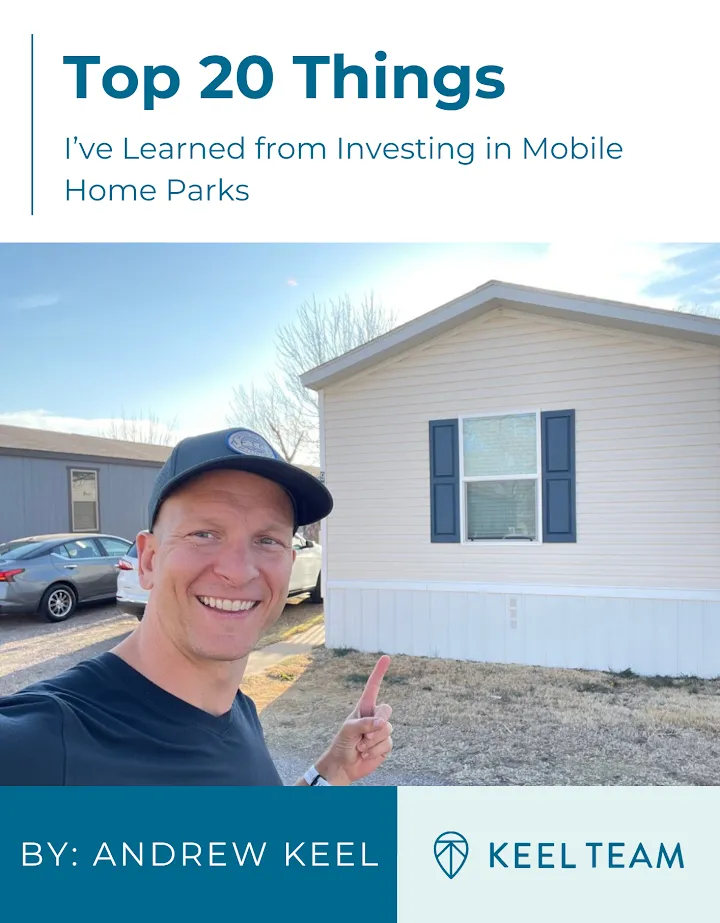
Two decades of hard-won lessons distilled into one free guide. Whether you’re evaluating your first deal or your fiftieth, these insights will sharpen your approach.
4. Ten Questions Every LP Should Ask Before Investing
When you connect with an operator, come prepared with specific questions. Here are ten worth asking — and pay close attention to how they’re answered, not just what’s said:
- What are the realized returns on your last three fully exited deals?
- Have you ever missed or delayed a preferred return distribution — and how was it handled?
- What vacancy assumptions did you underwrite, and how do they compare to current occupancy?
- Is the debt fixed or floating rate? When does it mature?
- What are your assumptions for lot rent increases over the hold period?
- What is the exit strategy, and what exit cap rate are you projecting?
- What happens if the stabilization timeline extends beyond projections?
- Can you connect me with two or three LP investors from previous deals?
- What has been your most challenging deal — and what did you learn from it?
- How do you communicate with LPs during the hold period, and how often?
The best operators welcome detailed questions. If a sponsor seems irritated, evasive, or vague in response to basic due diligence inquiries, treat that as meaningful information. Our full guide to mobile home park syndication red flags covers more warning signs worth knowing before you commit.
5. Legal Documents: The Fine Print Is Where Deals Go Wrong
Before signing anything, your documents package should include three core items:
- Private Placement Memorandum (PPM): The official disclosure document. Read the risk factors section carefully. If it’s thin or vague, the operator may be minimizing legitimate risks rather than disclosing them transparently.
- Operating Agreement (LLC Agreement): This governs how the entity is managed, how decisions are made, and what rights LPs actually hold. Pay attention to voting rights, major decision thresholds, and any provisions for removing or replacing the general partner.
- Subscription Agreement: This is what you sign to commit capital. It confirms your accredited investor status and formalizes the terms of your investment.
If you’re committing a significant amount of capital, have an attorney review these documents. A few hundred dollars in legal fees is trivial compared to the size of the investment being made.
The Difference Between a Good Deal and a Good-Looking Pitch Deck
Experienced passive investors have learned to slow down exactly where others speed up — at the moment when excitement about a new opportunity, a compelling operator, and an attractive projected return makes it tempting to skip steps.
Mobile home park passive investing has a genuinely strong case as an asset class: recession-resistant demand, low resident turnover compared to traditional rental housing, and a structural shortage of affordable housing that isn’t going away. The goal of due diligence isn’t to talk yourself out of good deals. It’s to invest in the right ones — with the right operators — with confidence and clear eyes.
For a broader look at how passive investing in mobile home parks compares to direct ownership, our comparison of active vs. passive mobile home park investing is worth reading before you decide which path fits your goals, timeline, and available bandwidth.
Conclusion
The returns from well-structured mobile home park passive investments can be compelling — but those returns are earned upfront, through the work done before committing capital, not after. Track record. Deal structure. Property fundamentals. Key questions. Legal documents. Work through all five areas, take your time, and invest with operators who have earned your trust through transparency and demonstrated results.
If you’d like to learn more about how experienced operators approach mobile home park investing, we’re happy to have an educational conversation. Reach out here and we’ll set up a call.
10 video modules, a 55-page master checklist, and 9 ready-to-use templates that walk you through every step of evaluating a mobile home park deal — from the first site visit to closing day.
Get the top 20 lessons from two decades of mobile home park investing — free.