When experienced mobile home park investors talk about their top target markets for 2026, Tennessee keeps rising to the top of the list. It has the population growth, the business-friendly climate, the affordable land basis, and — critically — the regulatory environment that makes owning and operating mobile home parks far less complicated than in many coastal or northern states.
This guide covers what you need to know before investing in mobile home parks in Tennessee: which markets to target, what lot rents and cap rates look like today, the regulatory landscape, and how to find deals. Whether you’re buying your first mobile home park or adding Tennessee exposure to a growing portfolio, this is the data-grounded overview you need.
Why Tennessee Is a Top Market for Mobile Home Park Investing
Tennessee’s appeal as a mobile home park investment market comes down to four structural factors:
1. Strong and Sustained Population Growth
Nashville’s metro area has been one of the fastest-growing in the Southeast for over a decade and shows no signs of slowing. Knoxville, Chattanooga, and the Tri-Cities (Kingsport-Bristol-Johnson City) metro have all seen consistent in-migration driven by job growth, low cost of living, and quality of life. More residents means more demand for affordable workforce housing — and mobile home parks are often the most affordable housing option in any market.
2. No State Income Tax
Tennessee has no personal income tax on earned income. For investors holding mobile home parks through pass-through structures (LLCs, limited partnerships, syndications), this matters. Net operating income distributions aren’t subject to state income tax at the individual level, which is a meaningful edge over states like California, New York, or even Georgia.
3. Business-Friendly Regulatory Environment
Tennessee consistently ranks among the top ten most business-friendly states in the U.S. The state has not passed aggressive manufactured housing tenant protection laws of the type seen in states like Oregon, California, or Washington — meaning operators face fewer bureaucratic hurdles, and the risk of rent control or restrictive eviction statutes is significantly lower. (More on Tennessee’s specific regulatory environment below.)
4. Affordable Entry Prices Relative to Coastal Markets
Mobile home parks in Tennessee — particularly outside Nashville — are still trading at prices that allow investors to acquire communities with real value-add potential. Rural Tennessee parks can often be purchased at 10-12% cap rates. Suburban Nashville assets command tighter cap rates (5.5–7%), but even those are wide relative to what the same investor would pay in a New England or West Coast market.
Tennessee’s Top Markets for Mobile Home Park Investing
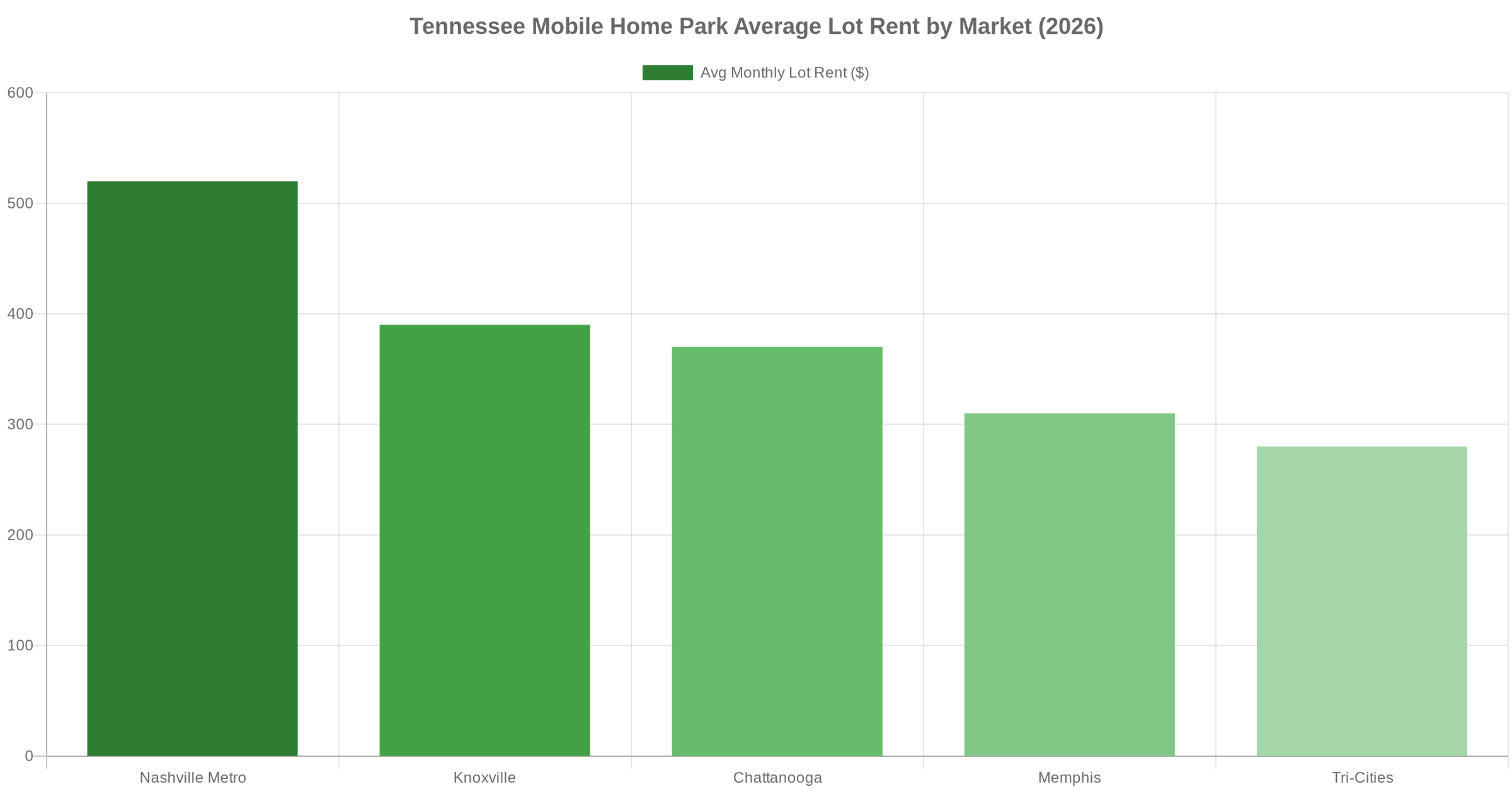
Not all Tennessee markets are created equal. Here’s how the major metros stack up:
Nashville-Davidson-Murfreesboro Metro
The state’s largest and fastest-growing metro. Population: 2.1M+. Lot rents in suburban Nashville communities run $450–$575/month for well-operated parks. Cap rates for stabilized assets typically land in the 5.5–7% range. Competition from institutional buyers is real here — companies like Sun Communities and UMH have presence in the market — but off-market deals from mom-and-pop operators still emerge regularly. The key is working the direct mail and broker networks before deals hit listing platforms.
Knoxville Metro
Knoxville is a college town (University of Tennessee) with a diverse economy, strong manufacturing base, and growing healthcare sector. Lot rents average $350–$430/month. Cap rates run 6.5–8% for stabilized properties. Knoxville is less picked-over than Nashville, which means patient investors who work the market directly can still find value-add mobile home park deals with realistic 18–24 month repositioning timelines.
Chattanooga Metro
Chattanooga sits at the intersection of Tennessee, Georgia, and Alabama — giving it a catchment area that extends well beyond city limits. It’s one of the most-improved mid-sized metros in the Southeast over the past decade. Lot rents range from $325–$400/month. Industrial and logistics job growth (Amazon, Volkswagen, Wacker) provides stable tenant employment, which directly supports mobile home park rent collections. Cap rates in the 7–8.5% range are still achievable for value-add deals.
Memphis Metro
Memphis is Tennessee’s most affordable major metro by housing cost, and mobile home parks here reflect that. Lot rents average $275–$340/month. Cap rates can stretch to 9–11% for distressed or under-managed parks. Memphis requires more careful underwriting — crime statistics, school quality, and tenant employment stability matter more here than in Knoxville or Chattanooga. But investors willing to do the work can find compelling yields on cost that aren’t available anywhere closer to the coast.
Tri-Cities (Kingsport-Bristol-Johnson City)
Often overlooked, the Tri-Cities region has a stable healthcare-and-manufacturing employment base and very affordable land values. Lot rents run $250–$320/month. For investors comfortable with rural or semi-rural markets, the Tri-Cities offer low competition, low acquisition prices, and consistent (if modest) income. These markets fit better in a portfolio alongside larger metro assets than as standalone investments.
Two decades of hard-won lessons distilled into one free guide. Whether you’re evaluating your first deal or your fiftieth, these insights will sharpen your approach.
Lot Rents, Cap Rates, and What Returns Look Like in Tennessee
Nationally, the average mobile home park lot rent hit approximately $752/month in 2026, up roughly 7% year-over-year according to Northmarq’s manufactured housing report. Tennessee markets sit below that national average, which is actually a positive signal for investors: there’s still meaningful room for lot rent growth in a state where affordable housing demand is intensifying but supply is functionally frozen (no new mobile home parks are being permitted at scale anywhere in the state).
Here’s a simplified return model for a hypothetical Tennessee market acquisition:
- Purchase price: $2.8M (80-lot park, Knoxville suburban market)
- Occupancy at purchase: 85% (68 occupied lots)
- Current lot rent: $370/month
- Year-1 gross income: ~$302K
- Stabilized NOI (at 92% occupancy, $410 rent): ~$235K
- Stabilized cap rate on cost: ~8.4%
These numbers are illustrative, but they’re grounded in real Tennessee market conditions. For a deeper dive on cap rate mechanics and how to underwrite returns, see our post on mobile home park cap rates explained.
Tennessee’s Regulatory Environment for Mobile Home Park Investors
Tennessee is one of the more investor-friendly states in the Southeast when it comes to mobile home park regulation. Key facts for 2026:
No Statewide Rent Control
Tennessee has no statewide rent control or rent stabilization laws. Operators can increase lot rents with proper notice — typically 30 days for month-to-month tenancies. The absence of rent caps means operators can gradually bring below-market rents toward market over time, which is a primary value-add lever in most Tennessee acquisitions.
Eviction Laws Are Straightforward
The Tennessee Uniform Residential Landlord and Tenant Act provides clear procedures for non-payment evictions. The typical timeline from notice to judgment is 15–25 days, which is fast by national standards. This reduces carrying costs for non-paying tenants and gives operators meaningful leverage to enforce community rules.
Manufactured Housing Licensing
Tennessee requires mobile home parks to be licensed through the Tennessee Department of Health. Parks must meet minimum lot size, setback, and utility standards. These are generally baseline operational requirements — not onerous for well-run communities — but buyers should verify compliance during due diligence. Non-compliance can affect licensure at closing. Our mobile home park due diligence checklist covers what to verify on the regulatory side before closing.
Right-of-First-Refusal: Not Yet in Tennessee
Several states (including New Hampshire, California, and Rhode Island) have passed right-of-first-refusal laws that require sellers to offer existing residents or their cooperatives the first chance to purchase the park before selling to an outside investor. As of mid-2026, Tennessee has no such law on the books — though this is worth monitoring as similar legislation has been proposed in multiple Southeast states.
Finding Mobile Home Parks for Sale in Tennessee
Tennessee’s market has two tiers of deal flow: what’s publicly listed and what’s off-market. For investors targeting value-add opportunities, the off-market channel is where the real deals live.
- Direct mail to owners: Build a list of Tennessee mobile home parks with 50+ lots using county assessor data, then run a direct mail campaign. Response rates are low (1–3%), but the deals that come back are often priced below market because the owner hasn’t talked to a broker.
- Brokers who specialize in manufactured housing: A handful of commercial real estate brokers specialize in mobile home park transactions in Tennessee and the Southeast. Building relationships with two or three of them puts you in front of listings before they hit CoStar.
- Drive the market: Tennessee is driveable. Weekend tours through suburban Nashville, Knoxville, and Chattanooga corridors will surface communities not on any list. Stop in, ask who owns it, follow up with a letter.
- Loopnet and CoStar: Less competitive than off-market, but still worth monitoring — especially for larger parks (100+ lots) where fewer buyers can qualify for financing.
For more on sourcing deals directly from owners, see our guide on finding off-market mobile home parks.
Key Due Diligence Points Specific to Tennessee
Beyond the standard due diligence process (utilities, occupancy, title, environmental), a few Tennessee-specific items deserve attention:
- Water/sewer infrastructure: Rural Tennessee parks frequently rely on well water and septic systems. City water and sewer connections dramatically reduce operational risk and improve valuation. Prioritize parks with municipal utilities or verify capacity and condition of private infrastructure carefully.
- Flood zone exposure: East Tennessee’s river systems (Tennessee River, French Broad, Clinch) create flood risk for low-lying parcels. Review FEMA flood maps before proceeding on any park near river corridors.
- Park-owned homes ratio: Tennessee markets have a higher-than-average proportion of park-owned homes (POH) in older communities. POH-heavy parks require more hands-on management and capital investment. Underwrite the cost of repositioning POH to tenant-owned carefully.
- Title and lien searches: Tennessee tax lien sale laws can affect title for mobile homes registered as personal property. Confirm how homes are titled (real vs. personal property) and whether any outstanding home-level liens will affect the transaction.
Conclusion: Tennessee Belongs on Every Mobile Home Park Investor’s Short List
Tennessee combines the fundamentals that make mobile home park investing work: population growth, affordable workforce housing demand, a frozen supply of new communities, and a regulatory environment that doesn’t fight you at every turn. Whether you’re targeting Nashville’s growth corridors or the quieter value-add markets in Knoxville and Chattanooga, the state offers a range of opportunities across different price points and risk profiles.
If you’re new to mobile home park investing and want to understand the full picture before diving into Tennessee or any other market, our comprehensive mobile home park investing guide is a good place to start. And if you’ve already been looking at deals, our financing guide covers how to structure mobile home park loans across agency debt, community banks, and seller financing options.
10 video modules, a 55-page master checklist, and 9 ready-to-use templates that walk you through every step of evaluating a mobile home park deal — from the first site visit to closing day.
Frequently Asked Questions: Mobile Home Park Investing in Tennessee
What cap rates should I expect on mobile home parks in Tennessee?
It depends heavily on market and asset quality. Stabilized Nashville suburban parks trade at 5.5–7% cap rates. Knoxville and Chattanooga markets typically run 6.5–8.5%. Value-add parks in smaller Tennessee markets can offer 9–12% cap rates on cost after stabilization — but those come with more operational complexity and longer repositioning timelines.
What is the average lot rent in Tennessee mobile home parks?
Lot rents vary significantly by market. Nashville suburbs average $450–$575/month, Knoxville $350–$430/month, Chattanooga $325–$400/month, Memphis $275–$340/month, and rural Tri-Cities markets $250–$320/month. All of these are below the national average of approximately $752/month — leaving meaningful upside for investors who acquire at current rents and grow them toward market over time.
Does Tennessee have any tenant protection laws specific to mobile home parks?
Tennessee does not have statewide rent control, mandatory right-of-first-refusal laws, or just-cause eviction requirements specific to mobile home parks. The state follows the Uniform Residential Landlord and Tenant Act, which gives operators clear procedures and timelines for notices and evictions. It is one of the more operator-friendly regulatory environments in the Southeast.
Is Tennessee a good state for first-time mobile home park investors?
Yes — with important caveats. Secondary markets like Knoxville and Chattanooga offer more forgiving pricing and less institutional competition than Nashville, making them reasonable entry points for investors learning the business. That said, even “easy” markets require thorough due diligence, particularly on utility infrastructure and park-owned home ratios, which are common in older Tennessee communities. Starting with a stabilized, city-utilities park reduces execution risk for first-time operators.
How do I find mobile home parks for sale in Tennessee?
The most productive channel is direct-to-owner outreach — direct mail, cold calls, and in-person canvassing. Most Tennessee mobile home parks are owned by individuals or families, not institutions, and many owners have never received a professional acquisition offer. Broker relationships (with manufactured housing specialists in the Southeast) and periodic monitoring of CoStar/LoopNet supplement direct outreach, particularly for larger parks.
Get the top 20 lessons from two decades of mobile home park investing — free.