You found the park. The numbers pencil. The broker says utility bill-backs are “standard practice” and the income is clean. You’re ready to move.
Stop.
There is a category of risk that is quietly destroying mobile home park deals in 2026 — and it doesn’t show up on the rent roll, the T-12, or the broker’s offering memorandum. It shows up six months after closing, in the form of a class-action lawsuit, a state AG investigation, or an NOI that’s suddenly 15% lighter than what you underwrote.
The issue is utility billing. Specifically, the way most parks pass utility costs to residents through RUBS (Ratio Utility Billing Systems) and submetering markups. And the regulatory ground has shifted so fast in the last 18 months that deals that were perfectly legal in 2022 are legal liability in 2026.
Here’s what every mobile home park investor needs to know before signing an LOI.
The Regulatory Collapse Nobody Warned You About
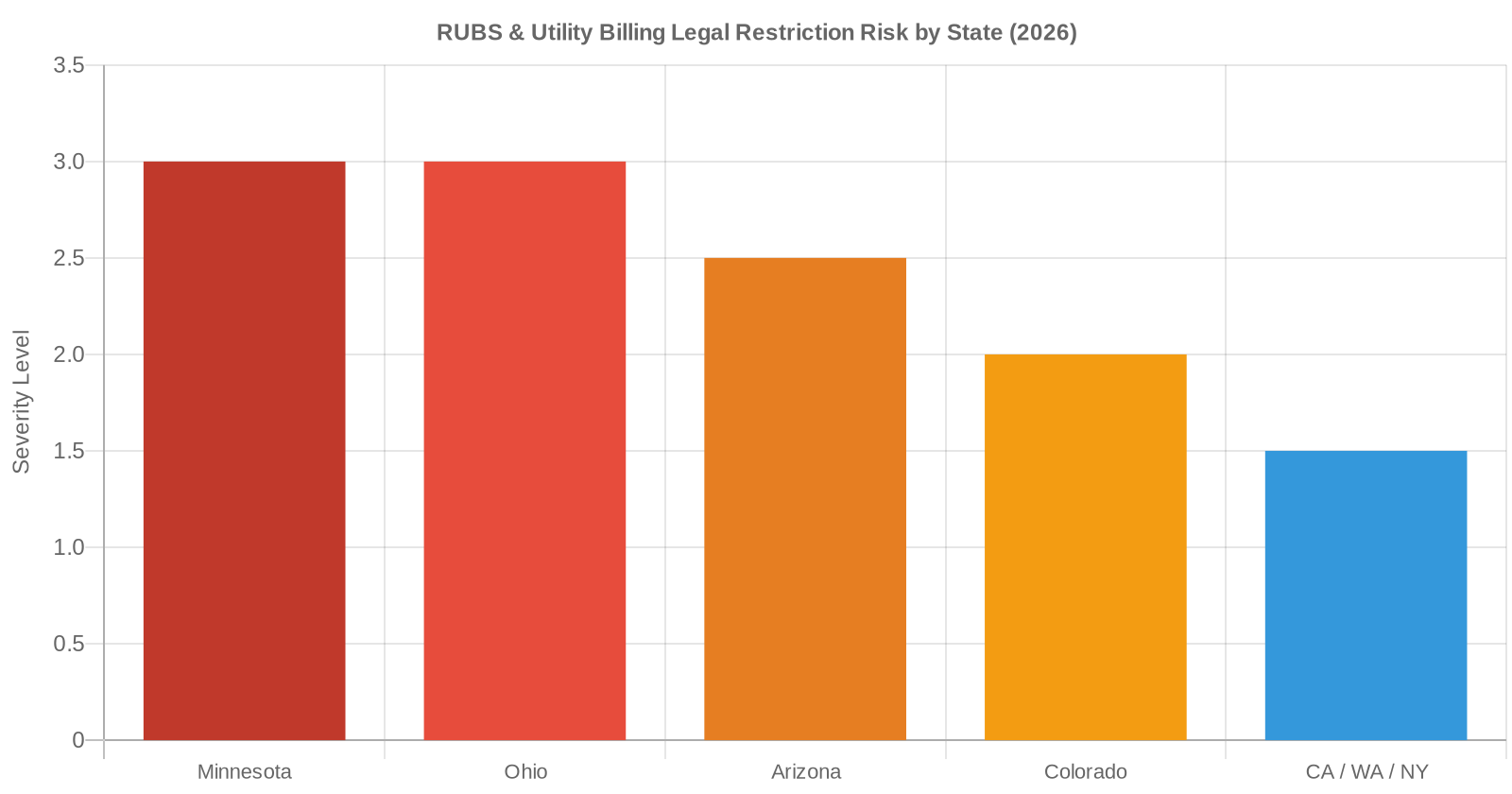
In January 2025, Minnesota became the first state in the country to ban RUBS for electricity outright. Not regulate it — ban it. Administrative markups on water and gas billing were also prohibited. This was a first. And it won’t be the last.
Then came April 22, 2026. The Ohio Supreme Court ruled that submetering companies operating inside mobile home communities are public utilities. Not just service providers. Public utilities — subject to state regulatory oversight, rate review, and the same consumer protections that apply when a resident is a direct utility customer.
The ripple effect is already visible. Colorado is restricting RUBS for new construction after July 2027. Arizona’s Attorney General has issued consumer alerts and is actively pursuing class-action litigation over overbilling. Active class-action suits are running in Los Angeles, Minnesota, and Illinois. California, Washington, and New York all have pending legislation on the table.
This is not a “wait and see” situation. This is a wave that’s already broken.
How This Kills Your Deal — Retroactively
Here’s the brutal math. A 100-lot park generating $150/month per lot in utility bill-backs through RUBS has $180,000 in annual utility income. At a 6.5% cap rate, that income represents $2.76 million of your purchase price.
If RUBS is banned or litigated away in your state, you didn’t just lose cash flow. You overpaid by nearly $3 million — based on income that was never legally defensible.
And it gets worse. Class-action damages in overbilling cases can exceed the total utility income collected over multiple years. Attorney fees. Regulatory fines. Required refunds to residents. Reputational damage that tanks your occupancy.
Deals that looked like value-add plays are turning into legal sinkholes.
Two decades of hard-won lessons — including utility billing mistakes, due diligence gaps, and the systems we built to protect our portfolio.
Download the Free eBook →
The 5 Due Diligence Questions You Must Ask Before Closing
We’ve updated our acquisition checklist to include these five utility billing questions as mandatory — before LOI stage, not buried in Phase II due diligence. (For a full walkthrough of our acquisition process, see the Mobile Home Park Due Diligence Playbook.)
- How is utility cost passed to residents? RUBS, submetering, flat fee, or direct billing? Get the actual billing statements for the last 12 months.
- Is there an administrative markup? Any markup above cost recovery — even $5/month per lot — is now legally questionable in multiple states and outright illegal in others.
- What state is this park in? Map the billing method against the current regulatory environment. Minnesota and Ohio are the danger zones today. Arizona, California, Colorado, New York, and Washington are close behind. Review the pros and cons of mobile home park investing in your target state before going under contract.
- Have there been any resident complaints or legal notices regarding utility billing? Ask the seller directly and verify with county records. Undisclosed complaints are a reason to walk.
- What percentage of total NOI comes from utility bill-backs? If it’s more than 10%, that income needs to be stress-tested against a scenario where it disappears entirely. Does the deal still work?
What We’re Doing at Keel Team
We own and operate 50+ mobile home parks across the Southeast. When the Ohio ruling dropped in April 2026, we immediately conducted a portfolio-wide audit.
Every park was mapped against its state’s current billing law. Parks using RUBS in borderline states got flagged. We prioritized conversion to individual, cost-based submetering in markets where regulatory risk is highest. We documented everything — meter certifications, billing formulas, audit trails — in case we ever need to defend our practices.
This isn’t just risk management. It’s investor relations. Our limited partners want to know their capital is in parks that won’t face a class-action six months after closing. Being proactive on compliance is part of how we protect the portfolio.
The Move for 2026
If you’re actively buying parks, add utility billing compliance to your standard due diligence protocol now — not later. If you already own parks, conduct an audit before a resident or state AG does it for you.
The operators who survive the utility billing wave are the ones who got ahead of it. The ones who are going to hurt are the ones who assumed “standard practice” was still legal.
In 2026, it frequently isn’t.
The Scale of This Problem in 2026
Our acquisition team has reviewed 14 mobile home park deals in active due diligence since the Ohio Supreme Court ruling in April 2026. Nine of them — 64% — had utility billing arrangements requiring immediate modification or legal review post-close. The parks most exposed are in the Midwest and Mid-Atlantic, where Public Utility Commission oversight is actively expanding into manufactured housing. If you’re evaluating deals in those regions, budget extra time and legal cost for a utility billing audit before you sign an LOI. For a current underwriting framework that accounts for these costs, see our guide on how to value a mobile home park.
Frequently Asked Questions
What is RUBS and why is it a liability risk in mobile home park investing?
RUBS (Ratio Utility Billing Systems) allocates a park’s master utility bill across residents based on a formula — typically occupancy or unit size. It was standard practice for decades. As of 2026, multiple states have restricted or banned RUBS in manufactured housing. The core risk: if RUBS income is priced into your acquisition and gets eliminated by regulation or litigation after closing, you may have significantly overpaid based on income that was never legally defensible.
How do I identify whether a mobile home park uses utility markups during due diligence?
Request 12 months of resident billing statements and compare them directly to the park’s master utility invoices. Any consistent spread between what residents pay and what the park pays the utility company signals a markup. Ask the seller directly: “Do you charge an administrative fee on utilities?” Many won’t volunteer this. Undisclosed markups are the most common source of post-closing regulatory disputes in this asset class.
Which states carry the highest utility billing compliance risk in 2026?
As of May 2026: Minnesota (RUBS banned for electricity), Ohio (submetering companies ruled public utilities), and Arizona (active AG investigations and class-action suits). California, New York, Colorado, and Washington have pending legislation. Keel Team’s primary acquisition targets — North Carolina, Tennessee, and Georgia — currently carry lower risk, but national trends warrant re-evaluation every six months.
Can I still acquire a mobile home park that currently uses RUBS?
Yes — but only if the deal works without the utility bill-back income. Underwrite it assuming RUBS disappears entirely on day one. If lot rent alone supports your return requirements, you have a defensible position. If the deal only pencils with RUBS income included, the risk isn’t correctly priced. Always get a written legal opinion from a real estate attorney in the target state before closing.
Where can I get a complete utility billing compliance checklist for mobile home park acquisitions?
The Mobile Home Park Due Diligence Playbook includes a full utility billing compliance module alongside environmental, legal, and financial due diligence frameworks — 10 video modules, a 55-page master checklist, and 9 ready-to-use templates built for active buyers.
10 video modules, a 55-page master checklist, and 9 ready-to-use templates — including a utility billing compliance audit. Don’t close another deal without it.
Get the Playbook →
Andrew Keel is the founder of Keel Team, which acquires and operates mobile home parks across the Southeast. For more on acquisition due diligence, visit keelteam.com/mhp-due-diligence-playbook.