Mobile home park investing has emerged as a compelling opportunity in the real estate market, attracting both seasoned investors and newcomers. With the potential for high cash flow and the growing demand for affordable housing, mobile home parks may offer unique advantages. However, challenges like financing hurdles and infrastructure issues could pose risks. This article explores the pros and cons of investing in mobile home parks in 2026, helping you make informed decisions. Let’s dive into the common benefits and drawbacks to see if this niche aligns with your investment goals.
Why Mobile Home Parks Are Gaining Attention
Mobile home parks provide affordable housing for millions of Americans, with approximately 20.9 million people living in mobile homes, according to recent housing data. As traditional home prices soar, these communities may fill a critical gap, offering low-cost living options. For investors, mobile home parks could deliver stable returns due to consistent demand and low tenant turnover. However, like any investment, they come with complexities. Below, we break down the key advantages and potential pitfalls.
The Pros of Investing in Mobile Home Parks
High Cash Flow Potential
Mobile home parks may generate strong cash flow, often surpassing traditional multifamily properties. Since tenants typically own their mobile homes and rent the land, investors might face lower maintenance costs. For example, lot rents could range from $300 to $600 per month, and with 50 lots, monthly revenue may reach $15,000 to $30,000. Additionally, vacancy rates tend to stay low—often below 5%—because moving a mobile home is costly, encouraging tenants to stay long-term.
Affordable Entry Point
Compared to apartment complexes, mobile home parks might require a lower initial investment. While a small apartment building could cost millions, a mobile home park with 20–50 lots might be acquired for $500,000 to $2 million, depending on location and condition. This lower barrier to entry could allow smaller investors to enter the market and diversify their portfolios.
Tax Advantages
Investing in mobile home parks may offer tax benefits. Land improvements, such as roads and utilities, might depreciate over 15 years, faster than the 27.5 years for residential properties. Additionally, mobile homes owned by tenants are often classified as personal property, potentially reducing property tax burdens. Investors might also deduct expenses like management fees and maintenance costs, further enhancing returns.
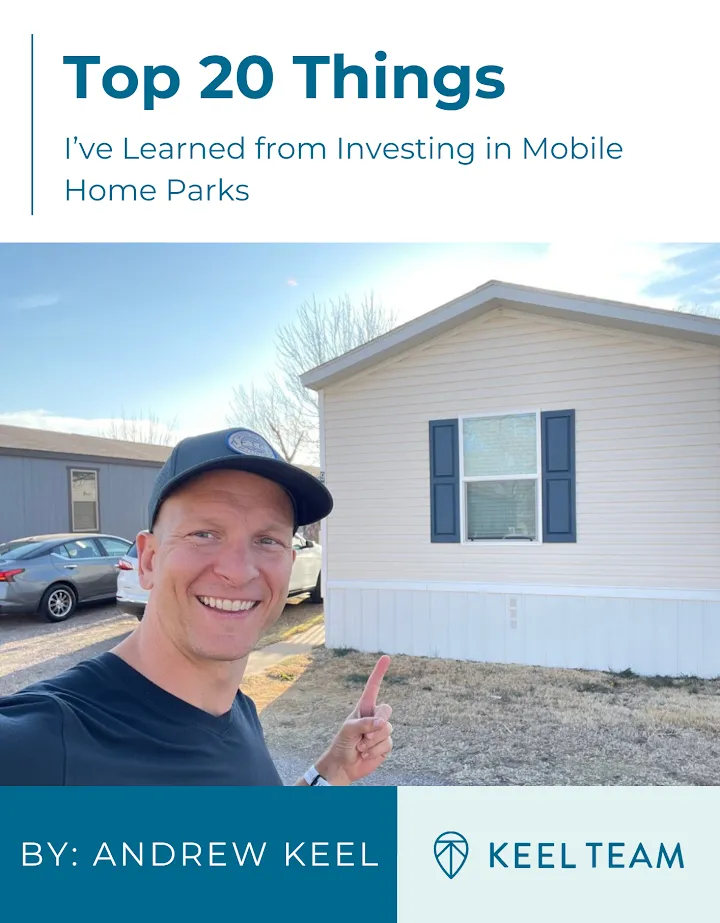
Download our FREE eBook on the Top 20 things to know BEFORE investing in mobile home parks!
Recession Resistance
Mobile home parks could perform well during economic downturns. As housing costs rise, more people may turn to mobile homes for affordability. During past recessions, mobile home parks often maintained high occupancy rates, as tenants prioritized cost-effective living. This resilience might make them a safer bet in uncertain economic times.
Value-Add Opportunities
Mobile home parks often present opportunities to increase value. Investors might raise lot rents to market rates, fill vacant lots with new homes, or add amenities like playgrounds or community centers. For instance, purchasing a 44-unit mobile home park for $385,000 and increasing its value to $1.3 million is possible by improving infrastructure and raising rents. Such strategies could significantly boost net operating income potential.
The Cons of Investing in Mobile Home Parks
Financing Challenges
Securing financing for mobile home parks can be difficult. Many lenders may view these properties as riskier than traditional real estate, leading to stricter loan terms or higher interest rates. Commercial loans might require 25–30% down payments, and some banks may avoid mobile home park deals altogether. Seller financing or syndications could help, but these options may limit your choices or involve complex partnerships.
Infrastructure Risks
Older mobile home parks might have outdated utilities, such as private septic systems or master-metered electric grids. These issues could lead to costly repairs, with septic system replacements potentially exceeding $50,000. Investors should conduct thorough due diligence, including utility inspections, to avoid unexpected expenses. Neglecting these risks might erode profits.
Management Demands
Managing a mobile home park could be time-intensive. Tasks like tenant screening, rent collection, and maintenance oversight might require active involvement or hiring a property manager, which could cost 8–10% of gross revenue. Additionally, tenant disputes or evictions, though rare, might demand careful handling to comply with local regulations. Investors unprepared for these responsibilities could face operational challenges.
Negative Stigma
Mobile home parks sometimes carry a negative stereotype, often associated with “trailer parks” or low-income housing. This stigma might deter potential tenants or complicate community relations. Investors may need to invest in rebranding efforts, such as upgrading amenities or marketing the property as a vibrant community, to attract quality tenants. Overcoming public perception could require time and resources.
Regulatory and Zoning Hurdles
Mobile home parks are subject to local zoning laws and regulations, which might restrict expansion or rent increases. Some municipalities may impose moratoriums on new mobile home park development, limiting supply but also complicating approvals for upgrades. Investors should research local policies carefully, as non-compliance could lead to fines or legal issues.
Key Considerations for 2026
Market Trends
In 2026, mobile home parks continue to attract significant institutional capital, with private equity firms and REITs competing for quality assets in secondary and tertiary markets. Recent transactions show cap rate compression in the 5–7% range for stabilized communities, reflecting strong investor demand. The number of manufactured housing communities has declined over the past decade due to redevelopment pressure, meaning supply is constrained while demand for affordable housing remains near record highs — a structural tailwind that distinguishes mobile home parks from most other real estate asset classes.
For passive investors considering a mobile home park syndication investment, 2026 presents an environment where experienced operators with proven deal flow are well-positioned to capitalize on motivated sellers — particularly smaller, family-owned mobile home parks in the Southeast and Midwest where owners are aging out of the business.
2026 Deal Flow and Acquisition Environment
After two years of elevated interest rates suppressing deal volume, 2026 has brought a meaningful increase in mobile home park transaction activity. As financing costs have stabilized and sellers — many of them aging operators who’ve owned communities for decades — have adjusted price expectations, motivated sellers are re-entering the market. Off-market deal flow has improved noticeably in the Southeast and Midwest, particularly in North Carolina, Tennessee, and South Carolina, where population growth and affordability demand remain strongest. Buyers with direct-to-seller outreach programs and strong lender relationships are finding attractive entry points that weren’t available in 2023-2024.
The supply side of the equation continues to work in investors’ favor: zoning restrictions and community opposition have made it nearly impossible to develop new manufactured housing communities in most markets. According to industry data, the total number of land-lease communities in the U.S. has declined by approximately 20% over the past two decades. This structural supply constraint — combined with growing demand for affordable housing — creates a durable tailwind for existing mobile home park operators and investors that distinguishes this asset class from nearly every other form of commercial real estate.
Economic Factors
Rising interest rates and inflation could impact mobile home park investments. Higher borrowing costs might reduce purchasing power, while inflation could increase operating expenses. However, the demand for affordable housing is likely to remain strong, potentially offsetting these pressures. Monitoring economic indicators might guide your timing and strategy. For more, see our complete guide to mobile home park investing.
Tariff Uncertainty and Construction Cost Insulation in 2026
One underappreciated advantage of mobile home park investing in 2026 is its structural insulation from construction cost volatility. Unlike apartment developers or fix-and-flip operators who depend on new construction materials, most mobile home park investors are not building — they’re operating land-lease communities where the physical homes are owned by residents. This means the tariff-driven inflation in lumber, steel, and imported building materials that has squeezed other real estate investors throughout 2025 and 2026 has limited direct impact on mobile home park operating costs. The land-lease model is a structural hedge against construction cost inflation that is particularly relevant right now.
Ethical Considerations
Investors should consider the social impact of their decisions. Raising lot rents to maximize profits could strain tenants, many of whom rely on mobile homes for affordable living. Balancing profitability with tenant well-being might foster long-term stability and community goodwill. For example, offering gradual rent increases or investing in amenities could maintain tenant satisfaction.
How to Get Started
If you’re considering mobile home park investing in 2026, start by researching markets with high demand for affordable housing, such as rural areas or regions with rising home prices. Network with brokers specializing in mobile home parks and attend industry events to find deals. Use tools like rental property calculators to evaluate potential returns, aiming for cap rates around 8–10%. Finally, partner with experienced inspectors and legal advisors to navigate due diligence and regulatory requirements. For more, see our how to invest in mobile home parks.
Is Mobile Home Park Investing Right for You?
Mobile home park investing in 2026 could offer compelling opportunities, with potential for high cash flow, tax benefits, and recession resistance among the key draws. However, financing challenges, infrastructure risks, and management demands may require careful planning. By weighing these common pros and cons, you can decide if this niche aligns with your financial goals and risk tolerance. With thorough research and strategic execution, mobile home parks might become a valuable addition to your investment portfolio.
Download our FREE eBook — Top 20 Things to Know BEFORE Investing in Mobile Home Parks. Get insider insights from operators who’ve acquired and managed hundreds of communities.
Frequently Asked Questions
What are the biggest advantages of investing in mobile home parks?
The biggest advantages of investing in mobile home parks include strong cash flow potential (since tenants own their homes and only pay lot rent), lower maintenance costs compared to traditional rental properties, recession resistance driven by demand for affordable housing, and significant value-add opportunities through rent optimization and occupancy improvements. Mobile home parks also benefit from a supply constraint — no new communities are being built at meaningful scale — which supports long-term appreciation. For more, see our why mobile home parks outperform other asset classes.
How difficult is it to get financing for a mobile home park?
Financing a mobile home park can be more complex than traditional residential real estate. Many conventional lenders shy away from these assets, so investors often rely on community banks, credit unions, agency loans (Fannie Mae/Freddie Mac for larger communities), or seller financing. Down payments typically range from 20–30%. Understanding your financing options for mobile home park investing before making an offer is essential to a successful acquisition.
What is lot rent and how does it affect mobile home park returns?
Lot rent is the monthly fee residents pay to lease the land their home sits on — they own the home, the investor owns the land. In 2026, average lot rents range from $350 to $700+ per month depending on location and amenities, though many older communities still charge below-market rates. Bringing lot rents to market is one of the primary value-add strategies in mobile home park investing and a key driver of net operating income growth. Learn more about lot rent and mobile home park basics.
Can I invest passively in mobile home parks without managing them myself?
Yes — through mobile home park syndications, passive investors can invest capital alongside an experienced operator who handles all acquisition, management, and improvement decisions. Returns to passive investors typically come from quarterly cash flow distributions, equity appreciation upon sale, and potential tax benefits through depreciation pass-throughs. This is an increasingly popular approach for accredited investors who want exposure to mobile home park returns without the operational demands. Learn more about passive mobile home park investing.
What should I look for when evaluating a mobile home park investment?
When evaluating a mobile home park investment, key factors include: city water and city sewer (avoid private wells and septic systems which carry major risk), occupancy rate and lot rent versus market rate, proximity to employment centers and major metro areas, the condition of roads and infrastructure, and whether homes are tenant-owned (preferred) versus park-owned. A thorough mobile home park valuation is critical before making any offer.
Mobile Home Park Investing Outlook: 2026 and Beyond
The manufactured housing sector continues to show resilience heading into the second half of 2026. With single-family home affordability near historic lows and rental rates elevated across major metros, demand for mobile home park lots remains structurally strong. Interest rate normalization has improved deal economics compared to the 2021–2022 cap rate compression era, and motivated sellers — many of them aging mom-and-pop operators — are creating off-market opportunities for disciplined buyers. Operators with defined acquisition criteria and direct-to-owner sourcing pipelines are finding 2026 to be one of the more favorable entry environments of the past decade.
Frequently Asked Questions
What is a realistic return expectation for mobile home park investing?
Most experienced operators target cash-on-cash returns of 7–10% annually during the hold period, with total IRRs (including appreciation at exit) in the 12–18% range depending on deal quality, market, and leverage. Value-add deals in secondary markets can outperform; stabilized parks in competitive markets typically land at the lower end. Returns are highly operator-dependent — the same park can deliver dramatically different outcomes based on management quality and capital allocation.
Is mobile home park investing passive?
It depends on your role. As a general partner or active operator, it involves significant hands-on work — managing teams, capital projects, and investor relations. As a limited partner in a syndication, it is largely passive: you provide capital, receive quarterly distributions, and review periodic reports without managing the property. Most new investors explore the passive LP structure first before considering active operations. Learn more: Active vs. Passive Mobile Home Park Investing.
What are the biggest risks in mobile home park investing?
The most common risks include: (1) infrastructure liability — parks with private wells or septic systems carry significant EPA compliance exposure; (2) low occupancy — parks under 70% occupied require substantial lease-up capital and effort; (3) market risk — parks far from employment centers can struggle with retention; (4) operator execution risk — in syndications, limited partners depend on the GP’s ability to execute the business plan. Pricing these risks correctly is the core competency of successful mobile home park investing.
How much capital do I need to start investing in mobile home parks?
As a passive LP in a mobile home park syndication, minimum investments typically range from $25,000 to $100,000. Buying a park directly as an active operator generally requires $200,000–$500,000+ in equity capital depending on park size and financing. Some smaller parks in tertiary markets can be acquired for less, but parks with fewer than 50 lots are generally too small to support professional management at acceptable returns.
How are mobile home parks valued?
Mobile home parks are primarily valued using the income approach — specifically the cap rate method applied to net operating income (NOI). Lot rent is the primary revenue driver. Cap rates for stabilized mobile home parks in desirable markets currently range from approximately 5–7%, with value-add parks priced higher to compensate for operational risk. For a detailed breakdown, read: How to Value a Mobile Home Park: Step-by-Step Guide.
Disclaimer:
The information provided is for informational purposes only and is not investment advice or a guarantee of any kind. We do not guarantee profitability. Make investment decisions based on your research and consult registered financial and legal professionals. We are not registered financial or legal professionals and do not provide personalized investment recommendations.