Ask any experienced mobile home park investor what they check first when evaluating a deal, and utility infrastructure will be near the top of the list — often at the top. The type of water and sewer system serving a mobile home park affects everything: operating expenses, regulatory compliance burden, lender appetite, cap rate, and long-term asset value.
Yet utility due diligence is consistently underestimated by first-time buyers. Sellers frequently minimize system issues. And the cost of getting this wrong can run from $200,000 to over $2 million in capital expenditures — sometimes after closing.
This guide breaks down every utility configuration you’ll encounter, what each one means for your investment, and exactly what to check before you commit to a deal.
The Four Utility Configurations You’ll Encounter
Mobile home parks run on one of four basic utility setups, ranging from least risky to most complex:
- City water + city sewer — The gold standard. Municipal systems handle water delivery and wastewater treatment. The park pays utility bills and passes costs through to residents.
- City water + private sewer — Municipal water supply, but the park owns and operates a private septic system, lagoon, or on-site wastewater treatment plant.
- Private well + city sewer — The park operates its own well system but connects to the municipal sewer line. Less common but manageable with proper maintenance.
- Private well + private sewer — The park handles both water production and wastewater treatment on-site. This configuration carries the highest risk profile and the heaviest regulatory burden of the four.
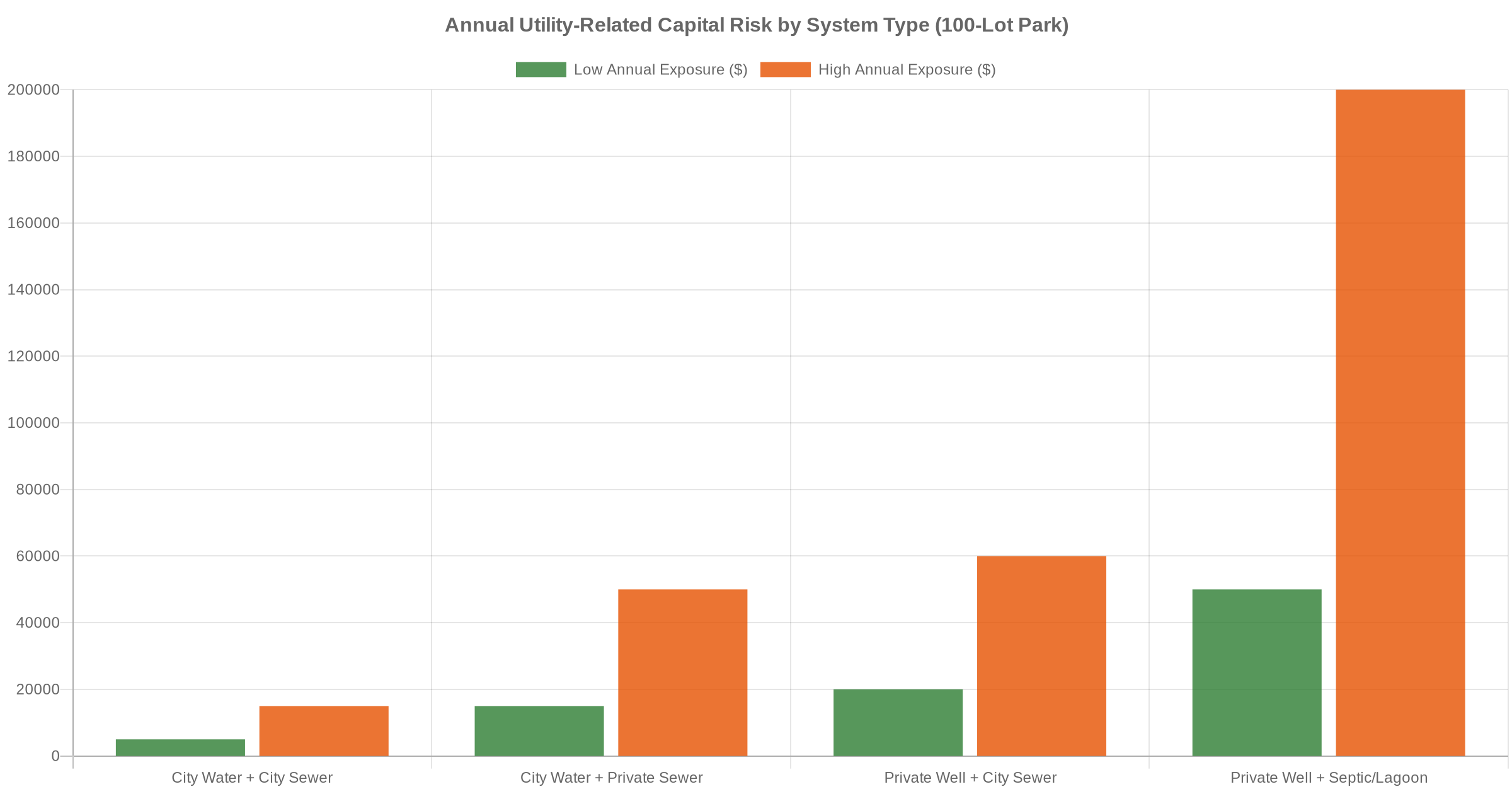
The chart below illustrates the range of annual utility-related capital exposure by system type for a 100-lot mobile home park. The difference between city/city and private/private can be staggering:
Why City Water and City Sewer Is the Gold Standard
For most mobile home park investors — especially those building a portfolio rather than buying a single asset — city water and city sewer is the preferred configuration, and for good reason.
No infrastructure ownership liability. When the municipality owns the water and sewer lines up to the park’s connection point, the park operator isn’t responsible for treatment plant operations, regulatory compliance filings, or capital investment in aging infrastructure. A main line break becomes the city’s problem, not yours.
Predictable utility expenses. Municipal utility bills are metered and consistent. You can budget accurately, pass costs through to residents via sub-metering or a ratio utility billing system (RUBS), and model your NOI with confidence.
Lender preference. Agency lenders — Fannie Mae and Freddie Mac — strongly prefer parks on city water and sewer. Getting financing on a private-system property is possible but harder, requires more equity, and often comes with higher interest rates. This affects your exit as much as your entry.
Tenant quality and marketability. Residents have increasingly high expectations around water quality. Parks on municipal systems can market clean, consistent water as a community amenity. Parks on private wells with water quality issues face resident complaints, potential liability, and higher turnover.
The practical threshold: if you’re evaluating a mobile home park with 50+ lots within an hour of a major metro, city water and city sewer should be a non-negotiable minimum. There are too many good deals on city utilities to take on unnecessary infrastructure risk.
Private Water Systems: The Regulatory and Financial Reality
Private well systems serving mobile home parks are regulated under the federal Safe Drinking Water Act (SDWA). If a private water system serves 25 or more people or 15 or more service connections, it qualifies as a “public water system” under SDWA — meaning it’s subject to federal and state regulations covering testing, reporting, certified operators, and treatment standards.
The compliance picture is sobering. Industry data suggests that nearly 70% of mobile home parks with private water systems have violated SDWA rules at some point in the past five years. These violations range from minor reporting lapses to serious contamination events. Any time you see a private water system, assume you need a full compliance audit before closing.
PFAS contamination: the 2026 wild card. Per- and polyfluoroalkyl substances (PFAS) — known as “forever chemicals” due to their persistence in soil and water — now have federal primary drinking water standards that regulate their levels in public water systems, including mobile home park private wells. The compliance deadline for most systems is April 2029.
If you’re buying a park with a private well, order a baseline PFAS screen as part of your Phase II environmental assessment. Contamination found after closing becomes your liability. Remediation costs can reach six figures or more, and there’s no guarantee the well can be brought into compliance without connecting to a municipal system — an expense that can easily reach $500,000 to $1.5 million depending on proximity.
Certified operator requirement. Most states require that private water systems serving mobile home parks employ or contract with a certified water system operator. This is an ongoing operating expense many first-time buyers overlook in their underwriting. Budget $800 to $2,500 per month for a certified operator contract, depending on system complexity.
Two decades of hard-won lessons distilled into one free guide. Whether you’re evaluating your first deal or your fiftieth, these insights will sharpen your approach.
Lagoons, Septic Systems, and Wastewater Treatment Plants: Understanding the Risks
On the wastewater side, three private configurations appear in mobile home parks: conventional septic systems (drain fields), sewage lagoons, and on-site wastewater treatment plants (WWTPs). Each carries distinct risk profiles.
Conventional septic systems work by distributing treated wastewater into a drain field. They’re the most common private wastewater solution and the most manageable — provided the drain field has adequate capacity for the park’s current population and isn’t failing. A failing drain field requires full replacement, which can cost $75,000 to $250,000 depending on lot count and soil conditions. During due diligence, get a professional inspection of every component: tanks, distribution boxes, and the drain field itself.
Sewage lagoons — open-air pond systems that treat wastewater through natural biological processes — are still operating in thousands of older mobile home parks across the Southeast and Midwest. They were commonly approved in the 1970s and 1980s but are increasingly subject to environmental scrutiny. Many states are phasing them out, requiring operators to connect to municipal sewer systems or install modern treatment plants. If you’re buying a park with a lagoon, model the cost of municipal sewer connection into your acquisition price or negotiate a significant price reduction.
On-site wastewater treatment plants are the most capital-intensive private option. These systems require licensed operators, regular chemical inputs, state inspection programs, and periodic capital upgrades. Annual operating costs for a 100-lot park WWTP can run $40,000 to $80,000, and major equipment replacement — aerators, blower systems, UV treatment components — adds sporadic capital events that are difficult to predict.
How Utility Type Affects Financing, Cap Rates, and Asset Value
The financial implications of utility type extend well beyond operating expenses. Utility configuration affects how lenders underwrite your deal, what cap rate the market assigns, and how easily you can exit.
Financing impact. As noted above, agency debt (Fannie Mae, Freddie Mac) is strongly preferred by most mobile home park operators because of its low rates and long amortization periods. Both agencies have published guidelines that favor parks on municipal utilities and may decline to lend — or require significant reserves — on parks with private water or wastewater systems. Community banks and bridge lenders will finance private-system parks, but at higher rates and lower LTV ratios, increasing your equity requirement and reducing your cash-on-cash return. For a deeper dive on loan types and requirements, see our Mobile Home Park Financing Guide 2026.
Cap rate differential. The market applies a risk premium to private-utility parks. All else being equal, a 100-lot park on city water and sewer will trade at a lower (tighter) cap rate than an equivalent park on a private well and lagoon. That premium can range from 50 to 150 basis points — which translates directly into a purchase price discount that must offset the ongoing risk and capital exposure the buyer is accepting.
Exit and buyer pool. When you eventually sell, your buyer pool for a private-utility park is narrower. Institutional buyers and larger operators almost universally require city water and sewer. Selling to a more limited buyer pool typically means longer time on market and lower final pricing. If your business plan involves a 5–7 year hold and a clean exit to an institutional or semi-institutional buyer, utility configuration matters at acquisition.
Utility Due Diligence: What to Check Before You Close
Whether you’re buying a city-utility or private-utility property, here’s the core utility due diligence checklist every investor should work through:
For City Water and Sewer Properties
- Confirm the park’s connection to municipal systems with written verification from the utility authority
- Review 24 months of utility bills to identify unusual spikes (indicators of leaks or billing errors)
- Confirm sub-metering or RUBS billing is in place — if not, quantify the value-add opportunity
- Inspect meter pits, common-area irrigation systems, and internal distribution lines for condition
- Verify water pressure adequacy across the community (low pressure affects resident satisfaction and home values)
- Confirm the sewer lateral connection is functional and up to code
For Private Water Systems
- Request complete SDWA compliance history from the state environmental agency — violations are public record
- Commission an independent engineering assessment of the well, pump systems, storage tanks, and distribution lines
- Order a comprehensive water quality test panel including PFAS, nitrates, bacteria, and heavy metals
- Verify certified operator contract is current and transferable
- Confirm the system has adequate capacity for 100% occupancy at current and planned lot counts
- Assess the cost and feasibility of connecting to a municipal water system as a contingency
For Private Wastewater Systems
- Retain a licensed septic/wastewater engineer to inspect all components
- Review all state environmental inspection reports and any outstanding violations
- For lagoons: confirm regulatory status and whether the state has issued phase-out timelines
- Model municipal sewer connection costs as part of your acquisition pro forma
- Understand discharge permit requirements and upcoming renewal dates
For a comprehensive framework covering all aspects of mobile home park due diligence — not just utilities — see our Mobile Home Park Due Diligence Checklist: 25 Things to Verify Before You Buy. For environmental-specific due diligence including Phase I and Phase II assessments, see our Mobile Home Park Environmental Due Diligence Guide.
Making the Utility Decision: When Private Systems Are Acceptable
This isn’t to say that private-utility mobile home parks should never be purchased. Plenty of experienced operators build strong returns from parks on private water or wastewater systems. But doing so requires:
- Accurate pricing. The acquisition price must fully reflect the ongoing capital costs and operational complexity of private systems. Don’t accept a seller’s proforma that treats a private well like a city water hook-up.
- Adequate reserves. Budget for infrastructure replacement, not just ongoing maintenance. Wells can fail. Drain fields can saturate. Lagoon regulatory risk can materialize with little warning.
- Clear capital improvement path. The best private-utility acquisitions have a visible path to municipal connection as a value-add play — buy at private-utility pricing, connect to city systems over a 2–3 year period, and exit at city-utility cap rates.
- Operator expertise. Running a private water or wastewater system requires specialized knowledge or reliable contractor relationships. This isn’t a task to wing.
For passive investors evaluating a mobile home park syndication, utility type is one of the first questions to ask the sponsor. A well-run general partner will have a clear answer and a documented capital plan for any non-city utility systems in their portfolio.
10 video modules, a 55-page master checklist, and 9 ready-to-use templates that walk you through every step of evaluating a mobile home park deal — from the first site visit to closing day.
Conclusion
Utility infrastructure is not a secondary due diligence item. For mobile home parks, it’s foundational. The type of water and sewer system serving a community affects your operating expenses, your regulatory exposure, your lender options, your cap rate, and your exit strategy.
City water and city sewer is the gold standard for a reason: it limits your liability, simplifies operations, maximizes your buyer pool, and keeps institutional lenders at the table. When evaluating deals with private utility systems, apply rigorous engineering assessments, accurate capital budgeting, and pricing discipline that reflects the real risk you’re taking on.
The investors who consistently win in mobile home park acquisitions aren’t just good at finding deals — they’re thorough evaluators who know exactly what they’re buying. Utilities are where undisciplined buyers lose money and disciplined buyers find their edge.
Get the top 20 lessons from two decades of mobile home park investing — free.
Frequently Asked Questions
Is city water and city sewer required to get agency financing on a mobile home park?
Not strictly required, but strongly preferred. Fannie Mae and Freddie Mac agency programs favor municipal utility connections and often require additional reserves or impose loan conditions on parks with private water or wastewater systems. Some private-system parks can still qualify, but the lender universe is narrower and rates are generally higher.
What does it cost to connect a mobile home park to a municipal water or sewer system?
Connection costs vary significantly based on proximity to existing municipal infrastructure. A park located adjacent to a city water main might connect for $50,000–$150,000. A park two miles from the nearest sewer line could face costs of $500,000–$2 million or more. Always get a licensed civil engineer to assess connection feasibility and cost before factoring it into your pro forma.
What is a RUBS system and how does it relate to utilities?
RUBS stands for Ratio Utility Billing System. Instead of installing individual sub-meters, a RUBS system allocates the park’s master-metered water bill across residents based on a formula (typically occupancy or square footage). It’s a common and legal method used in mobile home parks to pass water costs to residents. Sub-metering is generally more accurate and preferred where possible, but RUBS is widely used when installing individual meters would be cost-prohibitive.
What is PFAS and why does it matter for mobile home park investors in 2026?
PFAS (per- and polyfluoroalkyl substances) are synthetic chemicals that persist in soil and groundwater. The EPA established new federal primary drinking water standards for several PFAS compounds that apply to public water systems — including mobile home park private wells meeting the size threshold. The compliance deadline is April 2029. If a private-well park tests positive for PFAS above the new limits, remediation costs can be substantial. Any deal involving a private well should include a PFAS screen as part of due diligence.
How does utility type affect the value of a mobile home park?
Utility type affects value through two channels: NOI (lower expenses on city utilities vs. ongoing private system costs) and cap rate (market applies a risk premium to private-utility parks). A park generating $200,000 NOI on city utilities might trade at a 7% cap rate ($2.86M value). The same NOI on a private well and lagoon might trade at 8.5% ($2.35M value) — a half-million-dollar difference driven purely by utility configuration.