If you’ve been tracking the mobile home park investing space over the last few years, you already know that affordable housing is under a national spotlight. Lot rents have climbed. Occupancy rates have hit multi-decade highs — currently around 94% nationally, up from 86.5% a decade ago. And with that success has come something every mobile home park investor and operator needs to pay close attention to in 2026: a shifting regulatory landscape.
Mobile home park regulations 2026 represent one of the most significant due diligence factors for buyers, operators, and passive investors alike. This post breaks down the key legislative trends, which states are moving fastest, and what you should be doing about it — whether you own a community, are evaluating a deal, or are considering passive investment in a mobile home park syndication.
Why Regulators Are Paying Closer Attention to Mobile Home Parks
The economics are undeniable. As housing affordability crises have deepened across the country, mobile home park residents — many of whom own their homes but rent the land beneath them — have found themselves uniquely vulnerable to displacement. When an operator raises lot rent or announces a park closure for redevelopment, residents often have nowhere affordable to go. Their homes, which typically cannot be easily moved, may lose all practical value.
Media coverage of high-profile closure events — including the widely-discussed Cary, North Carolina displacement case — has accelerated political momentum. State legislatures have taken notice, and 2026 has brought a meaningful wave of new proposals and enacted laws targeting manufactured housing communities.
This does not mean mobile home parks are a bad investment. It means the regulatory environment is now a first-class due diligence item that belongs in every underwriting model.
The 4 Major Regulatory Trends Reshaping Mobile Home Park Investing in 2026
1. Extended Notice Requirements for Closure and Redevelopment
Several states have extended or introduced minimum notice periods before a mobile home park owner can close a community or convert it to another use. Where a 90-day notice was once standard, many states now require 12 months — and some proposals push toward 24 months or longer.
For investors evaluating a mobile home park deal with a value-add or redevelopment thesis, this directly affects the exit timeline and carrying cost assumptions. For a full walkthrough of how to value a deal, see our guide on how to value a mobile home park step by step. Underwriting should account for extended hold periods if closure or conversion is even a remote possibility.
2. Right of First Refusal (ROFR) Laws
Right of first refusal legislation is one of the most consequential mobile home park regulatory trends of 2026. Under ROFR laws — now enacted in states including Colorado, Oregon, Minnesota, and Maryland — when a mobile home park goes up for sale, residents or a qualified housing organization must be given the opportunity to purchase it first, on the same terms as the winning offer.
In practice, this typically adds 60 to 90 days to a transaction timeline and introduces deal uncertainty if a resident association or nonprofit decides to exercise the right. For buyers, this means:
- Purchase agreements must include ROFR-specific contingency language
- Closing timelines need to be structured accordingly
- Sellers should be educated upfront on their disclosure obligations
Several additional states have active legislation in committee for 2026. When evaluating a deal in any target state, verify the current ROFR statute before going under contract.
3. Rent Stabilization and Lot Rent Increase Caps
Rent stabilization proposals targeting mobile home parks have gained legislative traction in 2026. While most remain proposals rather than enacted law, several municipalities — particularly in Florida, California, and the Pacific Northwest — have implemented or are actively debating caps on annual lot rent increases.
Florida, where lot rents have grown at 5.5% to 11% annually in recent years, has seen especially intense political debate on this front. For passive investors, this matters because lot rent growth is the primary lever for NOI improvement in most mobile home park acquisitions. If growth is capped at a statutory level, return projections in an offering document need to be stress-tested against more conservative rent assumptions.
4. Relocation Assistance Mandates
Some states and localities now require mobile home park owners to fund relocation assistance for displaced residents in closure scenarios. Amounts vary widely — from a few thousand dollars per household to requirements tied to actual moving costs — but the trend is clearly toward greater financial responsibility for operators.
These mandates are worth quantifying when underwriting any mobile home park deal that includes redevelopment optionality in the business plan. What was once a minor footnote can represent a material liability that simply did not exist in deals closed five or six years ago.
📋 The MHP Due Diligence Playbook
10 video modules, a 55-page master checklist, and 9 ready-to-use templates that walk you through every step of evaluating a mobile home park deal — including how to assess regulatory risk in your target market before you sign a letter of intent. Get the Playbook →
State-by-State Regulatory Risk Snapshot
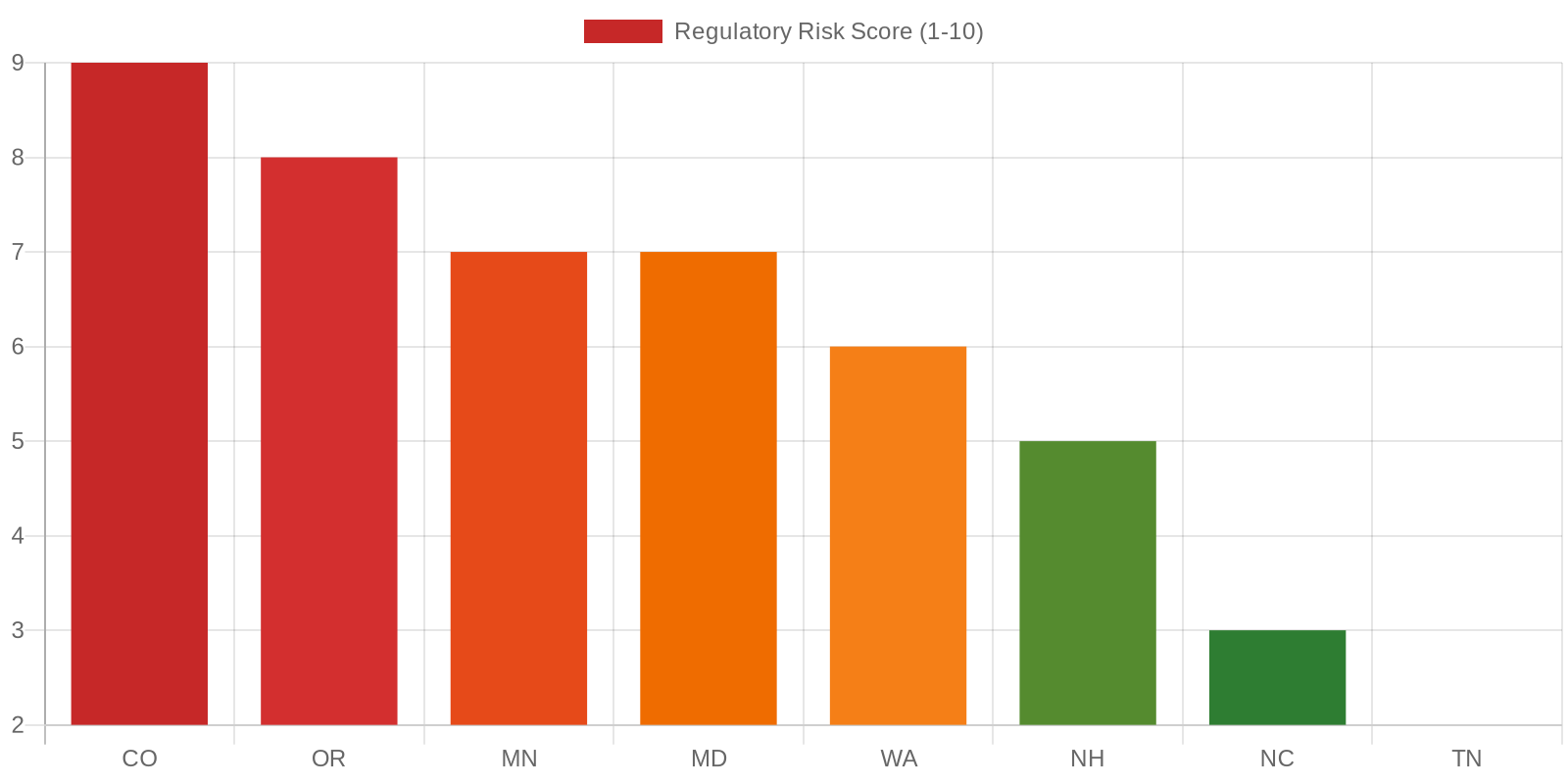
Not all states are moving at the same pace. Here is a quick snapshot of the regulatory environment across key markets:

- Colorado: Among the most active regulatory states. ROFR law enacted and enforced. Extended notice requirements in place. Highest current regulatory burden for operators.
- Oregon: Active ROFR statute with strengthened rent increase notice requirements. Continued legislative activity expected through 2026.
- Minnesota: ROFR enacted. Resident association rights are among the strongest in the country.
- Maryland: ROFR law passed. Relocation assistance requirements apply in closure scenarios.
- Washington: Active 2026 legislative session with several proposals pending. Mid-tier risk.
- New Hampshire: ROFR enacted but with a less robust enforcement mechanism compared to western states. Moderate risk.
- North Carolina: No ROFR law currently enacted. No statewide rent stabilization. One of the more operator-friendly regulatory environments in the country — a key reason it remains an attractive acquisition market.
- Tennessee: Minimal current regulation. Landlord-friendly statutory environment. No enacted ROFR legislation as of Q1 2026.
For buyers focused on the Southeast — North Carolina, Tennessee, Georgia, and South Carolina — the regulatory environment remains relatively favorable for operators with responsible practices. This is one structural advantage of targeting these markets for mobile home park acquisitions in 2026.
What This Means for Deal Underwriting
Regulatory due diligence is no longer a footnote. Here is how experienced buyers are building it into their process:
- State statute review before LOI: Confirm whether ROFR, extended notice, or rent stabilization laws apply in the target jurisdiction before sending a letter of intent. This takes 30 minutes and can prevent months of wasted effort.
- Resident organization status check: In ROFR states, determine whether an active resident organization exists and whether they have the financial capacity — or nonprofit partnerships — to exercise purchase rights.
- Lot rent growth sensitivity analysis: Run base, moderate, and conservative rent growth scenarios. In regulated markets, the conservative case may be the only scenario worth underwriting to.
- Closure liability quantification: If redevelopment is part of the thesis, calculate the relocation assistance liability under applicable state law and include it in your total cost basis.
- Manufactured housing attorney review: Work with a real estate attorney who specializes in manufactured housing law when drafting purchase and sale agreements in ROFR-active states.
How Responsible Operators Are Getting Ahead of Regulation
The most forward-thinking mobile home park operators are not waiting for legislation to force their hand. They are proactively building practices that reduce regulatory exposure and community tension:
- Transparent communication: Regular newsletters, community meetings, and direct channels with residents reduce the fear and uncertainty that tends to drive political pressure in the first place.
- Predictable, gradual rent increases: Operators who communicate planned rent schedules well in advance — and explain the capital improvements those increases fund — face far less resident blowback than those deploying large, sudden increases.
- Community investment: Improving roads, lighting, landscaping, and amenities alongside lot rent increases demonstrates reinvestment rather than extraction. It also makes communities more defensible in any regulatory hearing.
- Resident engagement programs: Some operators have proactively offered residents purchase options or right-of-first-opportunity programs before any regulation required it, building durable goodwill and regulatory goodwill simultaneously.
This is not just altruistic — it is smart business. Communities with strong resident relationships attract less regulatory scrutiny, maintain higher occupancy through transitions, and command better multiples on exit.
What Passive Investors Should Ask Sponsors
If you are evaluating a mobile home park syndication as a limited partner, the regulatory environment in the target state belongs in your diligence conversation with the sponsor. Good questions to ask:
- Does a right of first refusal law apply in this state, and how did it affect the acquisition timeline?
- What is the current lot rent relative to local market, and what is the projected annual growth rate? How does that compare to any rent stabilization proposals active in this jurisdiction?
- Does the business plan include any closure, conversion, or redevelopment scenario — and if so, what is the estimated relocation liability under applicable state law?
- What is the sponsor’s track record and policy for resident communication and community investment?
A sponsor who can answer these questions with specific data and a thoughtful operations philosophy is a sponsor who has genuinely done their regulatory homework.
The Bottom Line
Mobile home park investing remains one of the most compelling asset classes in real estate heading into the second half of 2026 — with strong national occupancy, severely constrained new supply, durable cash flow, and affordable housing demand that is not going away. But the regulatory environment is meaningfully more complex than it was five years ago, and investors who treat it as an afterthought do so at their own risk.
The good news: most of the regulatory risk is geographic, manageable, and priceable. Smart state selection, rigorous legislative due diligence before going under contract, and responsible community operations go a long way toward building a mobile home park portfolio that performs well and stays out of the headlines.
If you would like to learn more about mobile home park investing and how we think about risk and opportunity in today’s market, we would love to connect. Reach out here and we will set up a call.
📋 Ready to Evaluate Your Next Deal?
Get the MHP Due Diligence Playbook — the complete system for analyzing mobile home park acquisitions with confidence, including regulatory due diligence templates for every target state. Get the Playbook →