Picture this: you close on a 90-lot mobile home park. The numbers look solid. Cap rate checks out. NOI supports the purchase price. You feel good about the deal.
Then the first water bill arrives.
$9,200. For one month. And your residents pay nothing.
Welcome to one of the most overlooked — and most expensive — problems in mobile home park investing: the master-metered park trap. If you’re an operator dealing with this, you already know the pain. If you’re evaluating a deal right now, keep reading before you close.
Before you close on any mobile home park — master-metered or otherwise — you need a system. The MHP Due Diligence Playbook includes 10 video modules, a 55-page master checklist, and 9 ready-to-use templates that walk you through every step of evaluating a deal — including a full utility infrastructure audit. Don’t skip it.
What “Master Metered” Actually Means — And Why It Hurts
In a master-metered mobile home park, the owner pays a single consolidated water and sewer bill from the municipality (or manages a private well and wastewater system). Residents pay one flat lot rent and face zero individual accountability for water usage.
The parks most likely to carry this structure are those built before 1980, when it was the standard construction model. Sellers of these parks often normalize utility expenses in their pro formas — or bury them in operating costs — making acquisition economics look better than they are.
In reality, master-metered means you’re providing unlimited free water to every resident in your community. The consequences follow predictably:
- Consumption runs 20–40% higher than in individually-metered parks
- You bear 100% of the cost with no pass-through to residents
- Leaks go undetected for weeks or months — you only see the bill spike
- There is zero behavioral incentive for conservation
The Real Cost: A Number That Should Shock You
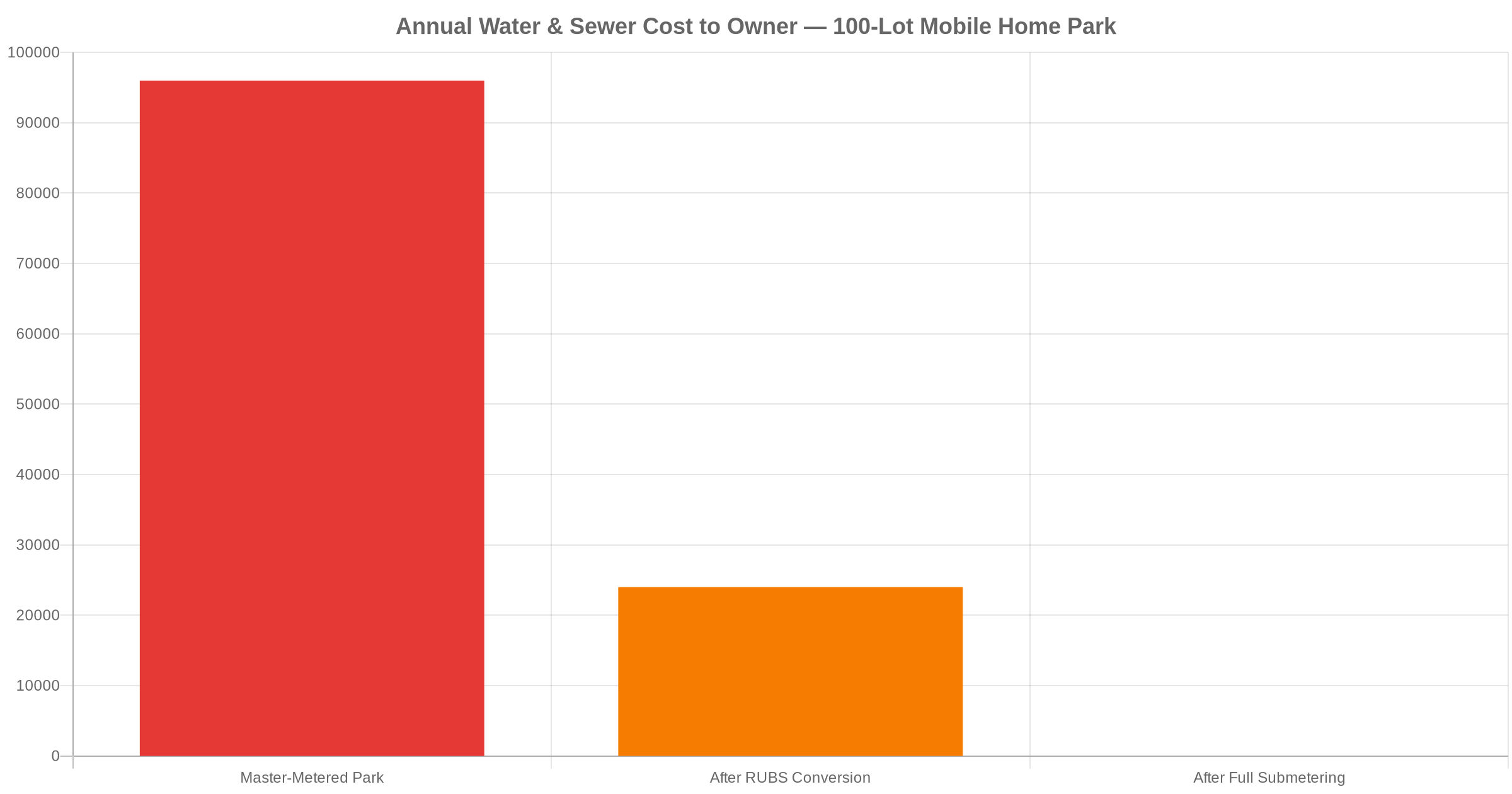
A 100-lot mobile home park in the Southeast commonly pays $6,000–$10,000 per month for water and sewer. That’s $72,000–$120,000 per year coming straight out of net operating income.
Let that sink in at a 7% cap rate. That utility expense represents $1.0 million to $1.7 million of value destruction — value that could be recovered by simply passing through utility costs to residents.
This isn’t a rounding error. For many mobile home park owners, it’s the margin between a strong return and a painful one. And because utility expenses are often understated or excluded from seller-provided financials, it’s also one of the most common nasty surprises at the 30-day mark post-closing.
Three Paths to Recovery
Path 1: Individual Submetering — The Gold Standard
Installing individual water meters on each lot, reading them monthly, and billing residents for actual usage is the cleanest solution. Once implemented, residents reduce consumption by 20–30% almost immediately — a well-documented behavioral response to being held accountable for what they use. You stop subsidizing waste entirely.
The cost is real: typically $800–$3,000 per lot for equipment and installation, depending on infrastructure age and local permit requirements. For a 100-lot park, you’re looking at $80,000–$300,000 in capital investment.
ROI timeline: 18–36 months in most markets, depending on current utility spend and what residents will absorb. After break-even, it’s pure NOI improvement — every year, indefinitely.
One critical operational note: use an Automatic Meter Reading (AMR) system rather than manual monthly reads. AMR systems transmit usage data automatically, flag leak spikes in real time, and dramatically reduce labor costs. Companies like Metron-Farnier and Mueller Water Products specialize in manufactured housing community submetering installations.
Path 2: RUBS — The Interim Solution
If submetering capital isn’t available, Ratio Utility Billing System (RUBS) is the next best option. Instead of individual meters, you allocate the consolidated water bill to residents based on a ratio — typically square footage of the home, number of occupants, or a flat per-lot split.
RUBS is legal in most states, but here’s the trap: the rules vary dramatically by jurisdiction, and implementing them incorrectly creates real legal exposure.
At minimum, a compliant RUBS implementation requires:
- A lease addendum explicitly authorizing utility pass-through billing
- Written notice to residents with adequate lead time (30–90 days, depending on your state)
- A documented, consistent calculation methodology
- Monthly billing statements showing the allocation formula
- Compliance with any state-specific caps on pass-through amounts
California, Illinois, New York, and several other states have additional layered requirements. Texas and Florida are comparatively permissive. Before implementing RUBS anywhere, spend $1,500–$3,000 with an attorney familiar with manufactured housing landlord-tenant law in your specific state. It’s cheap insurance against regulatory complaints or tenant-organized pushback.
When properly implemented, RUBS typically recovers 60–80% of utility costs from residents — a meaningful NOI improvement even if it doesn’t reach the clean efficiency of full submetering.
Path 3: Address Private System Risk Before It Becomes a Crisis
If your mobile home park is on a private well and/or lagoon wastewater system, you’re operating in a different risk category altogether.
EPA enforcement on private wastewater systems — particularly aging lagoon systems — has escalated in recent years. Parks receiving EPA notices face expensive consent orders. Connecting to municipal sewer when required by regulators can cost $500,000 to $2,000,000 or more, depending on distance and terrain.
Don’t wait for the notice to arrive. Within the first 90 days of ownership, get an environmental assessment on any private system. Know your risk. And explore USDA Rural Development grants and loans — the Water and Waste Disposal Loan and Grant Program exists specifically to help rural communities (including manufactured housing communities) fund infrastructure upgrades. Most mobile home park operators have never heard of it, which means their competitors haven’t tapped it either.
For a deeper look at infrastructure due diligence, see our guide on how to analyze a mobile home park deal — utility systems are a critical evaluation point.
The Hidden Upside: Leak Detection
One underappreciated benefit of submetering that operators rarely factor into their ROI calculation: you see leaks immediately.
In a master-metered park, a broken line under a home can run for 30–60 days before anyone notices. By the time you see the bill spike, you’ve potentially spent $5,000–$20,000 on water that went into the ground. With individual lot meters, a consumption spike on any single lot triggers an alert within days. You catch it. You fix it. You stop the bleeding.
At Keel Team, individual lot meters have caught leaks that would have cost $15,000–$30,000 in water bills before a master-metered system would have detected anything abnormal. Over a multi-park portfolio, this leak detection benefit alone has been worth hundreds of thousands of dollars.
What to Check During Due Diligence
If you’re evaluating a mobile home park and utility billing hasn’t been on your radar, here’s your minimum checklist before closing:
- Request 24 months of actual utility bills. Not seller estimates. Actual bills from the municipality or utility company. Verify the amounts, look for seasonal spikes, and flag any months that look anomalously low (sellers sometimes pay down balances pre-sale).
- Calculate your true utility cost per occupied lot per month. Anything over $50–$60/occupied lot/month in a master-metered park is a significant red flag. Price it into your offer.
- Research your state’s RUBS and submetering laws before you close — not after. Know exactly what you’re allowed to do, how long the conversion takes, and what resident notification requirements look like.
- Budget for submetering in your CapEx plan. Get a quote. Include it in your proforma as a Year 1 or Year 2 capital project.
- Inspect water mains. Ask the seller when mains were last replaced. Get a camera inspection on systems more than 30 years old. Old galvanized or cast-iron mains in 1960s–70s parks fail catastrophically, and emergency repairs are expensive.
- Ask about private systems explicitly. Is this park on a well? A lagoon? A private wastewater system? These carry environmental risk that changes the deal fundamentally.
Our full due diligence process — including the utility infrastructure checklist — is available in the MHP Due Diligence Playbook. It’s the same process we use across our portfolio of 50+ parks.
The Bottom Line
The master-metered mobile home park isn’t necessarily a deal-killer. But it is a deal-changer — and a massive ongoing cost if you acquire it without a conversion plan.
The operator who closes on a master-metered park and does nothing writes $72,000–$120,000 checks every year, forever. The operator who executes a RUBS conversion in the first 60 days and a full submetering project in Year 1–2 unlocks a six-figure NOI improvement that wasn’t in the acquisition pro forma.
The infrastructure is manageable. The regulatory process is navigable. The ROI is real. What’s not acceptable is being surprised by it — because this is the kind of problem that good due diligence catches before closing, not after.
If you want to see how we evaluate utility systems as part of our acquisition process, or want to compare notes on a RUBS or submetering conversion, reach out — we share what works.
Get the MHP Due Diligence Playbook — the complete system for analyzing mobile home park acquisitions with confidence. 10 video modules, a 55-page master checklist, and 9 ready-to-use templates. Covers utility infrastructure, cap rate validation, market analysis, and everything in between.
Frequently Asked Questions
What is a master-metered mobile home park?
A master-metered mobile home park is one where the owner pays a single consolidated water and sewer bill and residents are not individually billed for utility usage. This is common in parks built before 1980 and creates a significant ongoing cost burden for operators who don’t address it through submetering or a RUBS conversion.
How much can utility billing cost a mobile home park owner?
In a master-metered 100-lot park, annual water and sewer costs commonly run $72,000–$120,000 per year, or $6,000–$10,000 per month. This represents 1.0 to 1.7 million dollars of destroyed asset value at a 7% cap rate — value that is recoverable through utility pass-through billing.
What is RUBS billing for mobile home parks?
RUBS (Ratio Utility Billing System) is a method of allocating a master utility bill across residents based on a proportional formula — typically square footage, occupancy count, or a flat per-lot split. It is legal in most states but requires specific lease language, advance written notice to residents, and a documented calculation methodology. State rules vary significantly; consulting a manufactured housing attorney before implementation is strongly recommended.
How much does submetering a mobile home park cost?
Individual water meter installation typically costs $800–$3,000 per lot, including equipment, labor, and permits. For a 100-lot park, total capital outlay runs $80,000–$300,000. The return on investment is generally 18–36 months, after which the ongoing NOI improvement is permanent.
What USDA programs are available for mobile home park infrastructure upgrades?
The USDA Rural Development Water and Waste Disposal Loan and Grant Program provides financing to rural communities — including manufactured housing communities — for water and wastewater infrastructure improvements. Many mobile home park operators are unaware this program exists. Contact your USDA Rural Development state office to assess eligibility for your park’s location.