More than 20 million Americans call a manufactured housing community home. That’s not a niche statistic — it’s a testament to how essential mobile home parks are to the fabric of American housing. Yet despite this scale, mobile home park investing remains misunderstood by most real estate investors. Many don’t realize that buying and operating these communities can generate strong financial returns and provide genuine social benefit.
In 2026, as the housing affordability crisis intensifies, mobile home park investing sits at an unusual intersection: a real estate asset class that serves the public good while rewarding investors with durable, cash-flowing returns. Here’s why that matters — and what it means for investors thinking about the long-term picture.
The Affordable Housing Crisis Is Real — and Getting Worse
The numbers are stark. The National Low Income Housing Coalition estimates the U.S. has a shortage of more than 7.3 million affordable homes for extremely low-income renters. Across all income levels, roughly 30% of American households are “cost-burdened,” meaning they spend more than 30% of their income on housing.
New construction hasn’t kept pace with demand. Zoning restrictions, labor costs, and land prices have made it nearly impossible to build workforce housing at scale. Traditional affordable housing programs serve only a fraction of the population that needs help. The gap is enormous — and manufactured housing fills much of it.
Manufactured homes cost an average of $124,000 to build — compared to over $412,000 for the average site-built home. In a mobile home park, residents own their home and pay lot rent (typically $400–$800/month in most markets), making their total housing cost dramatically lower than renting an apartment or carrying a conventional mortgage. For millions of Americans, it’s the only realistic path to homeownership.
How Mobile Home Parks Fill the Affordable Housing Gap
Unlike other affordable housing solutions, manufactured housing communities operate without government subsidies. They’re privately owned, market-rate communities that happen to deliver genuine affordability — because the cost structure of manufactured housing makes it possible.
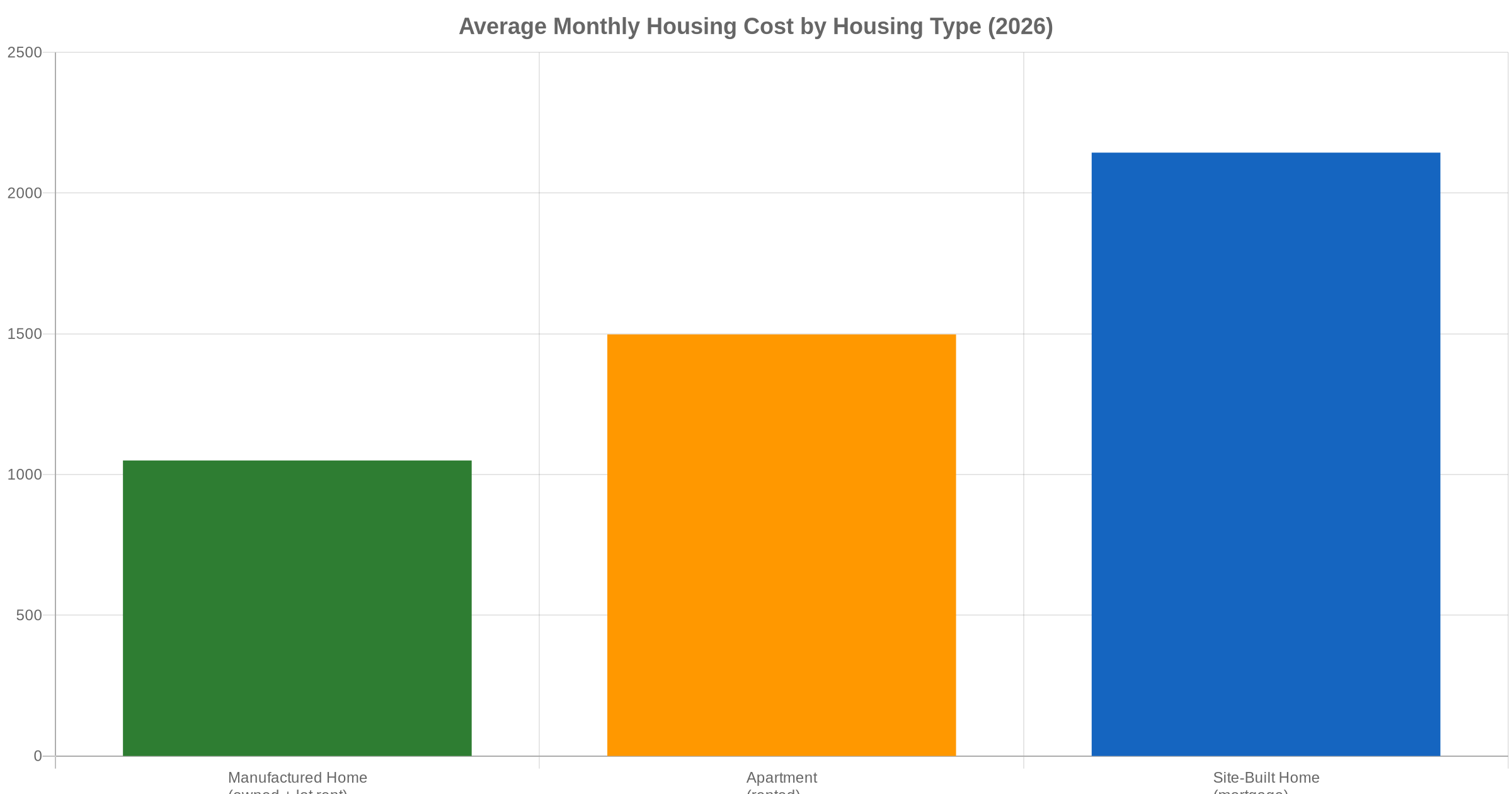
Consider the math: a resident in a mobile home park might pay $600/month in lot rent plus $400–$500/month on a manufactured home note. Total monthly housing cost: around $1,050. The equivalent apartment in many secondary markets costs $1,400–$1,800/month — for less space and no path to ownership equity.
This is why mobile home park occupancy rates have climbed to approximately 94% nationally, and why resident turnover in manufactured housing communities runs around 2.2% per year — compared to roughly 47% for apartment communities. Residents aren’t just renters. They own their homes, they’re invested in their neighborhoods, and they stay.
The Social Impact Equation: Strong Returns Without the Tradeoff
Impact investing — allocating capital to generate both financial returns and measurable social benefit — has traditionally been associated with below-market yields. Investors accept lower returns in exchange for the “feel good” factor.
Mobile home park investing breaks that tradeoff. Operators who responsibly manage manufactured housing communities:
- Preserve affordable housing stock that cannot be replaced (zoning restrictions mean very few new mobile home parks can be built)
- Provide stable, long-term housing for working families, retirees, and seniors on fixed incomes
- Invest in community infrastructure — roads, utilities, landscaping — that improves quality of life for residents
- Create local employment through property management, maintenance, and community operations
At the same time, the structural characteristics of mobile home parks — minimal vacancy, supply-constrained inventory, affordable housing demand that grows counter-cyclically — make them among the most resilient real estate asset classes available. During the 2008 financial crisis, manufactured housing communities posted positive net operating income while most other commercial real estate sectors saw significant declines.
📘 Free eBook: Top 20 Things I’ve Learned from Investing in Mobile Home Parks
Get the insights behind decades of mobile home park investing experience — distilled into 20 lessons that could save you time, money, and costly mistakes.
What Responsible Mobile Home Park Operators Actually Do
There’s an important distinction to make. Not all mobile home park operators are created equal. Media coverage has focused on bad actors — investors who buy parks, raise lot rents dramatically, and displace residents. That behavior is real, but it doesn’t represent responsible operators or the broader industry.
Operators who run communities with a long-term mindset take a fundamentally different approach:
- Gradual, market-rate rent increases: Lot rent adjustments that reflect operating costs and fair market value — not extractive rent hikes that force displacement
- Infrastructure investment: Replacing aging water and sewer systems, resurfacing roads, improving common areas
- Infill programs: Placing new homes on vacant lots to increase occupancy, house more residents, and strengthen the community’s economic base
- Transparent communication: Keeping residents informed about policy changes, maintenance schedules, and community improvements
- Long-term ownership mindset: Acquiring to hold 7–10+ years, not to flip — which aligns the operator’s financial interests with the community’s stability
When operators follow this playbook, something consistent happens: community satisfaction rises, turnover stays low, and the asset appreciates steadily. Treating residents well turns out to also be good business. The incentives are aligned in a way that most real estate asset classes simply don’t offer.
The Numbers Behind Manufactured Housing’s Scale and Impact
To understand the scale of mobile home park investing as a social force, consider a few key data points:
- 20+ million Americans live in manufactured housing communities — roughly 1 in 16 people
- 103,000+ manufactured homes were shipped in 2024, up approximately 15% year-over-year
- 1 in 6 new single-family homes started in the U.S. is a manufactured home
- ~45,000 manufactured housing communities exist nationally, with almost no new supply being added (approximately 0.04% annually)
- The average manufactured home costs roughly 70% less than a comparable site-built home
The supply constraint is particularly critical for investors. Because virtually no new mobile home parks are being permitted (most municipalities block them through zoning), existing communities become more valuable over time. The combination of growing affordable housing demand and a static supply base creates a durable long-term investment thesis that doesn’t depend on economic tailwinds to perform.
What This Means for Real Estate Investors in 2026
The ESG investing movement has pushed institutional capital toward assets with measurable social value. Pension funds, endowments, and family offices increasingly want investments that can demonstrate positive community impact alongside financial returns. Mobile home parks check that box — not because they’re packaged and labeled as “impact investments,” but because their fundamental economics serve a population that genuinely needs affordable housing.
The mobile home park investing thesis has always rested on stable, affordable housing demand. The social benefit is structural, not cosmetic. And that’s exactly what makes it durable.
For investors who care about what their capital does in the world, mobile home park investing offers something rare: competitive real estate returns alongside a genuine service to working American families. That alignment of incentives — where financial performance and community benefit point in the same direction — is increasingly hard to find in any asset class.
Conclusion
The affordable housing gap in America isn’t going away. With housing costs outpacing wage growth in most markets and new construction far short of demand, manufactured housing communities provide a critical, market-rate solution. Investors who recognize this — and who operate these communities responsibly — are positioned to benefit from one of the most compelling structural tailwinds in real estate while contributing meaningfully to communities that need stable, affordable housing.
Impact investing doesn’t have to mean accepting lower returns. In mobile home parks, doing right by residents and doing right by your portfolio are often exactly the same thing.
📋 The Mobile Home Park Due Diligence Playbook
10 video modules, a 55-page master checklist, and 9 ready-to-use templates that walk you through every step of evaluating a mobile home park deal. Everything you need to analyze, underwrite, and close with confidence.
Frequently Asked Questions
Is mobile home park investing considered an ESG or impact investment?
Not in the formal certification sense, but the structural role manufactured housing communities play in providing affordable housing to 20+ million Americans creates genuine social value alongside financial returns. Many institutional investors are beginning to recognize manufactured housing communities as impact-aligned assets given their essential role in the housing ecosystem.
Don’t mobile home park investors profit at the expense of low-income residents?
This narrative reflects bad operators, not the industry standard. Responsible mobile home park operators invest in community infrastructure, make gradual market-rate rent adjustments, and work to maintain high occupancy — which requires keeping residents housed, not displacing them. The financial incentive to maintain full occupancy actually aligns with treating residents well. Displacement is expensive and operationally disruptive.
How does manufactured housing help address the affordable housing crisis?
Manufactured homes cost roughly 70% less than site-built homes and are built to modern HUD safety and construction standards. In a mobile home park, residents own their home and pay lot rent — keeping total monthly housing costs well below apartment rents or conventional mortgage payments. This makes homeownership accessible to millions of Americans who would otherwise remain permanent renters.
Are new mobile home parks still being built?
Rarely. Zoning restrictions in most U.S. municipalities effectively prevent new manufactured housing communities from being developed. Only approximately 20 new communities are added to the national inventory of roughly 45,000 each year — a growth rate of around 0.04%. This supply constraint is one of the key structural factors that supports mobile home park valuations over time.
How does the social impact angle affect mobile home park investment returns?
It reinforces them rather than reducing them. The same factors that make mobile home parks socially valuable — essential housing, long-term residents, supply-constrained inventory — are what make them financially resilient. Operators who invest in their communities tend to see lower turnover, better occupancy, and more stable cash flow over the long term.
📘 Want to Go Deeper? Get Our Free eBook
Download “Top 20 Things I’ve Learned from Investing in Mobile Home Parks” — a practical, no-fluff guide to the asset class from operators who have acquired and managed communities across multiple states.
10 video modules, a 55-page master checklist, and 9 ready-to-use templates that walk you through every step of evaluating a mobile home park deal — from the first site visit to closing day.