Georgia has quietly become one of the most compelling states for mobile home park investing in 2026. A fast-growing population, a mix of booming metros and underserved rural markets, relatively landlord-friendly regulations, and a serious shortage of affordable housing all point in the same direction: demand for well-run mobile home parks is rising — and supply isn’t keeping up.
This guide breaks down what you need to know about mobile home park investing in Georgia: the best markets to target, what to expect on lot rents and pricing, how Georgia law affects operations, and where the real opportunities lie for investors willing to do the work.
Why Georgia Deserves a Closer Look
Georgia is the eighth most populous state in the country and home to Atlanta — the economic engine of the entire Southeast. But the opportunity in mobile home park investing isn’t only in the metro. Secondary and tertiary markets throughout Georgia have seen consistent population inflows, driven by lower costs of living, remote work migration, and retiree demand.
Key factors driving mobile home park demand in Georgia:
- Population growth: Georgia has added over 1 million residents in the past decade. Many are cost-sensitive and actively seeking affordable housing options.
- Affordable housing shortage: Georgia ranks among the states with the largest gaps between median incomes and median rents. Mobile homes remain one of the few unsubsidized affordable housing options available at scale.
- Limited new mobile home park supply: Zoning restrictions in most Georgia counties make it virtually impossible to build new mobile home parks. Existing parks are irreplaceable assets.
- Low existing lot rents in secondary markets: Many parks outside Atlanta are still running lot rents in the $250–$350/month range, well below what comparable affordable housing would rent for. That gap represents real upside for investors who can execute a value-add strategy.
Top Georgia Markets for Mobile Home Park Investing
Not all Georgia markets are equal. Here’s a breakdown of the primary opportunities by region:
Atlanta Metro (Fulton, Gwinnett, Cherokee, Hall Counties)
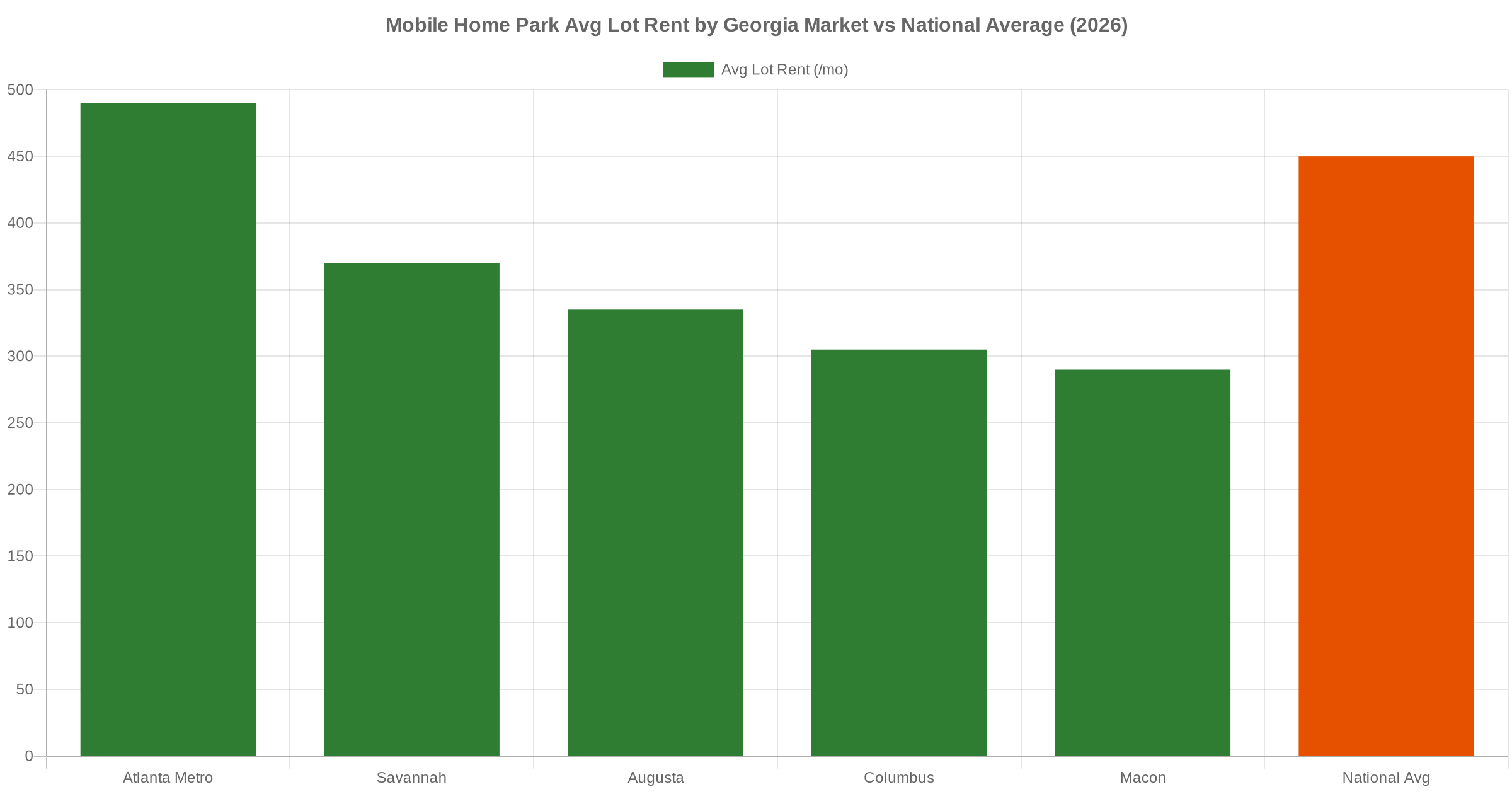
Atlanta is the largest manufactured housing market in Georgia by volume, but it’s also the most competitive. Prices per lot are higher here, and cap rates have compressed as institutional buyers have taken notice. That said, markets within 45–60 minutes of downtown Atlanta — Hall County (Gainesville), Cherokee County (Canton), and Forsyth County — still offer deals at reasonable cap rates with strong demand fundamentals. Average lot rents in the Atlanta metro are approaching $490/month in 2026, though you’ll find parks operating well below that in suburban fringe areas.
Savannah / Coastal Georgia
Savannah is booming. A flood of remote workers, Hyundai’s $5.5 billion EV plant in Ellabell, and steady military presence (Fort Stewart/Hunter Army Airfield) create durable demand for workforce housing. Mobile home parks in Chatham, Bryan, and Effingham counties are in high demand. Lot rents average around $370/month with room to move higher as the labor market tightens.
Augusta / CSRA
Augusta sits at the convergence of two states — Georgia and South Carolina — and draws its employment base from Fort Eisenhower (formerly Fort Gordon), the VA Medical Center, and a growing cybersecurity and healthcare sector. Mobile home parks in Richmond County and surrounding Burke and Columbia counties offer solid, stable cash flow, typically with lot rents in the $300–$365/month range.
Columbus / Muscogee County
Columbus is anchored by Fort Moore (formerly Fort Benning) — one of the largest military installations in the world. Military towns create consistent, predictable demand for affordable housing. Lot rents here are typically in the $290–$330/month range, with cap rates running higher than Atlanta due to less competition from institutional capital.
Macon / Middle Georgia
Middle Georgia offers the most value-add opportunity of any region in the state. Lot rents in Macon and surrounding Bibb, Baldwin, and Monroe counties are often still in the $250–$310/month range. These markets lack institutional attention, which means you can still source deals directly from longtime owners at prices that make the math work. Strong value-add operators can move rents $50–$100/month over 24–36 months with proper management and capital improvements.
What Does the Deal Math Look Like in Georgia?
Georgia mobile home park deals today generally fit one of two profiles:
Stabilized cash flow plays (Atlanta suburbs, Savannah, Augusta): These parks are already well-run with higher lot rents, low vacancy, and city utilities. Expect cap rates in the 5.5%–7% range. Competition is higher and prices are tighter, but you’re buying a more predictable income stream.
Value-add opportunities (Middle Georgia, rural counties): These parks often have below-market rents, higher vacancy, deferred maintenance, or owner fatigue. Cap rates on current income can look thin, but the story is in the upside — filling vacant lots, raising rents to market, and improving infrastructure. Buying at a 7%–9% cap on current income with a clear path to 10%–12% on stabilized income is still achievable in these markets.
A quick model: A 75-lot park in the Macon area, 80% occupied (60 occupied lots), rents at $280/month. Gross lot rent income: $201,600/year. After expenses (30–40% for a park on city utilities), NOI lands around $120,000–$140,000. At a 7.5% cap rate, that’s a purchase price of roughly $1.6–1.87 million. Now raise rents to $350/month over 24 months and fill 10 more lots: stabilized NOI climbs to $190,000+. That’s a meaningful value creation play.
For a deeper look at how to run this analysis, see our guide on mobile home park underwriting.
Two decades of hard-won lessons distilled into one free guide. Whether you’re evaluating your first deal or your fiftieth, these insights will sharpen your approach.
Georgia Mobile Home Park Regulations: What Investors Need to Know
Georgia is generally considered an investor-friendly state for mobile home park ownership, but there are a few key regulatory items to understand before buying:
Notice Requirements for Rent Increases and Evictions
Georgia requires landlords to provide 60 days’ written notice before a rent increase takes effect. For evictions, tenants must receive proper notice (typically 30 days for lease violations or non-payment), and landlords must go through formal dispossessory proceedings in magistrate court. Georgia’s courts tend to move relatively quickly compared to states with more tenant-protective laws.
Park Closure Notice
If you’re considering closing or redeveloping a mobile home park in Georgia, state law requires a 180-day notice period to residents. This is worth factoring into any ground lease plays or redevelopment strategies.
Manufactured Housing Standards
Georgia follows HUD standards for manufactured housing and requires that homes comply with OCGA Title 8 (buildings and housing). Park owners are typically responsible for maintaining common areas, roads, and utility infrastructure while home maintenance is the tenant’s responsibility — but this depends on lease structure.
Utility Regulations
Georgia does not have a statewide mandate on utility billing methods, giving park operators flexibility. RUBS (ratio utility billing system), submetering, or master meter arrangements are all used in Georgia. If you’re evaluating a park with a master meter, factor in the cost to submeter — it’s one of the highest-ROI capital investments you can make in a mobile home park.
How to Source Off-Market Mobile Home Park Deals in Georgia
The best Georgia deals aren’t listed on LoopNet. Most of the state’s mobile home parks are still owned by individual families who’ve held them for decades. Here’s how experienced investors are finding them:
- Direct mail to park owners: Use county tax records to identify park parcels (often coded as “mobile home park” or “manufactured housing community” in the county’s property classification). Mail letters or postcards directly to the owner of record.
- Drive for deals: In secondary Georgia markets especially, smaller parks are easy to miss online but obvious in person. Field trips through rural counties often surface deals that haven’t been marketed at all.
- Build relationships with local brokers: Even if they don’t specialize in mobile home parks, regional commercial brokers often know who owns the parks in their market and whether an owner might be open to a conversation.
- Industry networks: The Georgia Manufactured Housing Association (GMHA) and state-level landlord networks are good places to get connected with owners.
For more sourcing strategies, see our post on finding off-market mobile home parks.
Georgia vs. Other Southeast States: How Does It Stack Up?
Georgia sits in the middle of the pack among Southeast states for mobile home park investing. North Carolina and Tennessee both have larger manufactured housing inventories and arguably stronger rural demand fundamentals — but Georgia’s stronger urban core (Atlanta) and coastal growth story make it an attractive complement to an investor building a Southeast portfolio.
See our guides on mobile home park investing in North Carolina and the best markets for mobile home park investing in 2026 for a broader comparison.
Key Risks to Watch in Georgia
No market is without risk. Georgia-specific factors to evaluate carefully:
- Flood zones: Parts of coastal Georgia, the Savannah River basin, and low-lying areas around Macon have significant flood exposure. Always pull FEMA flood maps before making an offer. Flood insurance costs have risen sharply and can materially impact cash flow.
- Hurricane risk (coastal): Parks in Chatham, Bryan, and Glynn counties face hurricane and tropical storm exposure. Factor insurance costs and storm mitigation into your underwriting.
- Private utilities in rural parks: Wells, septic systems, and lagoons are common in rural Georgia parks. These add operating complexity and capital risk. City water and sewer is the gold standard — if you’re evaluating a park on private utilities, price in the infrastructure risk accordingly.
- Aging home inventory: Many Georgia parks still have a significant percentage of pre-HUD or early HUD-code homes from the 1970s–1980s. Homes in poor condition can suppress lot rents and hurt collections. Assess the home quality across the community before buying.
Is Georgia a Good Market for Mobile Home Park Investing in 2026?
Yes — with the right deal and the right market. Georgia’s population growth, affordability squeeze, and limited new supply create a durable demand story. Institutional capital has entered the Atlanta metro, but secondary and tertiary markets throughout the state remain accessible to individual investors and smaller operators.
The highest opportunity right now is in the middle Georgia and rural corridor where rents are genuinely below market, owners are aging out, and well-capitalized operators can execute meaningful value-add strategies without competing against institutional money.
For a broader view of what to look for when evaluating any mobile home park opportunity, visit our complete guide to investing in mobile home parks.
If you’re exploring mobile home park investing and want to learn more about how the asset class works, feel free to reach out — we’re happy to have a conversation.
10 video modules, a 55-page master checklist, and 9 ready-to-use templates that walk you through every step of evaluating a mobile home park deal — from the first site visit to closing day.
Get the top 20 lessons from two decades of mobile home park investing — free.