If you’re evaluating where to buy a mobile home park in 2026, geography matters as much as the deal itself. State-level regulation, population trends, lot rent headroom, and exit market depth all vary significantly. This guide breaks down the best states for mobile home park investing right now — with real data on what makes each market attractive or risky.
Why Market Selection Matters in Mobile Home Park Investing
Mobile home parks are inherently local assets. A 100-lot park in a growing Sun Belt suburb performs very differently from one in a shrinking Rust Belt town — even if the cap rates look identical on paper. The best operators do not just buy on yield; they buy into markets where:
- Population is growing (supports occupancy and lot rent increases)
- Affordable housing demand is structural, not cyclical
- The regulatory environment does not cap rent or impose hostile tenant protection laws
- There is a viable exit market where other operators or institutions will buy
With those filters in mind, the Southeast and select Midwest states consistently come out on top. Here is a state-by-state breakdown of the most compelling mobile home park investing markets heading into 2026.
1. North Carolina — The Top Mobile Home Park Market in the Southeast
North Carolina is the single best state for mobile home park investing right now, and it is not particularly close. The combination of population growth, business-friendly regulation, and still-reasonable valuations makes it a standout.
Why North Carolina Wins
- Population growth: NC added roughly 130,000 residents in 2024 alone, driven by Charlotte, Raleigh, and the Research Triangle. These metros drive lot rent growth in suburban and exurban markets within an hour of the city core.
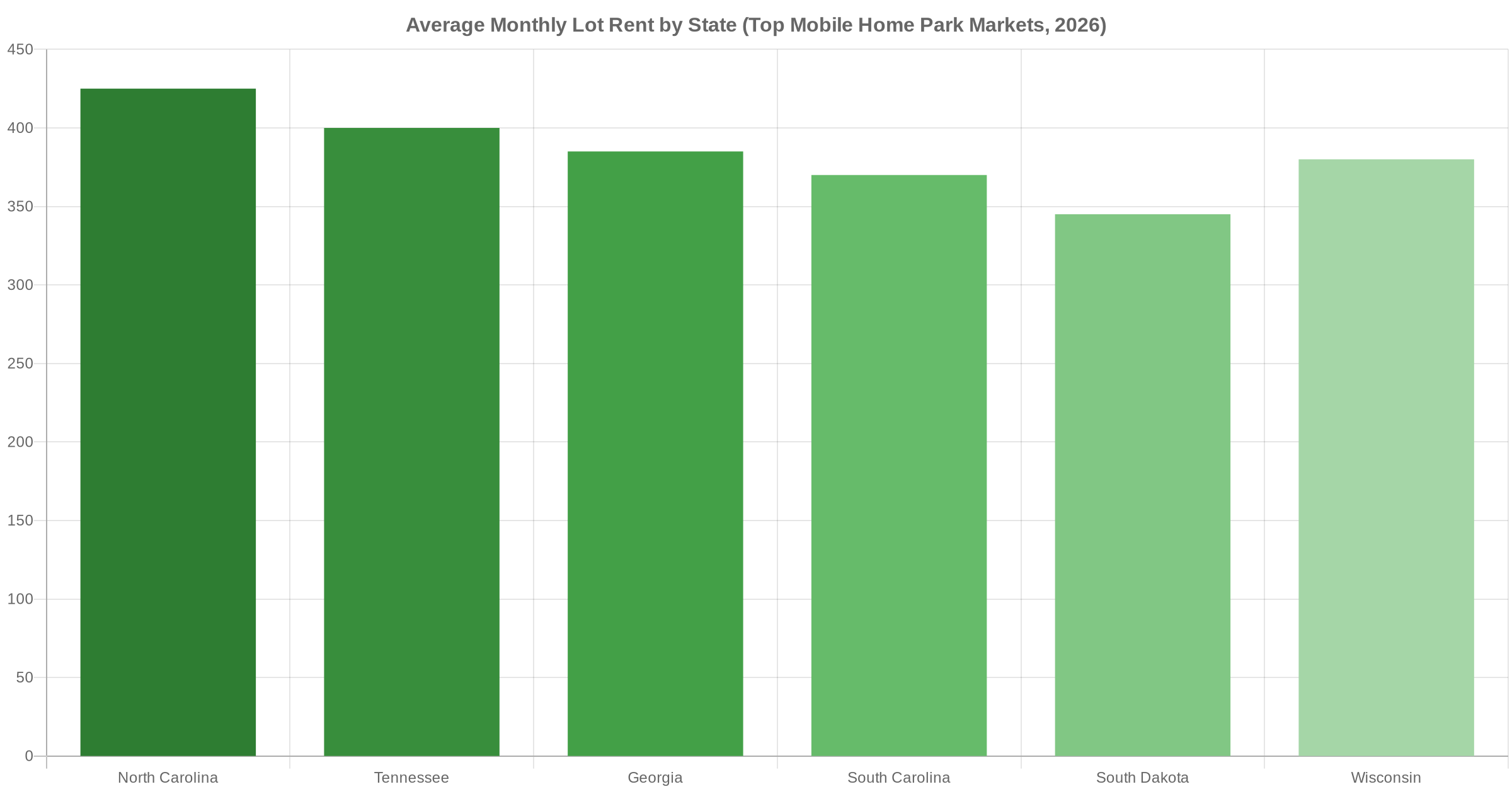
- Lot rent headroom: Average lot rents in NC run $380 to $470 per month in competitive suburban markets, with significant room to grow in rural communities still below $350.
- No statewide rent control: North Carolina preempts local rent control ordinances. Operators can implement reasonable annual increases without legislative interference.
- Active deal flow: A large base of mom-and-pop owners (many with 50 to 150 lots) creates consistent off-market deal flow for operators willing to do direct outreach.
For a deeper dive into the North Carolina market, see our dedicated mobile home park investing guide for North Carolina.
2. Tennessee — Fast-Growing and Operator-Friendly
Tennessee is a top-tier mobile home park acquisition market. Nashville metro growth has ripple effects across the state, pushing affordable housing demand into secondary and tertiary markets where mobile home parks operate.
Why Tennessee Is Compelling
- No state income tax: Attracts migration from higher-tax states, sustaining strong population growth in the Nashville, Knoxville, and Chattanooga corridors.
- Lot rent trajectory: Average lot rents of $370 to $430 per month in suburban Nashville markets, with value-add opportunity in East Tennessee markets still trailing $300 per month.
- Limited supply additions: Like the national picture, Tennessee sees essentially zero new mobile home park development. Existing communities benefit from this structural scarcity.
- Landlord-friendly laws: Tennessee eviction and property rights framework is among the most operator-friendly in the Southeast.
We published a full breakdown of the Tennessee market earlier this year: Mobile Home Park Investing in Tennessee: A 2026 Market Guide.
3. Georgia — Strong Metros, Improving Lot Rent Story
Georgia sits in the second tier of Southeast mobile home park markets — attractive but requiring selectivity. Atlanta sprawl creates demand corridors in Gwinnett, Hall, and Cherokee counties. Secondary markets like Augusta, Macon, and Savannah also offer value-add opportunities where lot rents have not kept pace with regional inflation.
- Average lot rents: $360 to $410 per month in Atlanta suburbs; lower in rural Southwest Georgia
- State population growing approximately 100,000 residents per year, with Atlanta metro driving most of it
- Watch for aging infrastructure in older rural communities — due diligence on utilities is critical
- No statewide rent control
4. South Carolina — Emerging Market with Coastal Tailwinds
South Carolina is becoming a more attractive mobile home park market as coastal migration accelerates. The Myrtle Beach and Charleston metros have seen sustained in-migration from the Northeast, and the labor force supporting hospitality, healthcare, and manufacturing in those corridors creates durable demand for affordable housing.
- Average lot rents: $340 to $390 per month; coastal markets approaching $420 and above
- Cap rates typically 6.5 to 8.0 percent on stabilized assets, though trophy assets near the coast can compress to 5.5 percent
- Growing institutional interest — exit market improving as major operators expand into SC
Two decades of hard-won lessons distilled into one free guide. Whether you are evaluating your first deal or your fiftieth, these insights will sharpen your approach.
5. South Dakota — Niche Market with Outsized Returns
South Dakota will not generate the deal volume of a Southeast state, but it is worth watching for investors focused on yield over scale. The Sioux Falls and Rapid City corridors have steady workforce housing demand, and the state no-income-tax status attracts ongoing business relocation.
- Average lot rents: $310 to $360 per month — lower than the Southeast, but operating costs are also lower
- Cap rates typically 7.5 to 9.0 percent on stabilized assets in secondary markets
- Thinner deal flow and thinner exit market — requires patience on disposition
- Best suited for operators with a long hold thesis of seven to ten years
6. Wisconsin — Midwest Stability With Strong Occupancy
Wisconsin is a market for operators who prioritize stability over growth. The Milwaukee, Madison, and Green Bay corridors have consistent affordable housing demand, and mobile home park assets in these markets tend to carry lower volatility than Sun Belt parks that have repriced aggressively in recent years.
- Average lot rents: $355 to $400 per month in the Milwaukee and Madison suburbs
- Occupancy rates typically high at 93 to 97 percent — cold-weather stickiness means residents do not move in Wisconsin winters
- Watch for local rent regulation proposals at the municipal level, though nothing has passed statewide
- Good for conservative investors seeking reliable cash flow over appreciation
What the National Data Says
To calibrate state-level numbers against the national picture:
- National occupancy rate: Approximately 94 percent, up from 86.5 percent a decade ago
- New supply: Roughly 20 new mobile home park communities opened nationally last year, out of approximately 45,000 existing — a 0.04 percent supply growth rate
- Transaction volume: Mobile home park sales volume up 66 percent year-over-year in the first half of 2025, signaling renewed institutional interest in the sector
- Cap rate compression: Nationally averaging around 5.9 percent on premium assets, with stabilized secondary-market assets still trading at 6.5 to 8.0 percent
For a broader look at whether the asset class makes sense in today’s environment, see our analysis: Are Mobile Home Parks a Good Investment in 2026?
Key Factors to Evaluate in Any Market
Beyond state rankings, the most important location-level factors are:
- Distance to a major employment center: Within 30 to 45 minutes of a metro with 100,000 or more jobs is the sweet spot. Too close and land is expensive; too far and you are exposed to single-employer risk.
- City water and city sewer: Private wells and septic systems introduce operational complexity and capital risk. City utilities are non-negotiable for most institutional underwriting.
- Lot rent-to-income ratio: Lot rent should represent 20 to 25 percent of median household income in the market. Below that, there is room to raise rents. Above 30 percent, you are hitting affordability constraints.
- Exit market depth: Can you sell this asset in five to seven years? Markets with growing institutional activity are easier to exit than tertiary markets with thin buyer pools.
Conclusion
The best mobile home park investing markets in 2026 share a consistent profile: population growth driving affordable housing demand, a landlord-friendly regulatory environment, and lot rents with room to grow. North Carolina and Tennessee lead the Southeast, with Georgia and South Carolina close behind. South Dakota and Wisconsin offer compelling yield opportunities for operators with longer time horizons and a preference for stability over velocity.
Market selection will not save a bad deal — but it will make a good operator’s job significantly easier. Pick the right markets first, then find the right assets within them.
10 video modules, a 55-page master checklist, and 9 ready-to-use templates that walk you through every step of evaluating a mobile home park deal — from the first site visit to closing day.
Frequently Asked Questions
What is the best state to invest in mobile home parks?
North Carolina consistently ranks as the top state for mobile home park investing, driven by strong population growth, no statewide rent control, high deal flow from mom-and-pop sellers, and improving lot rent fundamentals in suburban markets near Charlotte and Raleigh. Tennessee is a close second for similar reasons.
What lot rent growth rates can investors expect in the Southeast?
In established Southeast markets, annual lot rent increases of 4 to 8 percent are common for well-located communities with city utilities. Value-add communities coming from below-market rents have seen operators implement larger initial increases in the first year of ownership, followed by normalized annual adjustments.
Is it harder to find deals in growing markets?
Yes and no. Growing markets like NC and TN attract more operator attention, which compresses cap rates on listed deals. But the size of the mom-and-pop owner base is also larger, meaning there are more potential off-market opportunities for operators willing to invest in direct outreach and relationship-building with long-term owners.
What cap rates should I expect in these markets?
In 2026, stabilized mobile home parks in top Southeast markets are trading at 5.5 to 7.5 percent cap rates, depending on location, occupancy, and utility infrastructure. Value-add assets with below-market rents or occupancy upside can still be acquired at 7 to 9 percent going-in cap rates with meaningful upside to stabilized value.
Do regulations differ significantly between these states?
Yes. North Carolina, Tennessee, Georgia, South Carolina, and South Dakota are all considered operator-friendly states without statewide rent control. Wisconsin has a more mixed municipal environment, with some larger cities exploring tenant protections, though nothing has passed statewide. Always review local ordinances — city and county — in addition to state law before acquiring any asset.
Get the top 20 lessons from two decades of mobile home park investing — free.