If you are a passive investor in a mobile home park syndication, or actively evaluating one, there is a good chance you will eventually encounter this scenario: the general partner (GP) announces that an institutional buyer has made an offer to acquire the community. What happens next?
Institutional buyouts of mobile home parks have become increasingly common. Transaction volume in the manufactured housing sector jumped 47.1% year-over-year in 2025, with institutional buyers including private equity firms, REITs, and large-scale manufactured housing operators accounting for a growing share of that activity. In 2017, institutional buyers represented roughly 13% of manufactured housing community purchases. By 2025, that figure had climbed to an estimated 30-33%.
Understanding what happens when a large operator makes a move on your mobile home park is essential knowledge for every investor in this asset class.

Who Are the Institutional Buyers in Mobile Home Parks?
Not all institutional buyers look the same. In the manufactured housing space, you will encounter several distinct categories:
- Manufactured Housing REITs – Sun Communities (SUI) and Equity LifeStyle Properties (ELS) are the two largest publicly traded owners of manufactured housing communities. They primarily target premium assets with 200+ lots, high occupancy, and institutional-grade infrastructure, typically buying at cap rates of 4-5.5%.
- Private Equity-Backed Operators – Firms like Inspire Communities (backed by Apollo Global), Treehouse Communities (Blackstone), and RHP Properties have built large portfolios by systematically acquiring and improving communities at scale. They often pursue value-add opportunities in the 75-300 lot range.
- Large Private Operators – Companies like Yes Communities or Lakeshore Communities operate hundreds of communities and are continuously growing through acquisition, often competing on speed and relationships rather than pure price.
Each buyer type has a different acquisition profile. Understanding who is bidding on a property matters because it affects price, timeline, due diligence intensity, and what the community looks like post-sale.
Why Are Institutional Investors Targeting Mobile Home Parks?
The same structural advantages that attract individual and syndicated investors make mobile home parks irresistible to institutions:
- Supply constraints – Fewer than 20 new manufactured housing communities are permitted annually in the U.S., roughly 0.04% of the existing 43,000-45,000 community stock. Near-zero new supply creates durable pricing power for existing owners.
- Sticky residents – Annual home turnover in mobile home parks averages approximately 2.2%, compared to 47% in apartment complexes. Residents who own their homes rarely move.
- Affordable housing tailwind – With 20+ million Americans living in manufactured housing, demand is structural, not cyclical. Economic downturns actually increase demand for affordable housing options.
- NOI resilience through downturns – Manufactured housing community net operating income grew through both the 2008 financial crisis (mobile home park NOI +1.5% vs. apartments -5.6%) and COVID-19 (+4.2% vs. apartments -3.2%).
Institutions are acting on this data at scale. To understand how this consolidation is reshaping deal pricing and competition, see our detailed look at how private equity is changing the mobile home park market in 2026.
What Happens During a Mobile Home Park Buyout? Step by Step
When an institutional buyer targets a mobile home park, the process typically unfolds in several stages:
Stage 1: Initial Offer or Letter of Intent (LOI)
The buyer submits a non-binding letter of intent stating the proposed purchase price, terms (all-cash vs. assumption of existing debt), and due diligence period, typically 45-60 days. This is when the GP evaluates whether the price and structure make sense given the original investment thesis and remaining value-add runway.
Stage 2: Due Diligence Period
Institutional buyers perform extensive due diligence, reviewing rent rolls, utility infrastructure, environmental reports, title history, physical inspections, and often third-party appraisals. This phase typically takes 45-90 days for a well-prepared seller.
Stage 3: Purchase and Sale Agreement (PSA)
Once diligence is complete and both parties agree on final terms, they execute a binding PSA with earnest money deposited, typically 1-3% of purchase price. The closing timeline is generally 30-60 days from PSA execution.
Stage 4: Closing and Distribution to Passive Investors
At closing, proceeds flow to: (1) retire any outstanding debt, (2) return LP capital per the agreed waterfall structure, and (3) distribute profits per the equity split outlined in the PPM. This is the moment passive investors fully realize their returns from the deal.
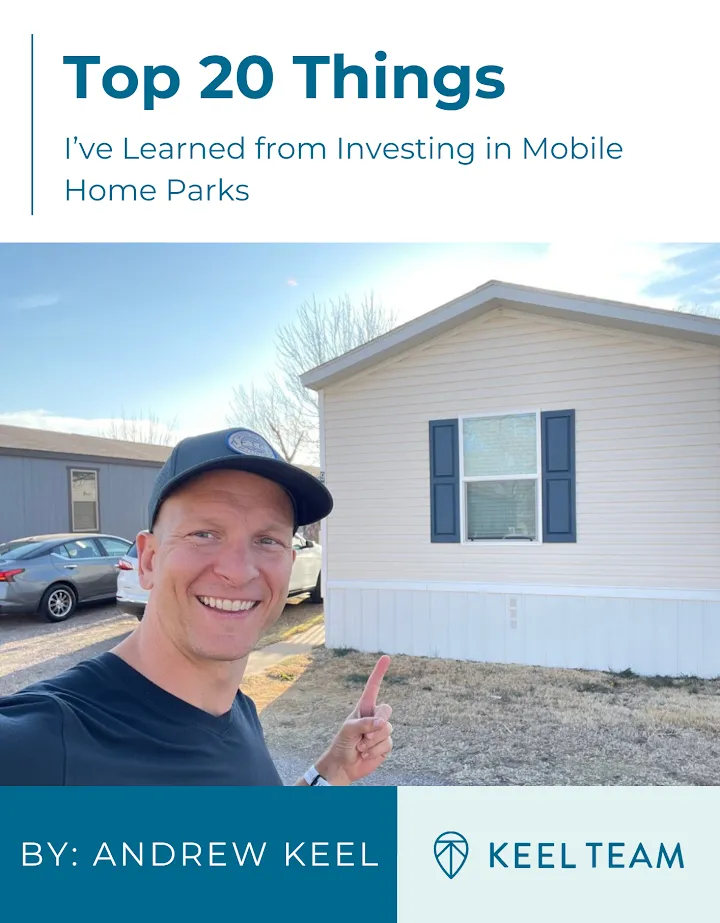
Two decades of hard-won lessons distilled into one free guide. Whether you are evaluating your first deal or your fiftieth, these insights will sharpen your approach.
How a Buyout Affects Passive Investors (Limited Partners)
As a limited partner (LP) in a mobile home park syndication, an institutional buyout is a liquidity event. Here is how the distribution waterfall typically flows at closing:
- Debt repayment first – The outstanding mortgage, bridge loan, or any preferred equity is paid off from sale proceeds before any equity distributions.
- Return of LP capital – LPs receive their invested principal back before the GP takes any profit participation.
- Preferred return catch-up – If a cumulative preferred return (e.g., 7-8%) was promised but not fully paid during the hold period, LPs are made whole before profit splits begin.
- Profit split above the hurdle – Remaining profits are split per the waterfall, commonly 70% LP / 30% GP until an IRR hurdle (e.g., 15%), then adjusting to 50/50 or 60/40 above that threshold.
The actual return multiple an LP receives depends on the sale price relative to the original acquisition basis, how much debt was on the property at closing, and how much had already been distributed during the hold. Institutional buyers typically pay at higher valuations than private operators, which benefits passive LPs through larger exit proceeds.
For a detailed breakdown of how these mechanics work before you invest, see how GP/LP waterfall structures work in mobile home park syndications.
Key Questions to Ask Your GP About Exit Strategy Before You Invest
Every passive investor should understand how their sponsor plans to exit before committing capital. These are the questions that matter most:
- What is the target hold period, and under what conditions would you consider an early exit? A 5-year hold with an institutional offer at year 3 may be the right move, or it may shortchange LP returns. Know how the GP evaluates these trade-offs.
- What exit cap rate are you underwriting to? If the GP models an exit at a 7% cap rate but institutional buyers are currently paying 5.5%, that represents meaningful upside. If they model 5.5% in a rising-rate environment, the margin of safety is thin.
- Do you run a competitive sale process or accept the first offer? Sophisticated GPs formally market properties to multiple buyers before accepting an offer.
- How have your prior exits performed relative to underwritten projections? Track record on exits is one of the clearest signals of whether a GP consistently executes their full investment thesis.
For a complete framework on evaluating GP exit discipline, see mobile home park syndication exit strategies for passive investors.
Institutional Buyer vs. Private Operator: Key Differences for Sellers
When a GP receives competing offers from an institutional buyer and a private operator, the differences extend well beyond price:
| Factor | Institutional Buyer | Private Operator |
|---|---|---|
| Purchase price | Often higher (lower cap rate) | Often lower (higher cap rate) |
| Closing timeline | 90-180 days typical | 45-90 days typical |
| Due diligence intensity | Extensive, multiple parallel teams | Streamlined, operator-focused |
| Certainty of close | High, institutional capital committed | Variable, depends on financing |
| Post-acquisition lot rent approach | Typically phases in market-rate increases | More variable by operator |
What Distinguishes a Sponsor With a Strong Exit Plan
The best mobile home park operators think about their exit strategy before they close on an acquisition. Here is what a well-structured exit plan looks like:
- Exit assumptions documented in the PPM – target exit cap rate, projected sale price range, sensitivity analysis for downside scenarios, and planned hold period with clear criteria for deviation
- Value-add milestones that institutional buyers pay premiums for – occupancy above 90%, city water and sewer, tenant-owned home majority, deferred maintenance addressed, and lot rents within 10-15% of market
- Consistent investor communication – quarterly updates tracking progress against exit milestones, not just cash-on-cash distributions
- Broker relationships in place – access to manufactured housing specialists at firms like Marcus and Millichap or CBRE who can run a competitive marketing process
Conclusion
Institutional investor buyouts in the manufactured housing sector are an active reality reshaping how communities are priced and exchanged. Transaction volume grew 47.1% year-over-year in 2025, and institutional consolidation shows no signs of slowing in 2026.
For passive investors, understanding the buyout process means knowing what to expect when your GP announces a sale, how proceeds will flow through the waterfall, and most critically, what questions to ask before you write a check. The quality of a sponsor’s exit strategy is just as important as their acquisition discipline.
10 video modules, a 55-page master checklist, and 9 ready-to-use templates that walk you through every step of evaluating a mobile home park deal, from the first site visit to closing day.
Frequently Asked Questions
What typically happens to residents when an institutional investor buys a mobile home park?
Institutional buyers vary in their operating philosophy. Large REITs typically maintain existing lot rent structures initially and phase in market-rate increases over time. Residents who own their homes retain the right to remain as long as they pay lot rent and comply with community rules. The primary resident concern is lot rent increases, which are governed by state law including required advance notice periods and, in some states, annual caps on increases.
How does a mobile home park sale affect passive investors tax situation?
A sale triggers a taxable event for passive investors. Capital gains taxes apply on profits above each LP’s adjusted cost basis. Many investors use 1031 exchanges or qualified opportunity zone investments to defer these gains, but both strategies require working with a qualified intermediary well in advance of closing. A well-organized GP should proactively communicate the expected tax treatment ideally 12-18 months before a projected sale.
What is the typical timeline from LOI to close for an institutional mobile home park acquisition?
Institutional buyers typically take 90-180 days from LOI to closing. A 45-90 day due diligence period plus PSA negotiation and closing preparation accounts for most of the timeline. Sellers who maintain organized records including current rent rolls, utility bills, title documents, and environmental reports can materially compress the diligence timeline and reduce re-trade risk.
Can passive investors block a sale they disagree with?
In most mobile home park syndication structures, the GP has discretionary authority to sell the asset on behalf of the partnership. Limited partners typically do not vote on individual sale decisions. The governing documents, the operating agreement and PPM, define the exact rights LPs hold. Some deals include LP approval thresholds for early exits or sales below a minimum price floor; many do not. Review your governing documents carefully before investing if this matters to you.
What cap rates are institutional buyers paying for mobile home parks in 2026?
Premium assets with 200+ lots, city utilities, 90%+ occupancy, and Sun Belt or Southeast location are trading at 4-5.5% cap rates with institutional buyers. Stabilized communities in secondary markets typically command 5.5-7%. Value-add or transitional communities are priced at 7-9%+. The gap between in-place lot rents and market rates can justify lower headline cap rates when buyers model significant upside from rent growth.
Get the top 20 lessons from two decades of mobile home park investing, free.