Tariffs rarely make headlines as good news for real estate investors. But for mobile home park investors, the steel and aluminum tariffs that took effect in 2025 may be quietly strengthening one of the most compelling fundamentals of the asset class: supply constraint.
Here’s what’s happening, why it matters, and how to think about it when you’re evaluating mobile home park deals in 2026.
What Tariffs Are Doing to Manufactured Home Prices
HUD-code manufactured homes — the kind you’ll find in mobile home park communities across the country — are built on steel chassis with steel framing, aluminum roofing components, and factory-installed systems that use significant raw material inputs. That makes them directly exposed to import tariffs on these materials.
The broad tariff packages enacted in 2025 imposed significant duties on imported steel and aluminum from multiple countries. Combined with persistent inflation in construction labor, transportation logistics, and appliances, the cost to produce a new HUD-code manufactured home has risen meaningfully over the past several years.
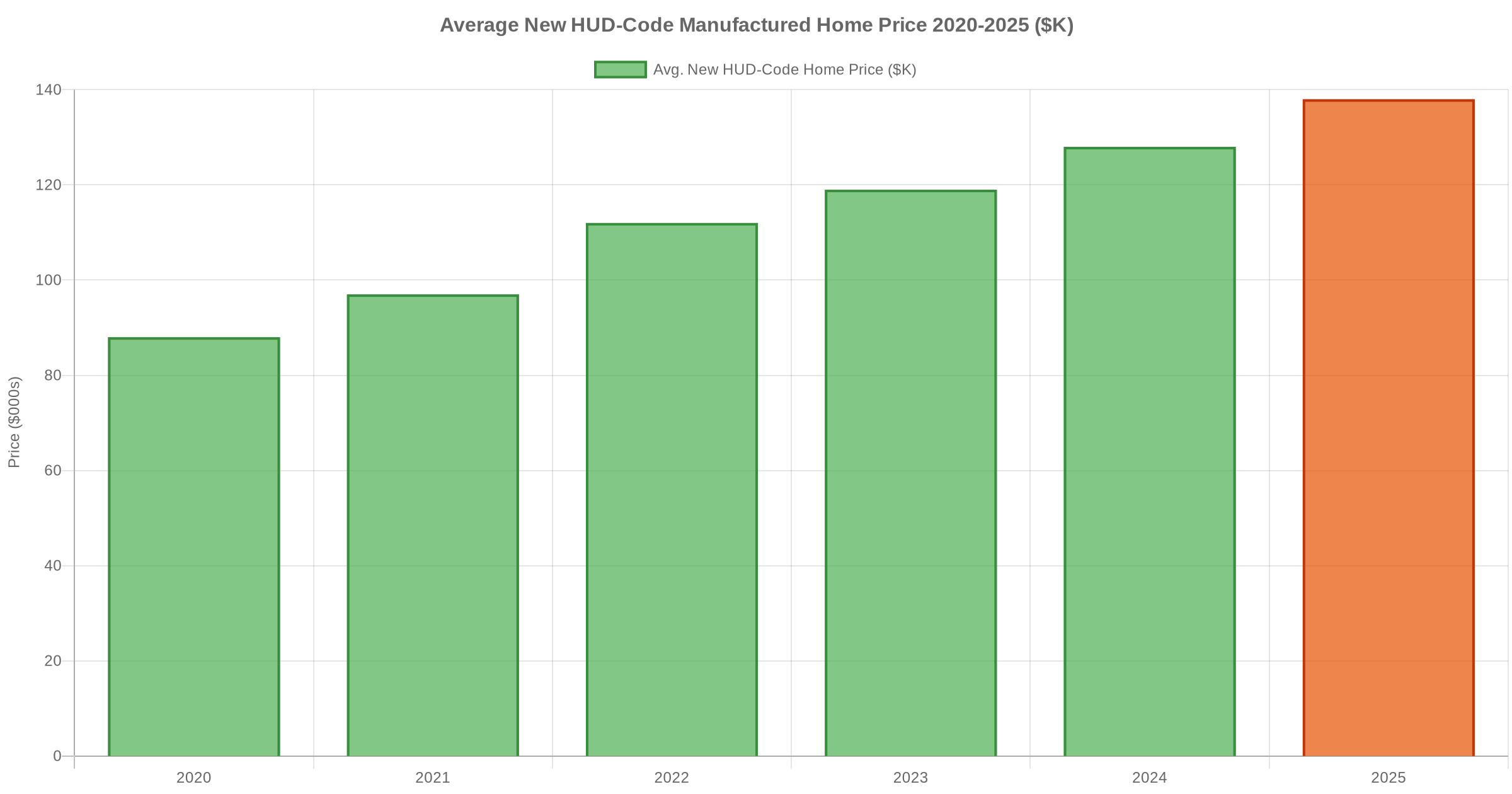
Average new manufactured home prices have climbed from roughly $88,000 in 2020 to over $138,000 today — with some of the steepest increases coming in 2022 and again in 2025 as tariff costs worked through supply chains. That’s still far below the national median site-built home price, which crossed $400,000 in 2024. But the gap is narrowing, and that narrowing has real implications for both manufactured home buyers and mobile home park operators.
The Steel and Aluminum Factor
A typical single-wide manufactured home contains roughly 2,000–3,000 pounds of steel in its chassis alone. Double-wides can double that figure. Even modest per-ton price increases from tariffs — and we’ve seen 20–25% jumps in certain steel categories — translate into thousands of dollars per unit in added cost at the factory level.
The largest HUD-code home builders — Clayton Homes, Cavco Industries, Skyline Champion — don’t absorb these cost increases indefinitely. They pass them through to dealers. Dealers add margin. Transport costs for 60-foot oversize loads have risen with fuel prices and driver availability. The result: new manufactured homes that cost meaningfully more in 2026 than they did three years ago.
For buyers of manufactured homes — particularly lower-income households who represent the core demand segment — this is a real squeeze. For operators of mobile home park communities, it creates a structural tailwind that most observers haven’t fully priced in.
Why Higher Manufactured Home Prices Strengthen Mobile Home Park Fundamentals
The core mobile home park investment thesis has always rested on two pillars: durable affordable housing demand and near-zero new supply. Tariffs reinforce both.
Pillar 1: Demand becomes stickier. As new manufactured homes get more expensive, the relative value of renting a lot in an existing mobile home park increases. Residents who might have considered purchasing a new home and placing it in a community may instead stay put longer. That improves retention, reduces vacancy, and stabilizes the income stream that drives mobile home park valuations.
Pillar 2: The supply constraint deepens. Mobile home park supply was already near-zero — only about 20 new communities were permitted nationally in 2025 out of roughly 45,000 total communities in operation. Tariff-driven cost increases make new development even harder to pencil. Higher material costs mean higher land improvement costs, which compress already-thin development margins in most markets. The economic rationale for building new manufactured housing communities was already challenged. Tariffs make it harder still.
For existing mobile home park investors and operators, this is a moat-deepening story. The communities that exist today become more competitively insulated precisely because new supply can’t replace them at comparable economics.
Two decades of hard-won lessons distilled into one free guide. Whether you’re evaluating your first deal or your fiftieth, these insights will sharpen your approach.
What This Means for Lot Rent and NOI
When new homes cost more, the affordable alternatives available to mobile home park residents become more expensive. That shifts pricing power — gradually but meaningfully — toward operators.
Lot rent nationally averaged approximately $752 per month in 2025, up roughly 7% year-over-year according to Berkadia’s Manufactured Housing Annual Report. In markets where demand is strong — Sun Belt metros, growing secondary cities, and areas with limited affordable housing alternatives — rent growth has been even higher.
That growth isn’t entirely because of tariffs. Strong occupancy (93% nationally), limited new supply, and broad affordable housing shortages are all contributing factors. But the tariff-driven cost increases on new homes add another layer to why lot rent growth is sustainable: there’s no cheap new alternative for residents to switch to. You can’t build a competing park nearby at the same economics, and buying a new manufactured home just got more expensive than it was two years ago.
For operators underwriting mobile home park deals in 2026, this supports continued rent growth assumptions — particularly in well-located communities where local housing costs are high relative to existing lot rents. For a broader look at national occupancy, rent growth by region, and cap rate trends, see our 2026 mobile home park market data breakdown.
What Investors Should Know When Underwriting Mobile Home Park Deals in 2026
If you’re evaluating a mobile home park investment this year, the tariff environment has a few specific underwriting implications to keep in mind:
- Replacement cost supports valuations. When new homes cost more, the replacement cost of an existing manufactured housing community rises alongside them. This is a legitimate argument for cap rate compression in well-run, well-located communities — existing communities are worth more when their replacement is prohibitively expensive.
- Resident retention improves in higher-cost environments. When moving is expensive — new homes cost more, transportation is expensive, alternative affordable housing is scarce — residents are less likely to leave. In tenant-owned home communities, rising home values give residents more equity and more reason to stay put.
- Infill strategies cost more. Budget accordingly. If you’re acquiring a community with vacant lots and planning to fill them with new homes as a value-add strategy, your per-unit infill cost has increased. A new home that cost $60,000–$70,000 to place a few years ago may now cost $80,000–$95,000 depending on size, market, and transport distance. Model this realistically in your pro forma before acquisition.
- Focus on stabilized communities with strong existing occupancy. The supply constraint and retention arguments work best for communities that don’t require massive capital expenditure to stabilize. Buying a distressed community and trying to fill it with expensive new homes changes the return math significantly compared to acquiring a well-occupied, cash-flowing asset.
For a comprehensive framework on what to verify before acquiring a mobile home park, see our mobile home park due diligence checklist — 25 items every investor should verify before writing a check.
The Long View: Structural Demand Won’t Change
Tariff policies will evolve. Trade negotiations will shift. Prices may moderate. But the underlying dynamic — a chronic national shortage of affordable housing, near-zero new supply of manufactured housing communities, and durable demand from the 17+ million Americans who call manufactured housing home — doesn’t change based on trade policy cycles.
What tariffs do is accelerate the cost pressure that was already building in the new manufactured home market. They make affordable housing more expensive to produce, which means existing affordable housing stock — including mobile home park communities — becomes more valuable by comparison.
That’s the counterintuitive reality of mobile home park investing in 2026: external cost pressures that would damage most real estate asset classes actually reinforce the mobile home park investment thesis. Higher construction costs mean higher barriers to new supply, which means existing communities retain their competitive position for longer than they would otherwise.
For a broader look at the fundamental case for this asset class in the current environment, read our analysis of whether mobile home parks are a good investment in 2026.
Conclusion
The tariff environment of 2025–2026 is adding real cost pressure across the manufactured housing industry. New homes are more expensive to build and buy. Developers face higher material costs that make new community construction even less viable than before. And residents face fewer affordable alternatives when considering a move.
For investors in existing mobile home park communities, these dynamics are structural positives. They deepen the supply moat, support continued lot rent growth, and reinforce the long-term value of owning well-located manufactured housing communities in markets with strong affordable housing demand.
The key is understanding where these dynamics are most powerful: high-demand markets, communities with city utilities and strong existing occupancy, and operators with the experience to execute value-add strategies without relying entirely on expensive new home placements to drive returns.
10 video modules, a 55-page master checklist, and 9 ready-to-use templates that walk you through every step of evaluating a mobile home park deal — from the first site visit to closing day.
Frequently Asked Questions
Are tariffs actually raising manufactured home prices in 2026?
Yes. HUD-code manufactured homes use significant steel and aluminum — in chassis, framing, and key components. The 2025 tariff packages on these materials added real costs to production that builders and dealers pass through to buyers. Average new manufactured home prices have risen over 56% since 2020, with tariff-driven acceleration evident in 2024 and 2025.
Does this make mobile home park investing more attractive in 2026?
From a supply and retention perspective, yes. Higher new home costs make it harder to build new manufactured housing communities at competitive economics, which deepens the supply moat around existing communities. This is one of several reasons the asset class continues to attract both individual and institutional capital. For the full picture, see our honest analysis of mobile home parks as an investment in 2026.
How do tariffs affect infill strategies for mobile home park operators?
Infill — buying and placing new manufactured homes on vacant lots — has gotten more expensive. A home that cost $60,000–$70,000 to place a few years ago may now cost $80,000–$95,000 depending on size, region, and transport. Investors with infill-heavy value-add plans need to update their cost assumptions and model realistic returns at current home prices before acquiring a community.
Will tariffs cause lot rents in mobile home parks to increase?
Tariffs don’t directly raise lot rents — operators set rents based on local demand, occupancy, and market conditions. But tariff-driven cost increases on new homes reduce affordable alternatives for residents, which subtly improves operator pricing power over time. Combined with strong occupancy and persistent affordable housing shortages, lot rent growth of 3–7% annually remains achievable in well-located communities.
What should passive investors ask mobile home park operators about tariff exposure?
Passive investors evaluating a mobile home park syndication should ask: Does the operator have infill plans that depend on placing new homes? If so, have placement costs been updated in the current underwriting to reflect today’s prices? Are there capital improvement plans involving significant steel or construction components? Understanding how cost increases have been modeled — and whether the operator has updated their assumptions — is a reasonable and important question for any limited partner.
Get the top 20 lessons from two decades of mobile home park investing — free.