You’ve reviewed the deal deck, asked the right questions, signed the subscription agreement, and wired your capital. Congratulations — you’re officially a passive investor in a mobile home park syndication. But what happens next?
For many first-time limited partners, the post-investment experience can feel like a black box. The check is cashed, updates are sparse, distributions haven’t arrived yet, and you’re not entirely sure what “normal” looks like. This guide walks you through exactly what to expect in your first year as a passive investor in a mobile home park syndication — from onboarding through your first K-1.
Month 1–2: Capital Deployment and Onboarding
The first thing that happens after your wire clears is the closing process. Depending on where the deal stands in its timeline, closing could be days or a few weeks out. Your capital typically sits in escrow until the acquisition is finalized, at which point the sponsor takes control of the property and begins executing the business plan.
During this ramp-up phase, a reputable sponsor will:
- Send a welcome email or onboarding packet with investor portal login credentials
- Confirm your capital was received and correctly allocated to the deal
- Provide a closing update once the acquisition is complete
- Share the property’s baseline metrics and any early operational observations
Don’t expect distributions yet. Most mobile home park syndications have a 60–90 day stabilization window before operating cash flow is sufficient to distribute. The sponsor is focused on transitioning management, addressing deferred maintenance, and identifying early value-add opportunities — things like vacant lot infill, utility billing optimization, or market-rate rent adjustments.
Use this window to verify your investor portal access and clarify the sponsor’s communication cadence going forward.
Month 3–6: First Distributions and Early Stabilization
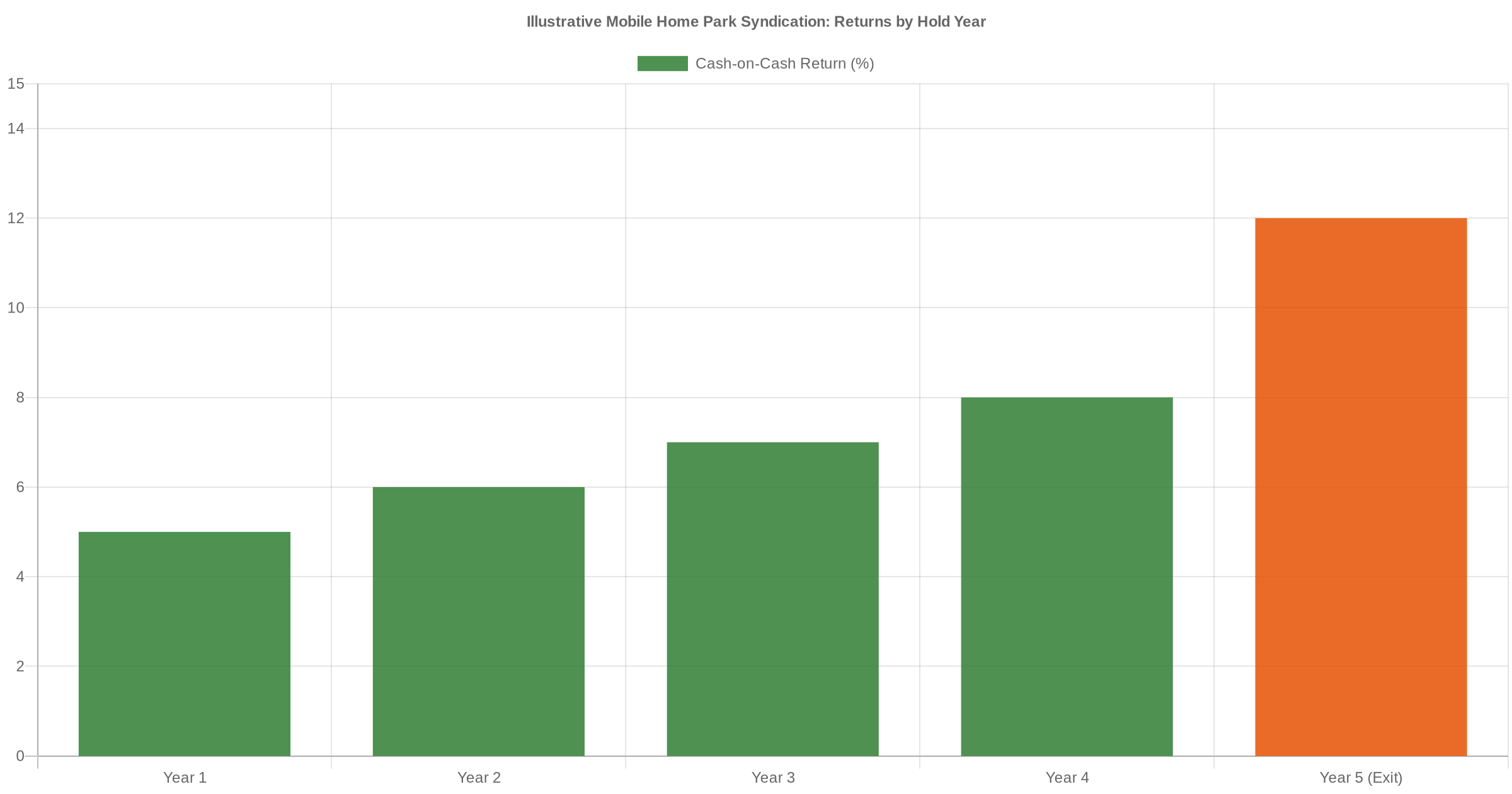
If the deal includes a preferred return — typically 6%–8% annualized — you should start seeing distributions in months three to six, usually paid quarterly. These initial payments represent your preferred return being funded from the property’s operating cash flow.
Keep in mind: year-one distributions are often lower than the deal’s projected stabilized returns. This is expected. A value-add mobile home park acquisition typically requires capital improvements, vacant lot infill, and management transitions — all of which temporarily compress available cash flow while the business plan gains traction.
Our guide to mobile home park distribution schedules for passive investors covers payment structures and timing in more detail.
What You Should Have by Month 6
- At least one full investor update — written report or video walkthrough
- Your first quarterly distribution, if the property is performing on plan
- A performance summary comparing actuals to underwriting projections
- Clear communication on any deviations from the original business plan
Understanding Your K-1: Tax Reporting in Year One
One of the biggest surprises for first-time passive investors in a mobile home park syndication is the K-1 — the Schedule K-1 (Form 1065) that pass-through entities use to report each partner’s share of income, losses, and deductions to the IRS.
Here’s what to know before tax season arrives:
- K-1s are typically issued between February and March 15 of the year following your investment. Some sponsors file for an extension and K-1s don’t arrive until September. Flag this with your CPA early so it doesn’t delay your personal return.
- You may show a paper loss in year one even if you received cash distributions. This is one of the most powerful tax benefits of real estate investing, driven by depreciation — especially if the sponsor conducted a cost segregation study that front-loads deductions early in the hold period.
- K-1 income is classified as passive income and tracked separately from your ordinary income. Your CPA will handle this on a passive activity loss schedule. If your income exceeds the IRS threshold for passive loss deductions, excess losses may carry forward and be realized at exit.
If you’re investing through a self-directed IRA, the tax treatment is fundamentally different — see our guide on using a self-directed IRA to invest in mobile home parks for the specifics.
Two decades of hard-won lessons distilled into one free guide. Whether you’re evaluating your first deal or your fiftieth, these insights will sharpen your approach.
Investor Reporting: What Good Sponsors Deliver
Consistent, transparent communication is one of the clearest signals of a well-run mobile home park syndication. Here’s what you should receive from a quality operator:
- Quarterly updates: Property-level performance data covering occupancy, collections, expenses, and a narrative on business plan progress — delivered within 45 days of each quarter close.
- Annual report: Full-year financials, year-over-year comparison to underwriting projections, and an updated outlook on hold period and exit timing.
- Capital event notices: Any refinances, major capital expenditure decisions, or capital calls should be communicated proactively with full context — not buried in a footnote of a quarterly report.
- Investor portal access: Professional operators typically use platforms like Juniper Square, AppFolio Investment Manager, or similar tools so you can monitor your investment in real time without waiting for scheduled updates.
If you’re not receiving meaningful updates within the first few months, that’s worth a direct conversation with the general partner. Review our list of 15 questions to ask a mobile home park syndicator — most of these communication standards should be established before you invest, but they apply equally once you’re in the deal.
Year-One Red Flags Worth Watching
Most mobile home park syndications run smoothly, but here are signals worth paying attention to during the first 12 months:
- Missed or delayed distributions with no explanation. Cash flow challenges happen. Silence doesn’t. A quality operator communicates proactively when distributions will be delayed and provides a clear plan for resolution.
- Sustained occupancy declines post-acquisition. Some resident turnover at acquisition is normal. But ongoing occupancy drops suggest a management or market problem that needs to be addressed — not glossed over in quarterly updates.
- Unexpected capital calls without clear rationale. Not all capital calls are bad — sometimes a disciplined operator seizes a smart value-add opportunity that requires additional equity. But every capital call deserves a detailed explanation: what the capital is for, the expected outcome, and how it fits the original business plan.
- K-1 delays past the September extension deadline. Organized operators run clean books. Repeated tax document delays suggest back-office disorganization that can compound over the hold period.
If you notice any of these warning signs, open a direct conversation with the general partner before drawing conclusions. Many year-one challenges are temporary and manageable. What separates good operators from bad ones is how honestly and proactively they communicate about them.
Conclusion: Year One Sets the Tone for Everything That Follows
The best thing about being a passive investor in a mobile home park syndication is exactly that — it’s passive. Your role in year one is to stay informed, understand your tax documents, and trust the process. These investments are structured for five-to-seven-year holds, and year one is typically the most operationally intensive period for the sponsor as they transition and stabilize the asset.
By the time your first full year closes out, you’ll have a clear read on how this operator runs their business, how transparently they communicate with limited partners, and whether the deal is tracking to plan. That information is worth as much as the returns — it tells you whether this is a team worth investing with again.
To learn more about how mobile home park syndications are structured and what to look for before committing capital, visit our complete guide to mobile home park syndication.
10 video modules, a 55-page master checklist, and 9 ready-to-use templates that walk you through every step of evaluating a mobile home park deal — from the first site visit to closing day.
Get the top 20 lessons from two decades of mobile home park investing — free.