When most people hear “mobile home park investing,” they picture a hands-on operator tracking lot rent, managing a maintenance crew, and fielding calls about busted water lines. That’s one version. But there’s another: writing a check, receiving quarterly distributions, and letting an experienced operator do all of that work while you focus on other things.
These two approaches — active vs. passive mobile home park investing — are fundamentally different in terms of time commitment, risk profile, capital requirements, and potential upside. Neither is better in the abstract. The right choice depends entirely on what you’re trying to accomplish and what you can actually put into it.
This guide breaks down both paths so you can make an informed decision.
What Is Active Mobile Home Park Investing?
Active mobile home park investing means you are the operator. You find the deal, negotiate the purchase, arrange financing, close the transaction, and then run the park — or at minimum oversee the management. You are the decision-maker, and the success or failure of the investment lands squarely on your shoulders.
What Active Investors Actually Do Day-to-Day
Even with a professional property manager in place, active owners stay deeply involved. Typical responsibilities include:
- Acquisitions: Sourcing deals, building relationships with sellers, running underwriting models, and negotiating purchase contracts
- Financing: Securing bank loans, agency debt, seller financing, or private capital — and managing lender relationships through the life of the deal
- Operations oversight: Reviewing monthly financials, approving capital expenditures, setting rent increase schedules, and monitoring occupancy trends
- Problem-solving: Handling evictions, utility issues, zoning disputes, and regulatory compliance
- Capital improvements: Managing infill programs, infrastructure upgrades, and long-term value-add projects
Expect to spend 20–60 hours per month in the early years — more if you’re actively building a portfolio.
Pros and Cons of Active Mobile Home Park Investing
Pros:
- Full control over acquisitions, operations, and exit strategy
- Higher upside potential — you capture all the equity, not a share of it
- Deep learning curve accelerates future deals
- No need to trust a third-party operator with your capital
Cons:
- Significant time commitment, especially in the first 12–24 months
- Higher capital requirements — most active deals require $250,000–$1M+ in equity
- Requires specialized knowledge: due diligence, lending, operations, and local market expertise
- Full exposure to downside risk
Before going active, you’ll want to understand how to rigorously evaluate deals. Our mobile home park due diligence checklist covers 25 critical items to verify before signing a purchase agreement.
10 video modules, a 55-page master checklist, and 9 ready-to-use templates that walk you through every step of evaluating a mobile home park deal. Whether you’re buying your first park or your tenth, this system helps you avoid costly mistakes and close with confidence.
What Is Passive Mobile Home Park Investing?
Passive mobile home park investing means contributing capital to a deal or fund managed by an experienced operator — and receiving a share of the returns without being involved in day-to-day operations. You are a limited partner (LP). The operator (general partner or GP) runs the show.
This structure is typically organized as a real estate syndication under Regulation D of the Securities Act. Passive investors review the deal, sign subscription documents, wire funds, and then receive quarterly or annual distributions while the operator executes the business plan.
How Passive Investing Through a Syndication Works
In a typical mobile home park syndication:
- The operator identifies, underwrites, and negotiates an acquisition
- A private offering is structured (often as an LLC) with a defined equity split, preferred return, and waterfall
- Passive investors contribute equity in exchange for an ownership percentage
- The operator manages the property — handling all daily operations, reporting, and eventual sale
- Investors receive distributions from cash flow and a share of the profits at exit
Understanding how operators structure their deals — and how to evaluate whether an operator is actually good — is critical before committing capital. We cover this in depth in how to evaluate a mobile home park operator before you invest.
Pros and Cons of Passive Mobile Home Park Investing
Pros:
- True passive income — no operational involvement required
- Lower capital minimums (often $25,000–$100,000 per deal)
- Diversify across multiple deals without needing to learn operations from scratch
- Access to institutional-quality deals you couldn’t source or close independently
- Real estate tax benefits (depreciation, cost segregation) flow through to LPs
Cons:
- No control — you’re trusting the operator to execute
- Less total upside than owning the deal outright
- Capital is illiquid for the duration of the hold period (typically 5–7 years)
- Requires vetting the operator carefully — execution risk is real
Want to understand what returns actually look like on the passive side? Our breakdown of what returns to expect from passive mobile home park investments covers realistic cash-on-cash yields, equity multiples, and IRR ranges.
Active vs. Passive: A Side-by-Side Comparison
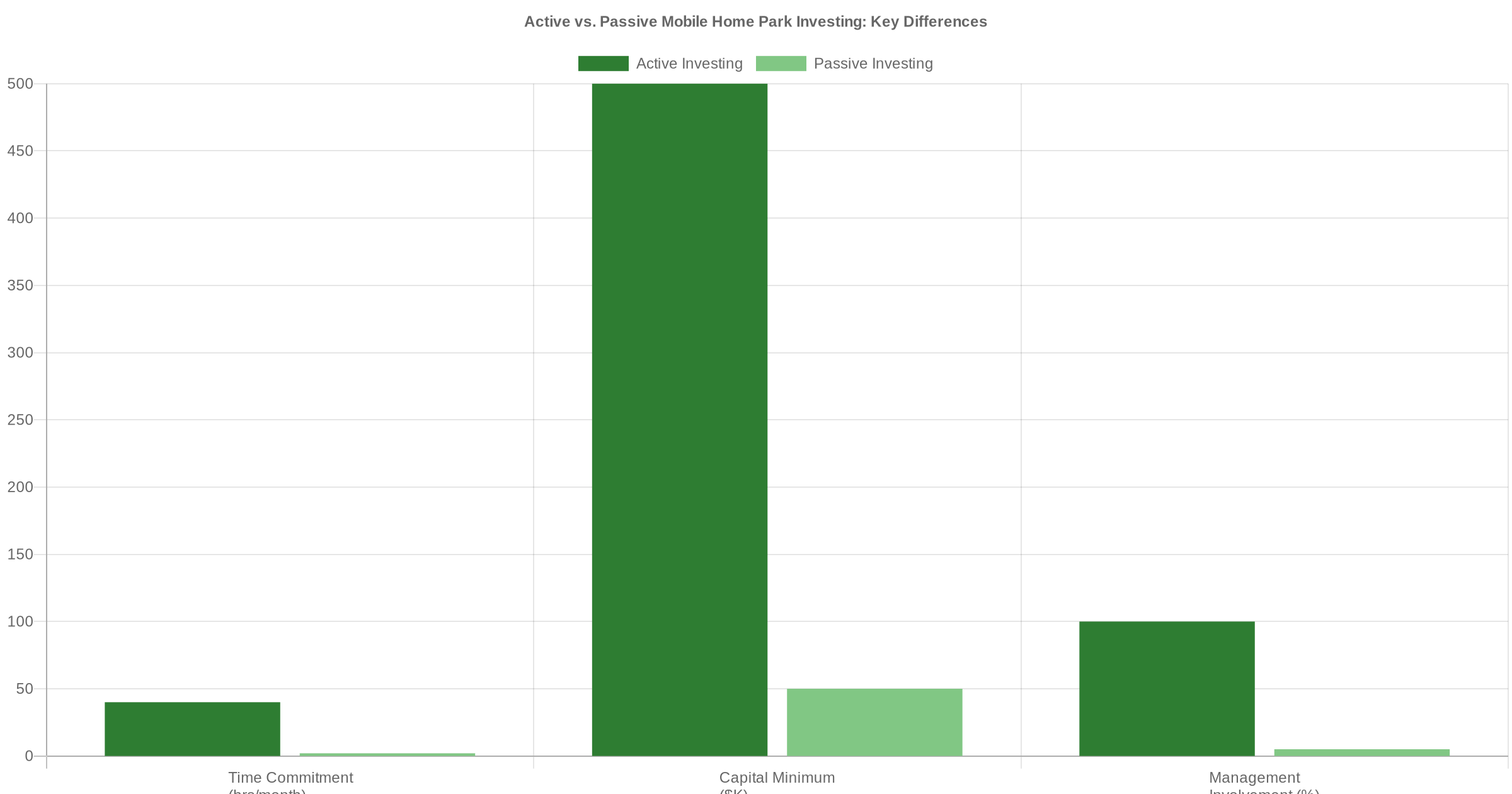
| Factor | Active Investing | Passive Investing |
|---|---|---|
| Time Commitment | 20–60+ hrs/month | 1–3 hrs/month |
| Typical Capital Minimum | $250,000–$1M+ | $25,000–$100,000 |
| Control | Full | None (LP) |
| Upside Potential | Higher (you keep all equity) | Moderate (share of profits) |
| Learning Curve | Steep | Moderate (vetting operators) |
| Diversification | Harder (capital-intensive) | Easier (spread across deals) |
| Ideal For | Operators, full-time investors | Professionals, high earners, retirees |
Who Should Choose Active Mobile Home Park Investing?
Active investing makes sense if you:
- Have the time to fully commit to acquiring, learning, and operating a mobile home park
- Have sufficient capital — typically $500,000+ liquid or investable assets
- Want full control of every decision, from rent increases to capital expenditures to exit timing
- Are building a long-term business, not just looking for a passive income stream
- Have relevant experience in real estate, property management, or operations
The active path is not for the faint of heart. Mobile home park operations are more complex than they appear from the outside — between utility infrastructure, tenant relations, local regulations, and deal sourcing, there’s a steep learning curve. But for those who commit to it, the economics can be exceptional.
Who Should Choose Passive Mobile Home Park Investing?
Passive investing is the right fit if you:
- Have capital but not time — a busy professional, business owner, or retiree who wants exposure to mobile home park returns without the workload
- Want diversification into real estate without concentrating all capital in one operating deal
- Prefer to trust experts rather than learn operations from scratch
- Are comfortable with illiquidity — passive positions typically lock up capital for 5–7 years
- Want tax-advantaged returns — depreciation and cost segregation benefits flow through to LPs
The most important skill for passive investors isn’t real estate — it’s operator evaluation. A great deal in the hands of a poor operator will underperform. A mediocre deal in the hands of a great operator can still generate solid returns.
To go deeper on the passive investing side, visit our guide to passive investing in mobile home parks.
Can You Do Both?
Yes — and many experienced mobile home park investors do. A common pattern: start as an active operator, build a track record and portfolio, then offer co-investment opportunities to passive investors as you scale. This lets you leverage outside capital to grow faster while your LPs get access to deals they couldn’t source or manage themselves.
Others go the opposite direction: start as a passive LP to learn the business, build relationships with operators, and understand what separates good deals from bad ones — then eventually transition to active ownership once they have the knowledge and capital base to execute.
There’s no single right path. The best mobile home park investors are clear-eyed about what they’re optimizing for — whether that’s maximum control, maximum income passivity, diversification, or scale — and they choose their structure accordingly.
Final Thoughts
Active and passive mobile home park investing are not competing strategies — they’re different tools for different goals. Active investing offers more control and upside but demands your time, expertise, and substantial capital. Passive investing offers access to the asset class with minimal involvement but requires trust in the operator and patience through the hold period.
The first step is honest self-assessment: How much time do you realistically have? How much capital can you deploy? How much control do you need to sleep at night? Answer those questions clearly, and the right path becomes obvious.
If you’re exploring either route and want to talk through the details, feel free to reach out — we’re happy to have an educational conversation about mobile home park investing.
Get the MHP Due Diligence Playbook — the complete system for analyzing mobile home park acquisitions with confidence. Includes 10 video modules, a 55-page master checklist, and 9 ready-to-use templates.