If you’ve been following mobile home park investing over the past few years, you’ve noticed a clear trend: states are paying more attention to manufactured housing communities than ever before. Tenant protection legislation is expanding across the country — and while most of these laws are designed to protect residents, they carry real implications for investors evaluating deals and operators managing assets.
This post breaks down what’s happening in the regulatory landscape, which states are most active, and — most importantly — what it all means if you’re a passive investor considering a mobile home park syndication in 2026.
The Regulatory Wave Hitting Manufactured Housing Communities
The regulatory environment for mobile home parks has shifted meaningfully over the past three years. What was once a largely overlooked corner of real estate is now drawing legislative attention at both the state and federal level. The driving force? Affordability pressure. As housing costs climb nationally, manufactured housing communities provide one of the last bastions of unsubsidized affordable housing — and policymakers want to make sure residents aren’t displaced.
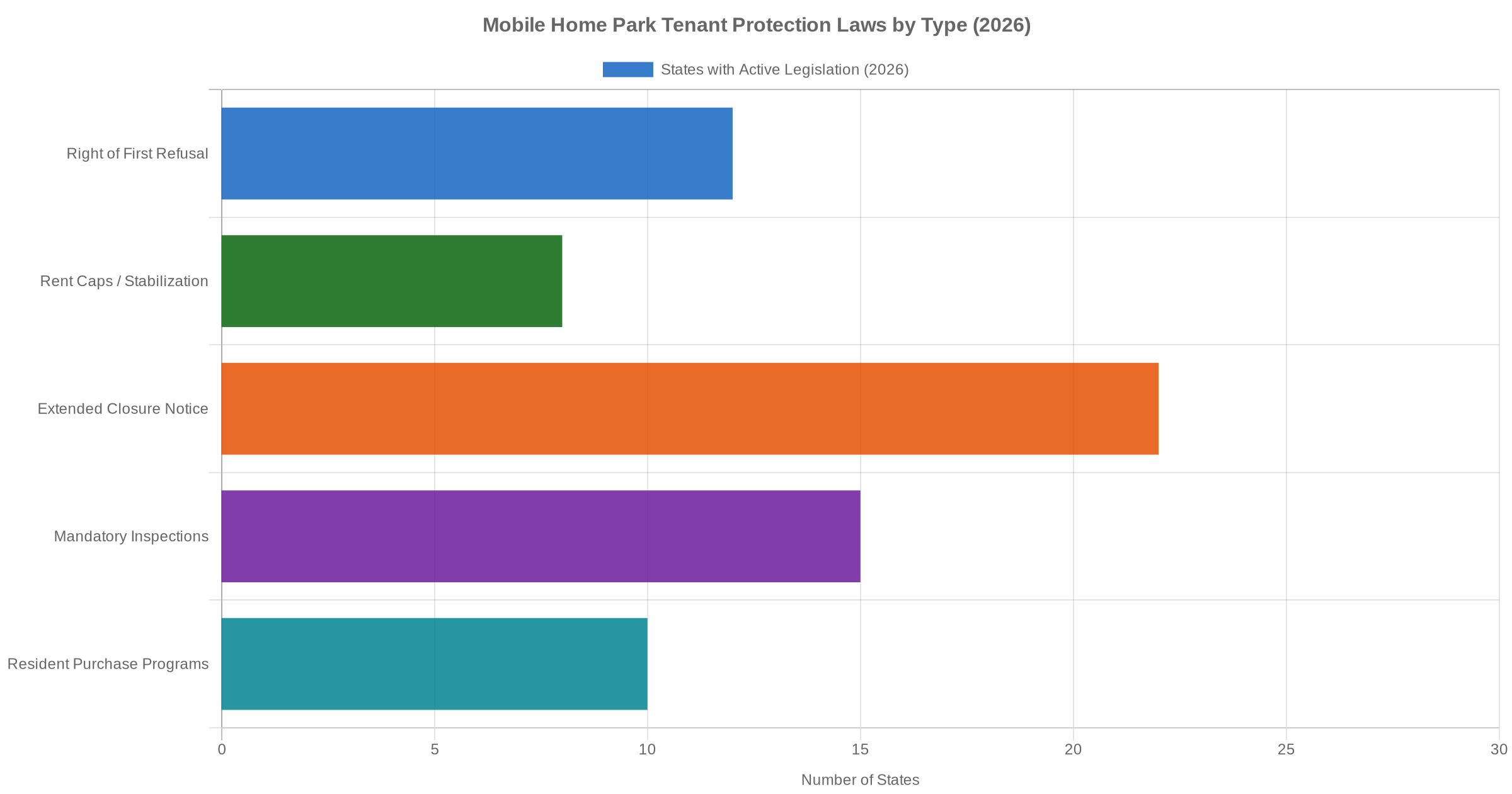
The most common types of legislation being proposed or enacted in 2026 include:
- Right of First Refusal (ROFR): Requires park owners to offer residents (or their association) the opportunity to purchase the community before selling to an outside buyer. Currently active in roughly 12 states, including Colorado, Connecticut, Illinois, and — as of a May 2026 Senate bill — Michigan.
- Rent Caps or Stabilization: Caps on annual lot rent increases, typically tied to CPI or a fixed percentage. Washington state’s HB 1217 (effective May 2025) limits annual increases to 5% with 3 months’ advance notice. About 8 states have active rent regulation for mobile home parks.
- Extended Closure Notice Requirements: Mandates requiring park owners to provide 90-180+ days of notice before closing or converting a community. These exist in roughly 22 states and are expanding.
- Mandatory Inspections: Annual or periodic park inspections with public violation posting, currently in about 15 states. Michigan’s pending bill includes this provision.
- Resident Purchase Assistance Programs: State-funded loan programs helping resident cooperatives purchase communities. About 10 states have some form of this infrastructure.
For a deeper state-by-state breakdown of tenant protection laws in Keel Team’s target markets, see our post on Mobile Home Park Tenant Protection Laws in 2026: NC, TN, GA, SC Guide.
Which States Are Moving Fastest?
Regulatory activity is concentrated in the Northeast, Pacific Coast, and upper Midwest. States with the most aggressive legislative agendas in 2026 include:
- California: SB 1092 (pending) would require 360-day advance notice before accepting a purchase offer. Additional protections under the Mobilehome Residency Law are updated annually.
- Michigan: SB 934-939 (passed Senate, May 2026) creates a resident opportunity to purchase, mandatory 12-month leases, fee limits, and annual inspections.
- Florida: SB 1550 (filed January 2026) expands considerations for “unreasonable” rent increases and substantially increases relocation compensation for displaced residents.
- Washington: Already has a 5% annual lot rent cap in effect, one of the strictest in the country.
By contrast, the Southeast — including North Carolina, Tennessee, Georgia, and South Carolina — remains among the most landlord-friendly regulatory environments in the country. These states have not enacted rent caps or aggressive ROFR legislation, which is one of several reasons they consistently attract operator attention and deal flow.
Two decades of hard-won lessons distilled into one free guide. Whether you’re evaluating your first deal or your fiftieth, these insights will sharpen your approach.
What This Means for Passive Investors in Mobile Home Park Syndications
If you’re a passive investor evaluating a mobile home park syndication, regulatory risk is now a line item in your diligence checklist — not a footnote.
Here’s how the regulatory environment affects your returns as a limited partner:
NOI Compression from Rent Caps
In states with annual lot rent caps, operators lose the ability to bring rents to market when they’ve fallen behind. If a mobile home park was underpriced at acquisition and the value-add thesis depended on catching rents up to market rates, a statutory cap could meaningfully reduce projected cash flow and exit valuation. Always ask the sponsor: does your rent growth assumption comply with state law in this specific market?
Exit Complexity from ROFR Laws
Right of First Refusal requirements don’t prevent a sale — they slow it down. In states with active ROFR laws, the park must first be offered to the resident association, which may have 90-180+ days to organize financing and make an offer. This can delay exits and introduce uncertainty in hold period projections. Experienced operators in ROFR states factor this timeline into their underwriting; inexperienced ones don’t.
Closure Risk and Redevelopment Constraints
Extended closure notice requirements and relocation compensation mandates make it costly to close or redevelop a mobile home park. For most buy-and-hold investors, this is actually a positive signal — it reduces the risk of involuntary closure events that could destabilize occupancy. But for operators who might consider land redevelopment as a secondary exit, it’s a constraint worth understanding upfront.
Inspection and Compliance Costs
Mandatory inspections with public violation posting can create reputational and operational risk for poorly managed communities. For well-run operators, this is a competitive advantage — they pass inspections, their competitors don’t. For passive investors, it underscores the importance of choosing a sponsor with strong operational infrastructure and a consistent maintenance program.
How to Evaluate a Sponsor’s Regulatory Exposure
The good news: most of this is manageable if you’re working with an experienced operator who selects markets thoughtfully. When evaluating a mobile home park sponsor, the right questions to ask include:
- “Does this state or municipality have active rent regulation or pending ROFR legislation?”
- “Is the projected rent growth assumption within statutory limits in this jurisdiction?”
- “What is the operator’s track record in this specific regulatory environment?”
- “Has the operator stress-tested the return model against a scenario where rent increases are capped?”
- “Are there any pending legislative changes in this state that could affect the exit timeline or sale process?”
Sponsors who haven’t thought through these questions shouldn’t be managing your capital. Sponsors who have clear, well-reasoned answers — and a deliberate preference for stable regulatory markets — are far better positioned to deliver consistent returns.
The Southeastern Advantage: Why Market Selection Matters More Than Ever
One of the most significant factors in mobile home park investing today isn’t cap rate or occupancy — it’s geography. Operators who concentrate in Southeast markets like North Carolina, Tennessee, Georgia, and South Carolina have a meaningful regulatory tailwind working in their favor:
- No state-level lot rent caps in any of these four states
- No enacted ROFR legislation as of June 2026
- Generally landlord-friendly eviction and lease enforcement frameworks
- Strong population growth and affordable housing demand driven by Sun Belt migration
- Active deal flow from legacy owners — many multigenerational families with limited succession planning
This combination creates an environment where responsible operators can raise rents at market-appropriate rates, exit on their preferred timeline, and run communities without excessive compliance overhead — all while serving a genuine affordable housing need in high-growth markets.
Conclusion: Regulatory Awareness Is Part of the Investment Thesis
The expansion of tenant protection legislation is a permanent feature of the manufactured housing landscape, not a temporary trend. Passive investors who understand how these laws affect deal underwriting, exit timelines, and NOI projections are better equipped to evaluate sponsors and ask the right questions.
The bottom line: regulations don’t make mobile home park investing less attractive — they make market selection and operator quality more important. In stable, landlord-friendly markets with experienced operators, the fundamentals of the asset class remain as strong as ever.
10 video modules, a 55-page master checklist, and 9 ready-to-use templates that walk you through every step of evaluating a mobile home park deal — from the first site visit to closing day.
Frequently Asked Questions
Do right of first refusal laws prevent investors from buying mobile home parks?
No. ROFR laws require that the park first be offered to the resident association, which typically has a set period (often 90-180 days) to arrange financing and make a purchase offer. If residents cannot meet the terms, the owner can proceed with a standard sale. These laws add time to the process but do not block outside transactions.
Are rent caps common in mobile home park investing markets?
Active lot rent caps are concentrated in a relatively small number of states — primarily Washington, some California jurisdictions, and a handful of others. The Southeast (NC, TN, GA, SC), Midwest, and Plains states generally do not have enacted rent stabilization laws for mobile home parks, which is one reason these markets attract substantial operator attention.
How do tenant protection laws affect mobile home park investment returns?
The impact depends on the specific law and the operator’s strategy. Rent caps can constrain NOI growth if the business plan relies on catching rents up to market. ROFR laws can delay exits. Mandatory inspections add compliance overhead. However, experienced operators in stable markets build these factors into their underwriting — and well-run communities often benefit from the competitive differentiation that compliance creates.
Should passive investors avoid states with tenant protection laws entirely?
Not necessarily. The better approach is to understand the specific laws in each target state, verify that the sponsor has underwritten them correctly, and confirm that projected returns account for any regulatory constraints. Some strong mobile home park markets have some level of tenant protection — what matters is that the operator knows the rules and operates proactively within them.
Where can I learn more about evaluating a mobile home park operator’s approach to compliance?
Start with the operator’s track record in their target markets. Then ask specific questions about how they manage rent increases, what their legal counsel says about ROFR exposure, and how they communicate with residents. Our guide on 15 questions to ask a mobile home park syndicator covers this in detail.
Get the top 20 lessons from two decades of mobile home park investing — free.