If you’ve invested in one mobile home park syndication and liked what you saw, you’re probably thinking about what comes next. A single deal is a great start — but building a mobile home park syndication portfolio across multiple deals is how passive investors move from “getting their feet wet” to generating meaningful, diversified income streams.
This guide walks through the strategy, mechanics, and practical steps for building a portfolio of mobile home park syndication investments over time.
Why a Single Syndication Deal Isn’t Enough
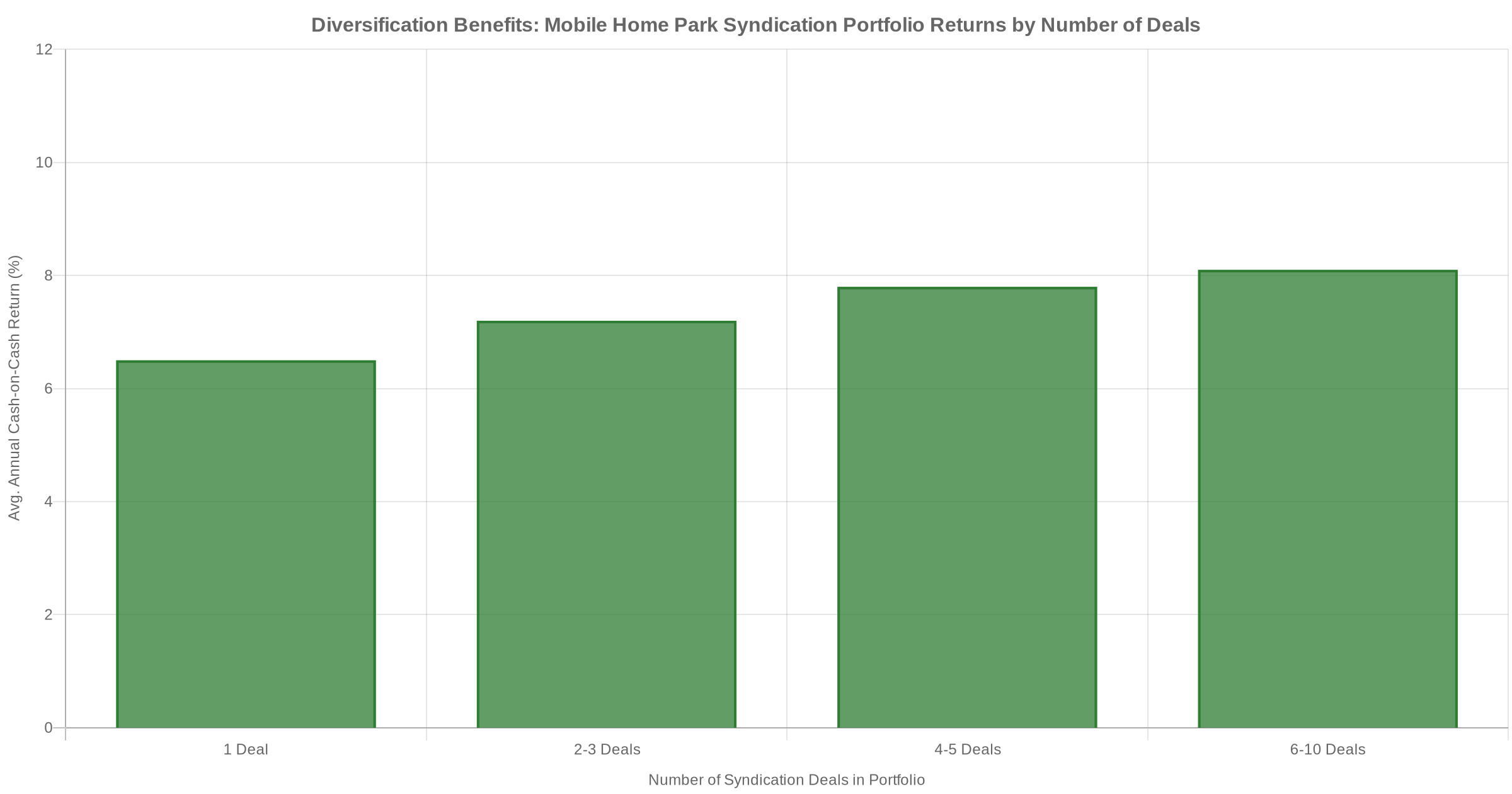
Every syndication carries deal-specific risk. A single mobile home park syndication could underperform due to local market conditions, operator execution issues, unexpected capital expenditures, or changes in the regulatory environment. If all your capital is in one deal, you live and die with its outcome.
Portfolio theory tells us diversification reduces unsystematic (deal-specific) risk without necessarily reducing expected returns. In the world of mobile home park syndications, this means:
- Geographic diversification across states reduces exposure to regional regulatory shifts
- Operator diversification reduces dependence on any single sponsor’s execution
- Vintage diversification (investing across different market cycles) smooths out entry-point risk
- Deal-size diversification mixes large stabilized assets with higher-upside value-add plays
For more foundational context on how mobile home park syndications are structured, see our mobile home park syndication guide.
How Much Capital Do You Need to Build a Portfolio?
Most mobile home park syndications have minimum investments ranging from $50,000 to $100,000 per deal. To build a portfolio of 4-6 deals — enough to achieve meaningful diversification — you are typically looking at $250,000 to $600,000 in investable capital deployed over several years.
That said, building a portfolio is not an all-at-once move. Most passive investors take a staged approach:
- Year 1-2: First deal. Learn the mechanics, review reports, understand distributions, meet the operator team.
- Year 2-3: Second deal with a different operator or different state. Start seeing the comparison points.
- Year 3-5: Third and fourth deals. Portfolio income starts to compound. Distributions from earlier deals can sometimes offset minimums in new ones.
- Year 5+: Portfolio matures. Some deals may have exited, returning capital for reinvestment. You are now recycling capital across new opportunities.
Diversification Strategies That Work
1. Diversify by Geography
The Southeast and Midwest are two of the strongest markets for mobile home park investing right now. North Carolina, Tennessee, Georgia, South Carolina, and South Dakota each have different regulatory climates, affordability dynamics, and population growth trajectories. Spreading investments across two or three states insulates your portfolio against state-specific headwinds like changes to landlord-tenant law or local permitting challenges.
2. Diversify by Operator
Not all mobile home park syndicators operate the same way. Some specialize in value-add turnarounds — buying distressed parks and improving operations. Others focus on stabilized assets with steady cash flow. Diversifying across two or three trusted operators gives you exposure to different risk/return profiles while reducing reliance on any one team’s execution.
If you have not yet evaluated multiple operators, our post on how to evaluate a mobile home park operator is a good starting point.
3. Diversify by Deal Type
There are two broad categories of mobile home park syndication deals:
- Stabilized cash-flow deals: Higher occupancy, predictable distributions, lower upside but lower risk
- Value-add deals: Below-market rents, vacant lots, operational inefficiencies — higher upside, higher execution risk
A well-constructed portfolio might blend 60% stabilized deals (for reliable quarterly distributions) with 40% value-add deals (for equity upside at exit). The right mix depends on your risk tolerance and income goals.
4. Diversify by Hold Period
Mobile home park syndications typically target hold periods of 5-7 years. If you stagger entry points — investing in deals 18-24 months apart — you avoid having all your capital in liquidity lockup at the same time. This creates a natural “ladder” effect where deals are exiting and returning capital at different times.
Two decades of hard-won lessons distilled into one free guide. Whether you are evaluating your first deal or your fiftieth, these insights will sharpen your approach.
Tracking and Managing a Multi-Deal Portfolio
Once you have two or more deals in your portfolio, staying organized matters. Here is what experienced passive investors track:
- Distribution schedule: When does each deal pay? Monthly, quarterly? Some deals pay quarterly from the start; others defer distributions during a value-add phase.
- Projected vs. actual returns: Is the deal performing to the original proforma? Most sponsors provide quarterly updates comparing actual NOI to projections.
- Capital events: When is each deal expected to refinance or sell? Refinances often return a portion of equity tax-free mid-hold.
- K-1 timeline: Mobile home park syndications typically issue K-1s by March 31. With multiple deals, K-1s stack up — plan your tax filing accordingly.
A simple spreadsheet tracking deal name, operator, state, entry date, projected hold, investment amount, distributions received, and projected exit date will serve you well. You do not need fancy software — consistency is the goal.
When to Reinvest Distributions vs. Spend Them
One of the most powerful aspects of a mobile home park syndication portfolio is what you do with distributions. You have two main options:
- Spend them: Use quarterly distributions as supplemental income to cover living expenses or reduce W-2 dependence.
- Reinvest them: Accumulate distributions in a dedicated account and use them to fund new syndication minimums.
For investors in wealth-building mode, reinvesting distributions — even partial reinvestment — dramatically accelerates portfolio growth. A $50,000 investment generating 8% cash-on-cash annually produces $4,000/year in distributions. Over 3-4 years, that is $12,000-$16,000 toward your next deal’s minimum.
Many sophisticated passive investors also use self-directed IRAs to compound tax-advantaged returns across multiple syndication deals.
Sizing Your Positions
Conventional portfolio wisdom suggests no single position should represent more than 20-25% of your total investable real estate capital. In syndication practice, this means:
- If you have $500,000 to allocate to mobile home park investments, consider 5-8 deals of $60,000-$100,000 each rather than 2-3 large positions
- If you are just starting out with $150,000, two deals of $75,000 each gives you meaningful diversification to start
- Do not sacrifice position size just to diversify — a $25,000 position in a $100,000 minimum deal may not be possible; focus on quality operators over quantity
Questions to Ask Before Adding Each New Deal
As your portfolio grows, adding a new deal should not be an automatic yes just because you have capital available. Ask:
- Does this deal add geographic or operator diversification, or am I doubling down on existing exposure?
- Is the business plan (value-add vs. stabilized) complementary to my existing deals?
- How does the projected exit timeline fit with my other deals’ schedules?
- Do I have tax capacity to absorb depreciation pass-throughs this year?
- Have I reviewed the operator’s track record on previous exits?
For a deeper look at what to evaluate before committing capital, see our guide on 15 questions to ask a mobile home park syndicator.
What a Mature Portfolio Looks Like
A passive investor who started building a mobile home park syndication portfolio in year one and continued steadily for 7-10 years typically ends up with:
- 3-5 active deals in various stages of the hold period
- 1-2 deals that have exited, returning substantial equity
- Meaningful quarterly cash flow — often $15,000-$40,000 per year depending on total capital deployed
- Significant tax-sheltered returns from depreciation pass-throughs on each deal
- A network of trusted operators and co-investors developed through years of participation
The compounding effect of recycled exit proceeds into new deals is where real wealth acceleration happens. Early exits return both original capital and profits — which then go back to work in new syndications with fresh depreciation benefits.
Conclusion
Building a mobile home park syndication portfolio is a methodical, long-term process. Start with one quality deal from a vetted operator. Learn the mechanics, follow the reports, understand the tax implications. Then diversify thoughtfully — by geography, operator, deal type, and hold period — as capital and opportunity align.
The investors who approach this consistently over a decade typically look back and wish they had started building their portfolio sooner. The time to understand the structure is before you need it.
If you would like to learn more about mobile home park investing and how experienced operators approach this asset class, reach out and we will set up a call.
10 video modules, a 55-page master checklist, and 9 ready-to-use templates that walk you through every step of evaluating a mobile home park deal — from the first site visit to closing day.
Get the top 20 lessons from two decades of mobile home park investing — free.