Regulatory risk is rarely the first thing a mobile home park investor thinks about when evaluating a deal. Cap rates, occupancy, lot rents, utility infrastructure — those get most of the attention. But in 2026, tenant protection legislation is becoming a genuine underwriting variable, and operators who aren’t tracking it are flying blind.
This isn’t a signal to avoid the asset class. Mobile home parks remain one of the most structurally sound real estate investments available, with national occupancy near 94% and a deeply entrenched affordable housing demand base that isn’t going anywhere. But understanding how the regulatory environment differs by state — and where it’s heading — gives operators and investors a meaningful edge at the deal table.
Here’s what you need to know about mobile home park tenant protection laws in 2026, with a focus on North Carolina, Tennessee, Georgia, and South Carolina.
Why Tenant Protections Are Expanding in Manufactured Housing
Mobile home park residents occupy a unique legal position: they typically own their homes but rent the land beneath them. That arrangement creates a power imbalance that advocacy groups and state legislatures have increasingly targeted over the past several years.
The growth of institutional capital in the sector has amplified this dynamic. When a local family sells a mobile home park to a regional operator or national fund, the story tends to attract attention — particularly if lot rents increase in the months following acquisition. High-profile displacement events, including cases in states like North Carolina, have drawn media coverage and legislative responses.
The result: a wave of tenant protection legislation across the country that is rewriting the rules of mobile home park ownership in many markets. As an operator or buyer, you need to know which rules apply where you’re investing.
The Four Main Categories of Tenant Protection Laws
Right of First Refusal (ROFR) Laws
A right of first refusal law requires a mobile home park owner, before completing a sale, to notify residents (or a qualified nonprofit or government entity) and give them a set window — typically 30 to 180 days — to match the purchase price. Over a dozen states have enacted ROFR laws as of 2026, including California, Colorado, Oregon, Washington, Connecticut, Maryland, Minnesota, Montana, New Hampshire, Rhode Island, and Vermont.
ROFR requirements complicate deal timelines and can affect financing arrangements. They don’t necessarily kill deals, but they do require careful structuring and advance legal review. Buyers in ROFR states need to build notice periods into their closing schedules.
Rent Increase Notice Requirements
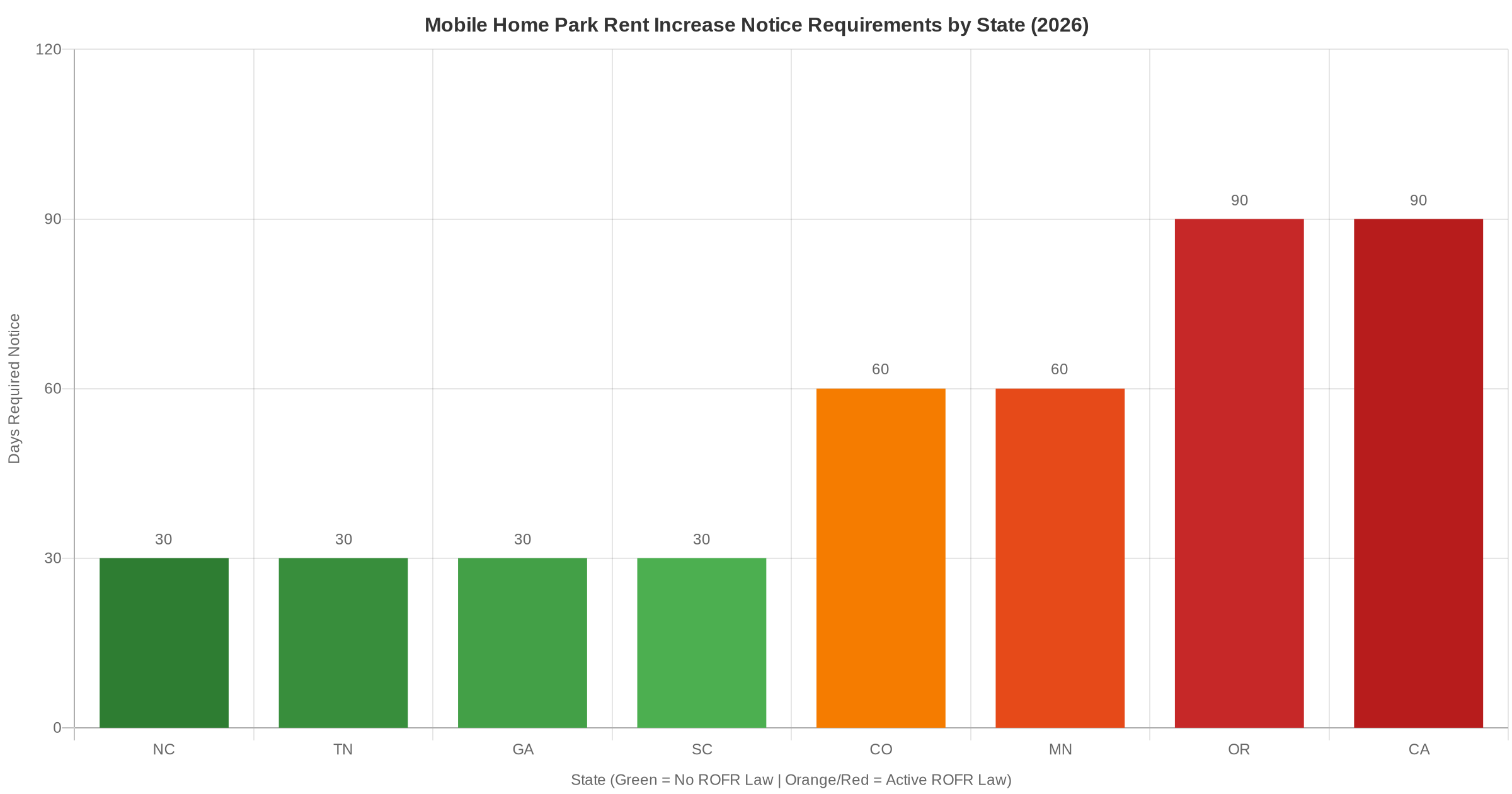
Every state has some baseline notice requirement before a rent increase can take effect — typically tied to the lease term (30 days for month-to-month tenancies). Some states have legislated longer advance notice for manufactured housing specifically. In California, for example, certain rent increase notices for mobile home parks require 90 days. Minnesota and Oregon have similar extended requirements.
These extended timelines matter when underwriting a value-add deal that assumes rapid lot rent increases post-acquisition. If you need 90 days of notice before each increase, your timeline to stabilized income stretches accordingly.
Just-Cause Eviction Protections
Just-cause eviction laws restrict a landlord’s ability to remove a tenant without a qualifying reason, even after a lease term expires. For mobile home park operators, this can limit the ability to remove non-paying residents, clear underperforming lots, or realign tenant mix. States with just-cause requirements typically allow eviction for non-payment, lease violations, criminal activity, and park closure — but eliminate at-will termination.
Park Closure Notice and Relocation Assistance
Several states now require extended advance notice — typically 12 to 18 months — before a mobile home park can close, along with mandatory relocation assistance funded by the operator. These provisions are most active in the Pacific Northwest and Northeast but are increasingly cited by Southeast advocates as models for new legislation.
10 video modules, a 55-page master checklist, and 9 ready-to-use templates that walk you through every step of evaluating a mobile home park deal — including regulatory and legal review. Get the MHP Due Diligence Playbook →
State-by-State Breakdown: NC, TN, GA, and South Carolina
North Carolina
North Carolina’s manufactured housing relationships are governed primarily by the Residential Rental Agreements Act (G.S. Chapter 42) and the state’s Manufactured Home Landlord-Tenant Act. The state requires standard notice periods for rent increases and lease terminations but does not currently have a statewide right-of-first-refusal law for mobile home parks.
That said, NC has been one of the more active states in the Southeast for tenant advocacy activity. A 2024 displacement event in Cary, NC attracted significant local media attention and renewed calls for stronger protections. Advocacy groups including the NC Justice Center and ROC USA have been pushing for ROFR legislation in the General Assembly. As of early 2026, no ROFR bill has passed in NC, but the momentum is real and worth monitoring.
NC operators should be particularly attentive to community communication practices. Proactive engagement — clear written notice, reason-based rent increase explanations, accessible management — tends to defuse the conditions that trigger legislative responses in the first place.
For a detailed look at evaluating mobile home parks in this market, see our guide on mobile home park due diligence.
Tennessee
Tennessee is generally considered a landlord-friendly state with limited statutory protections specific to manufactured housing tenants beyond standard landlord-tenant law. The state does not have a ROFR law as of 2026, and rent increase notice requirements follow the standard 30-day rule for month-to-month tenancies.
Tennessee’s political environment makes sweeping tenant protection legislation less likely in the near term, but operators should not interpret “currently landlord-friendly” as “permanently free of regulation.” Even traditionally light-touch states can move quickly when high-profile displacement events generate news coverage.
Georgia
Georgia also maintains a relatively light regulatory touch on mobile home park landlord-tenant relationships. There is no statewide ROFR law, and manufactured housing-specific tenant protections are limited. Standard 30-day notice requirements apply to rent increases under month-to-month tenancy arrangements.
Georgia’s strong population growth — particularly in metro Atlanta and its surrounding counties — has drawn increasing institutional interest in the state’s mobile home park inventory. More institutional activity tends to correlate with more media scrutiny, which can in turn prompt legislative activity. Operators should track any bills introduced in the Georgia General Assembly related to manufactured housing.
South Carolina
South Carolina is among the most landlord-friendly states in the country for real estate generally, and manufactured housing is no exception. There is no ROFR law, and tenant protections for mobile home park residents are minimal beyond the state’s landlord-tenant statute.
South Carolina’s Coastal region has seen significant mobile home park demand driven by workforce housing pressures, and lot rents have risen accordingly. The relative absence of regulation makes the market operationally efficient — though operators should remain attentive to the national trend and run their communities accordingly.
Two decades of hard-won lessons distilled into one free guide. Whether you’re evaluating your first deal or your fiftieth, these insights will sharpen your approach.
What This Means for Deal Underwriting
Regulatory risk should now be a standard line item in your mobile home park acquisition checklist. Specifically, you should be researching the following before signing a purchase agreement:
- Does the state have an active ROFR law? If so, what is the notice period, and who has the right to match (residents, nonprofits, government entities, or some combination)?
- What are the rent increase notice requirements? How does this affect your value-add timeline and first-year cash flow projections?
- Are there any active bills in the state legislature? Check session calendars and bill tracking sites for manufactured housing-specific legislation.
- What is the local political environment? A liberal-leaning college town in an otherwise landlord-friendly state can still generate local ordinances that affect your operations.
- Has there been any media coverage of mobile home park displacement or rent increases in the area? Local stories can catalyze local ordinances even without state-level action.
For buyers doing thorough pre-LOI research, our guide on what to look for in a mobile home park investment covers the broader due diligence framework.
How Responsible Operators Are Getting Ahead of Regulation
The best defense against adverse regulation isn’t lobbying — it’s operational excellence. The mobile home parks that attract legislative attention are almost universally ones where residents feel ignored, disrespected, or blindsided by management decisions.
Here’s what proactive operators are doing in 2026:
- Communicating rent increases in writing, with lead time. Even where only 30 days is legally required, giving 60 to 90 days notice and explaining the rationale (property tax increases, utility cost pass-throughs, infrastructure investment) dramatically reduces resident friction.
- Investing in community amenities. Clean common areas, functioning infrastructure, and responsive maintenance create goodwill that makes residents far less likely to organize or speak to local media.
- Maintaining professional management. Most resident grievances stem from poor management behavior — unanswered calls, deferred maintenance, inconsistent enforcement. Professional management removes most of the fuel for tenant advocacy campaigns.
- Engaging local officials proactively. Operators who introduce themselves to city council members, attend planning meetings, and participate in local housing discussions are rarely the ones who end up in the news.
Regulatory risk, in other words, is partially a management quality signal. Communities run well tend not to generate the political pressure that produces bad legislation.
You can find additional frameworks for evaluating mobile home park operators in our post on how to evaluate a mobile home park operator before you invest.
The Bottom Line
Mobile home parks in the Southeast remain among the most operator-friendly markets in the country. North Carolina, Tennessee, Georgia, and South Carolina do not currently have right-of-first-refusal laws, and rent increase notice requirements are at the standard 30-day baseline. That is a meaningful structural advantage compared to investing in California, Oregon, or Minnesota.
But the direction of travel nationally is clear: more scrutiny, more advocacy, and more legislative activity aimed at manufactured housing communities. Operators who track this environment, run their communities responsibly, and build genuine goodwill with residents will be well positioned — regardless of what any particular state legislature does next.
Get the MHP Due Diligence Playbook — the complete system for analyzing mobile home park acquisitions with confidence. Includes regulatory and legal review checklists, 55 pages of frameworks, and 9 ready-to-use templates. Get the Playbook →
Frequently Asked Questions
What is a right of first refusal law for mobile home parks?
A right of first refusal law requires a mobile home park owner to notify residents (or a designated nonprofit or government entity) before selling the property to an outside buyer, and to give them an opportunity to match the purchase price. Over a dozen states currently have ROFR laws, primarily in the West, Northeast, and Midwest. As of 2026, North Carolina, Tennessee, Georgia, and South Carolina do not have statewide ROFR requirements.
How do rent increase notice requirements affect mobile home park operations?
Most states require at least 30 days advance written notice before a rent increase takes effect for month-to-month tenants. Some states require 60 to 90 days for manufactured housing specifically. Extended notice requirements affect how quickly operators can implement post-acquisition lot rent increases, which in turn affects first-year cash flow projections on value-add deals.
Does North Carolina have tenant protection laws specific to mobile home parks?
North Carolina has the Manufactured Home Landlord-Tenant Act (G.S. Chapter 42) governing mobile home park landlord-tenant relationships. The state does not currently have a right-of-first-refusal law. Standard 30-day notice applies to rent increases and lease terminations. Advocacy groups have been pushing for stronger protections in the General Assembly, but no ROFR bill has passed as of early 2026.
What is just-cause eviction, and does it apply in southeastern mobile home park states?
Just-cause eviction laws prevent a landlord from removing a tenant without a qualifying legal reason — even after a lease term expires. These laws are common in California, Oregon, and some northeastern states but are not currently in effect in North Carolina, Tennessee, Georgia, or South Carolina. Operators in these states retain broader rights to terminate tenancy, subject to applicable notice periods.
Should I factor tenant protection laws into my mobile home park acquisition underwriting?
Yes — regulatory risk should be a standard part of pre-LOI due diligence on any mobile home park acquisition. Research current state law, any active legislation, and local political context. In Southeast target states the regulatory environment is currently favorable, but national trends suggest more activity ahead. Model conservative rent increase timelines and factor in the cost of community management best practices that reduce the political risk of adverse regulation.
10 video modules, a 55-page master checklist, and 9 ready-to-use templates that walk you through every step of evaluating a mobile home park deal — from the first site visit to closing day.
Get the top 20 lessons from two decades of mobile home park investing — free.