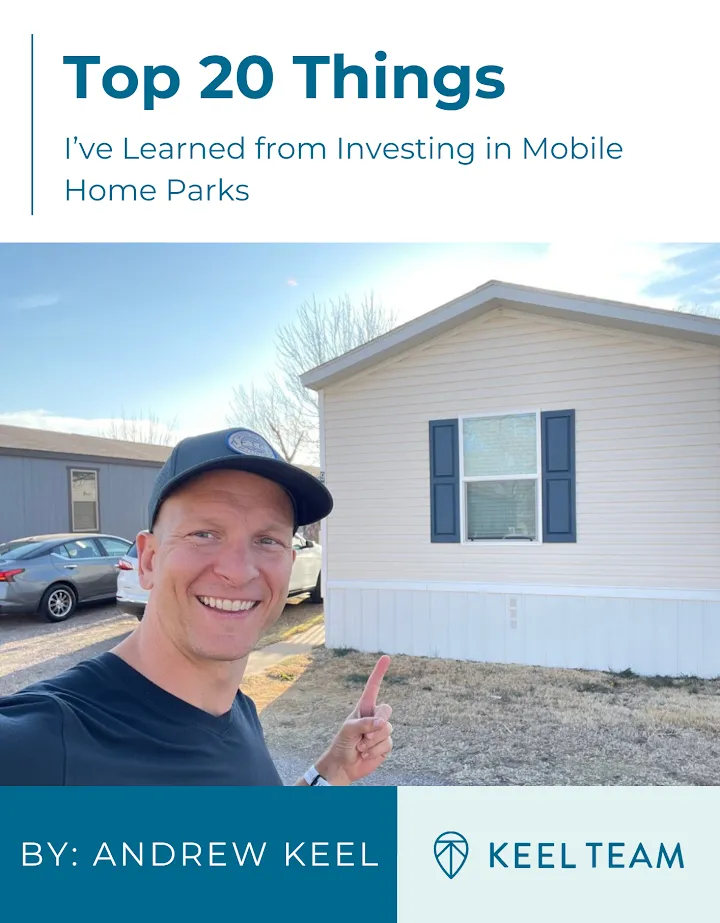
The Accredited Investor’s Guide to Mobile Home Park Syndications
Andrew Keel
[wpbread]
The Accredited Investor’s Guide to Mobile Home Park Syndications
If you’re a high-net-worth investor looking to diversify into real estate, mobile home park syndications offer a compelling combination of cash flow, tax efficiency, and recession resistance. But this asset class has its own language, its own metrics, and its own risks. Before you commit capital to any deal, you need to understand how it works.
This guide — developed by Keel Team Real Estate Investments, an operator with 50+ mobile home park acquisitions — gives you everything you need to evaluate a manufactured housing community syndication like an informed limited partner.
What’s Inside This Guide
How mobile home park syndications are structured — GP/LP roles, typical deal terms, preferred returns, and how distributions work
Why manufactured housing communities outperform — supply/demand fundamentals, the 44,000 parks that can’t be replicated, and recession resistance backed by data
The investment thesis explained — lot rent growth, tenant-owned home model, utility bill-back, and infill programs
10 critical questions to ask any syndicator — before you sign a subscription agreement
Key metrics every LP must understand — cap rate, DSCR, IRR, equity multiple, preferred return, and how to stress-test projections
Red flags to watch for — overleveraged deals, inexperienced operators, private utilities, unrealistic projections
How to read a deal package — what to look for in an offering memorandum
The LP due diligence process — operator verification, document review, legal document checklist
Glossary of 35+ mobile home park terms — from cap rate to RUBS to tenant-owned home model
Who This Guide Is For
This guide is written for accredited investors who are new to manufactured housing syndications, or who want to approach their next deal with more confidence and better questions. It’s the educational foundation that helps you make better decisions regardless of which operator you work with.
Why Mobile Home Parks?
Manufactured housing communities are one of the few real estate asset classes where demand consistently outpaces supply. No new large-scale mobile home parks have been built in decades due to zoning restrictions and NIMBYism — meaning the existing inventory of ~44,000 parks is essentially fixed. Meanwhile, the affordable housing crisis continues to drive demand for lower-cost living options.
For passive investors, the appeal is the combination of stable cash flow from lot rents, significant value-add upside through rent optimization and infill, and a business model that’s historically proven resilient through recessions.
Understanding the GP/LP Structure
In a mobile home park syndication, the General Partner (GP) sources, acquires, and operates the property. Limited Partners (LPs) provide equity capital and receive passive ownership in the deal. Typical structures include a preferred return (often 6–8%) paid to LPs before the GP earns a profit split, followed by a profit-sharing arrangement on cash flow and appreciation at exit.
Understanding this structure — and the incentives it creates — is fundamental to evaluating any deal.
Key Metrics to Evaluate
Cap Rate — Net Operating Income divided by purchase price. The lower the cap rate, the more you’re paying for each dollar of income.
DSCR (Debt Service Coverage Ratio) — NOI divided by annual debt service. Lenders typically require 1.25x minimum.
IRR (Internal Rate of Return) — The annualized return accounting for the time value of money across the hold period.
Equity Multiple — Total cash returned divided by total cash invested. A 2.0x equity multiple means you doubled your money.
Preferred Return — The minimum annual return LPs receive before the GP participates in profits.
Red Flags in MHP Syndications
Private water or sewer systems (significant liability and capex risk)
High percentage of park-owned homes (creates landlord/tenant risk, not lot rental)
Operators with fewer than 5–10 acquisitions in this specific asset class
Projections showing aggressive rent growth in year 1 without supporting market data
Loan-to-value above 75–80% with no interest rate cap in a floating rate environment
Markets with rent control or pending ROFR (right of first refusal) legislation
Andrew is a passionate commercial real estate investor, husband, father and fitness fanatic. His specialty is in acquiring and operating manufactured housing communities. Visit AndrewKeel.com for more details on Andrew's story.