Buying a mobile home park off-market starts with one document: the letter of intent. Get the LOI right and you build immediate credibility with the seller, protect yourself during due diligence, and set the tone for everything that follows. Get it wrong and you risk losing the deal before it starts — or locking into terms you did not see coming.
Whether you are submitting your first offer or your fiftieth, understanding how to structure a mobile home park letter of intent is one of the most practical skills an active buyer can develop.
What Is a Letter of Intent for a Mobile Home Park?
A letter of intent is a non-binding document that outlines the proposed terms of a purchase before a formal purchase and sale agreement is drafted. It is not a contract — but it is not casual either. A well-written LOI signals you are a serious buyer, establishes the basic economics of the deal, and creates a framework for the more detailed agreement that follows.
Most sellers — especially direct-to-owner mobile home park sellers who have never sold a commercial property before — will not know what they want until they see a credible offer in front of them. That makes the LOI both a negotiating tool and a trust-building document.
When to Submit an LOI
Submit after you have done enough preliminary underwriting to know the deal has potential — but before you have spent serious time or money on formal due diligence. A sound acquisition process looks like this:
- Initial contact and relationship building with the seller
- Basic financial review (rent roll, occupancy, utility setup, rough net operating income)
- Site visit or virtual walkthrough
- LOI submitted and negotiated
- Executed LOI triggers formal due diligence period
- Purchase and sale agreement drafted
- Close
The biggest mistake inexperienced buyers make: waiting too long to submit. If you have done a site visit and the numbers work at your target price, submit the LOI. You will learn more in the due diligence period than by stalling.
Key Terms Every Mobile Home Park LOI Should Include
1. Purchase Price
State your proposed purchase price clearly. If you are using a cap rate-based valuation, include a brief rationale explaining your net operating income estimate and the capitalization rate you applied. This shows the seller you have done the math and are not throwing out an arbitrary number. For a deeper look at valuation methodology, see our mobile home park valuation guide.
2. Earnest Money Deposit
Specify the earnest money amount and when it becomes hard (non-refundable). For mobile home parks, $25,000 to $75,000 is common on smaller transactions; larger deals may require more. Keep the deposit soft (fully refundable) during the due diligence period and hard only after DD closes. Never let earnest money go hard before completing utility inspections, title review, and financial verification.
3. Due Diligence Period
Request 45 to 60 days for due diligence. This is your window to verify everything: rent rolls, leases, utility infrastructure, environmental status, title, survey, and financials. Mobile home parks have more moving parts than single-family or small multifamily properties — 45 days is the minimum for any park over 50 lots. Your LOI should specify that the due diligence period begins upon execution (both parties signing) and that you have the unilateral right to terminate for any reason during this window with a full deposit refund.
4. Financing Contingency
If you are financing the purchase, include a financing contingency that protects you if the loan does not come through. State the expected loan type (agency, community bank, seller financing) and the deadline for receiving a commitment letter. For a full breakdown of loan types, see our mobile home park financing guide.
5. Closing Timeframe
Specify a target closing date — typically 30 to 45 days after the due diligence period ends. Build in buffer. Agency debt (Fannie Mae and Freddie Mac programs) can take 60 to 90 days to close from application; community bank loans typically run 30 to 45 days. Know your financing timeline before committing to a closing date in the LOI.
6. Inclusions and Exclusions
Be explicit about what is included in the purchase price: real property, park-owned homes, office equipment, maintenance equipment, vehicles, and existing resident leases. If the seller has park-owned homes you do not want, say so upfront. Ambiguity here causes expensive disputes later.
7. Exclusivity / No-Shop Period
Request that the seller agrees not to market the property or accept other offers during the due diligence period. This is standard and most sellers accept it once they have signed — they are mentally under contract at that point even if the document is technically non-binding.
Two decades of hard-won lessons distilled into one free guide. Whether you are evaluating your first deal or your fiftieth, these insights will sharpen your approach.
What to Avoid in Your Mobile Home Park LOI
Overpromising on Price
Do not submit an LOI at a price you cannot support with the numbers. Sellers talk to each other, brokers remember buyers who retrade, and your credibility in a market is a long-term asset. If the numbers support a lower figure, start a conversation — do not inflate your LOI to get a foot in the door and then renegotiate after due diligence. See our guide on how to negotiate when buying a mobile home park for proven tactics.
Ignoring Utility Infrastructure Upfront
Before finalizing your LOI price, ask about the utility infrastructure. Is it city water and city sewer? Does the park operate its own well or lagoon? Private utility systems create significant ongoing liability and capital exposure that can shift your underwriting by hundreds of thousands of dollars. Read our full guide on mobile home park water and sewer due diligence.
Not Securing an Exclusivity Period
Without a no-shop clause, you risk spending 45 days on due diligence only to lose the deal to a buyer who showed up late. Most sellers agree to exclusivity once they have signed — it is a reasonable ask and a sign of mutual commitment to the transaction.
Mobile Home Park Acquisition Timeline
One of the most common questions from first-time buyers is how long the process takes from signed LOI to closing day. Here is a realistic look at each phase:
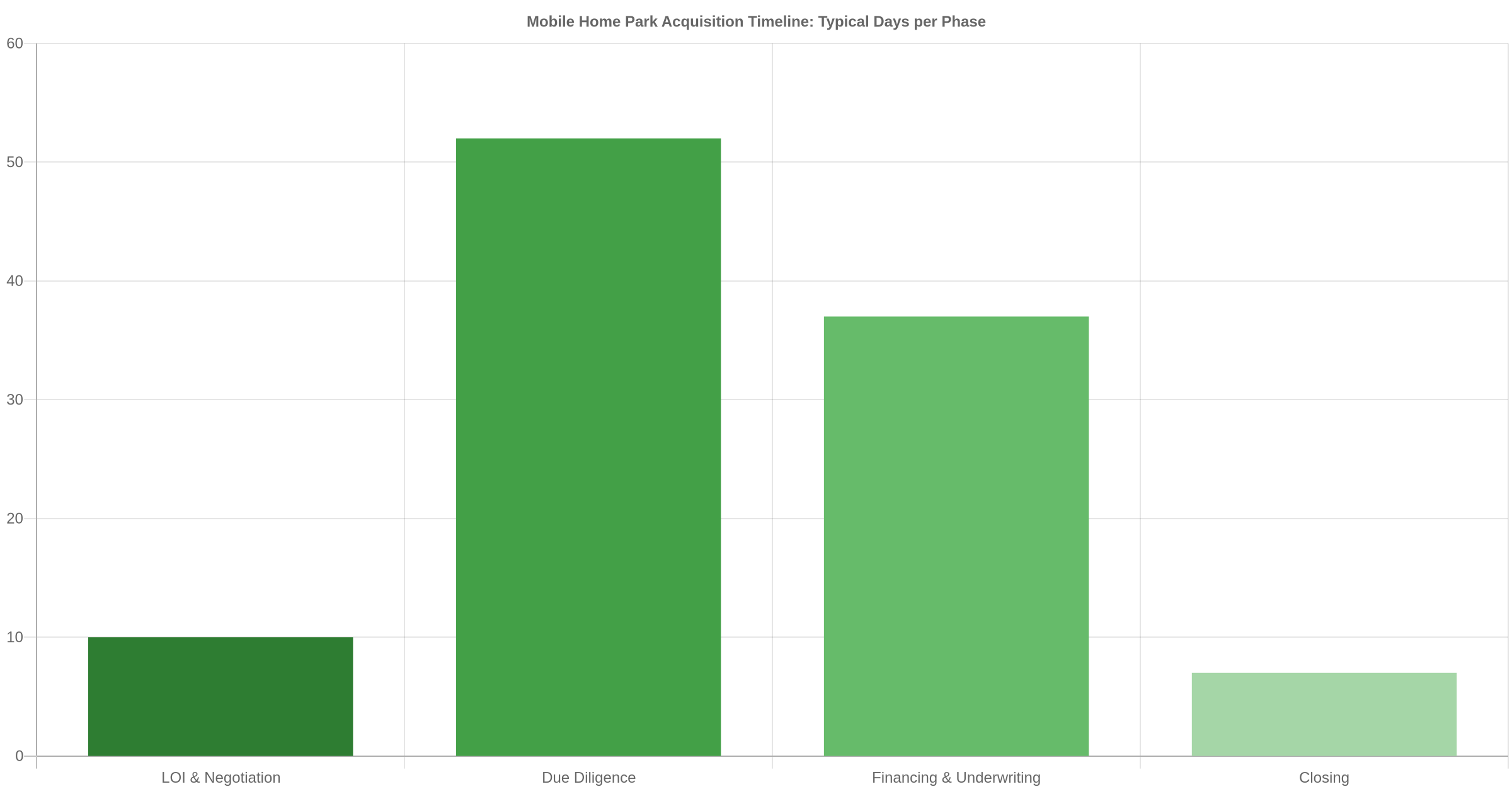
Direct-to-owner off-market transactions often move faster in the LOI and negotiation phase — sellers who know you personally are more likely to sign quickly. But due diligence and financing timelines are driven by process requirements, not relationships.
A Note on Direct-to-Owner Sellers
Mobile home park owners selling directly — not through a broker — often have not been through a commercial real estate transaction before. Your LOI should be clear and readable, not a dense legal document. Explain in plain English what each section means. Sellers who understand what they are agreeing to are far more likely to sign.
Many experienced buyers include a brief phone call alongside the LOI submission to walk the seller through what happens next and answer questions. That human touch often makes the difference between a signed LOI and a seller who goes quiet.
After the LOI: What Comes Next
Once both parties sign the LOI, the clock starts. Your due diligence period is live and you should be moving immediately on:
- Ordering a Phase I Environmental Site Assessment
- Requesting full financials (two to three years of operating statements)
- Reviewing all resident leases and verifying the rent roll against actual deposits
- Inspecting utility infrastructure (water, sewer, electric metering)
- Getting a title commitment ordered
- Submitting your loan application if financing
- Scheduling a detailed site visit with a mobile home park inspector or consultant
For a complete checklist of what to verify, see our mobile home park due diligence checklist. Once the due diligence period closes, you will move into the formal purchase and sale agreement — review our guide on mobile home park purchase agreement key terms before signing.
Conclusion
A strong mobile home park letter of intent is not complicated — but it needs to be clear, credible, and complete. Nail the purchase price, protect yourself with a proper due diligence period, specify what is included, and keep earnest money soft until you have verified what you are buying. Do that consistently and you will move through the acquisition process with fewer surprises and more deals that close.
For experienced mobile home park buyers, the LOI process is often where the real negotiation happens — not at the closing table. Learn it well and you will have a meaningful edge in the off-market deal pipeline.
10 video modules, a 55-page master checklist, and 9 ready-to-use templates that walk you through every step of evaluating a mobile home park deal — from the first site visit to closing day.
Frequently Asked Questions About Mobile Home Park Letters of Intent
Is a mobile home park LOI legally binding?
No. A letter of intent is typically non-binding — either party can walk away without legal penalty. Specific provisions such as the exclusivity clause can be written as binding, but the general terms are not. Your purchase and sale agreement is the binding contract.
How long should the due diligence period be in a mobile home park LOI?
For any mobile home park over 50 lots, request 45 to 60 days. Smaller parks may be manageable in 30 days, but it is easier to close early than to ask for extensions. Budget more time than you think you need.
Should I use an attorney to write my mobile home park LOI?
Having an attorney review your LOI template is worthwhile — especially for your first deal. Once you have a trusted template, you can adjust it deal by deal. Always use an attorney for the purchase and sale agreement itself.
Can a seller back out after signing an LOI?
Yes. Since a letter of intent is non-binding, a seller can legally withdraw. This is why relationship-building matters in direct-to-owner acquisitions. Having a signed exclusivity clause reduces but does not eliminate this risk.
What is a typical earnest money deposit for a mobile home park?
Most buyers offer one to two percent of the purchase price, kept soft (fully refundable) through the due diligence period. On a $2 million acquisition, that is $20,000 to $40,000. Never let earnest money go hard before completing your core due diligence items.
Get the top 20 lessons from two decades of mobile home park investing — free.