Negotiating the purchase of a mobile home park is unlike almost any other real estate transaction. Sellers are often long-time family owners. Valuations hinge on net operating income — not comparable sales. And the deal structure can matter just as much as the headline price.
This guide walks through how to approach mobile home park purchase negotiations step by step: from pre-offer research to closing-day protections.
Why Mobile Home Park Negotiations Are Different from Other Real Estate
Before you submit your first offer, it helps to understand why mobile home parks negotiate differently than apartments, commercial properties, or single-family homes.
Sellers are often emotionally attached. Many mobile home park owners built or bought their communities decades ago. They know the residents by name. Coming in with an aggressive lowball can offend them into walking away — even if your price is defensible on the numbers.
Valuations are income-based, not comp-based. There are no comparable sales to anchor a mobile home park’s value. The price is derived almost entirely from net operating income (NOI) and the cap rate a buyer applies to it. This gives buyers who understand underwriting significantly more room to justify their position — and push back on a seller’s price expectations.
Deal structure is a real lever. Seller financing, due diligence period length, earnest money timing, and closing flexibility all affect the real economics of the deal. Sellers who won’t move on price will sometimes move substantially on terms — and terms can be more valuable than a small price reduction.
Step 1: Build Your Case Before You Make an Offer
Effective mobile home park negotiation starts long before you send a Letter of Intent. Pre-offer research shapes how credibly you can defend your price — and where you have room to push back.
Before submitting any offer, you should have verified:
- Current lot rents vs. market rates — call nearby mobile home parks and check online listings to confirm where the seller’s rents sit relative to the market
- Actual occupancy — physically count occupied lots, or verify against utility billing records. Never rely solely on what the seller reports.
- Utility infrastructure type — city water and sewer vs. private well and septic carries dramatically different risk, and dramatically different value
- Road and infrastructure condition — deferred capital expenditures are negotiating currency
- Seller motivation — estate settlement, health, retirement, or tax pressure all affect what matters most to the seller beyond price
The deeper your pre-offer knowledge, the more confidently you can support a number that protects your return.
For a comprehensive look at what to examine before making an offer, see our full guide to investing in mobile home parks.
Step 2: Submit a Credible LOI — Not a Lowball
Your Letter of Intent (LOI) sends the first negotiation signal. A common mistake is going in aggressively low with the plan to “meet in the middle.” With long-time family owners, that approach often backfires — it signals that you don’t understand the asset or that you’re not serious.
A stronger approach: submit a credible offer anchored to documented assumptions.
“We’re offering $X based on the trailing 12-month NOI of $Y at a Z% cap rate. This reflects X occupied lots, average lot rent of $Z/month, and city water and sewer. We’re requesting a 60-day due diligence period and $X in earnest money.”
When your offer is tied to specific, verifiable data, you turn the negotiation into a logical discussion — not a bidding war. If the seller pushes back, you can point to the numbers rather than argue about gut feeling.
Every LOI should also specify:
- Earnest money amount and when it goes non-refundable (“goes hard”)
- Due diligence period length (60–90 days is standard for mobile home parks)
- Whether you’re seeking seller financing and at what rate and term
- Key contingencies: financing, physical inspection, title, environmental
- Target closing date
Step 3: Work These Key Negotiation Levers
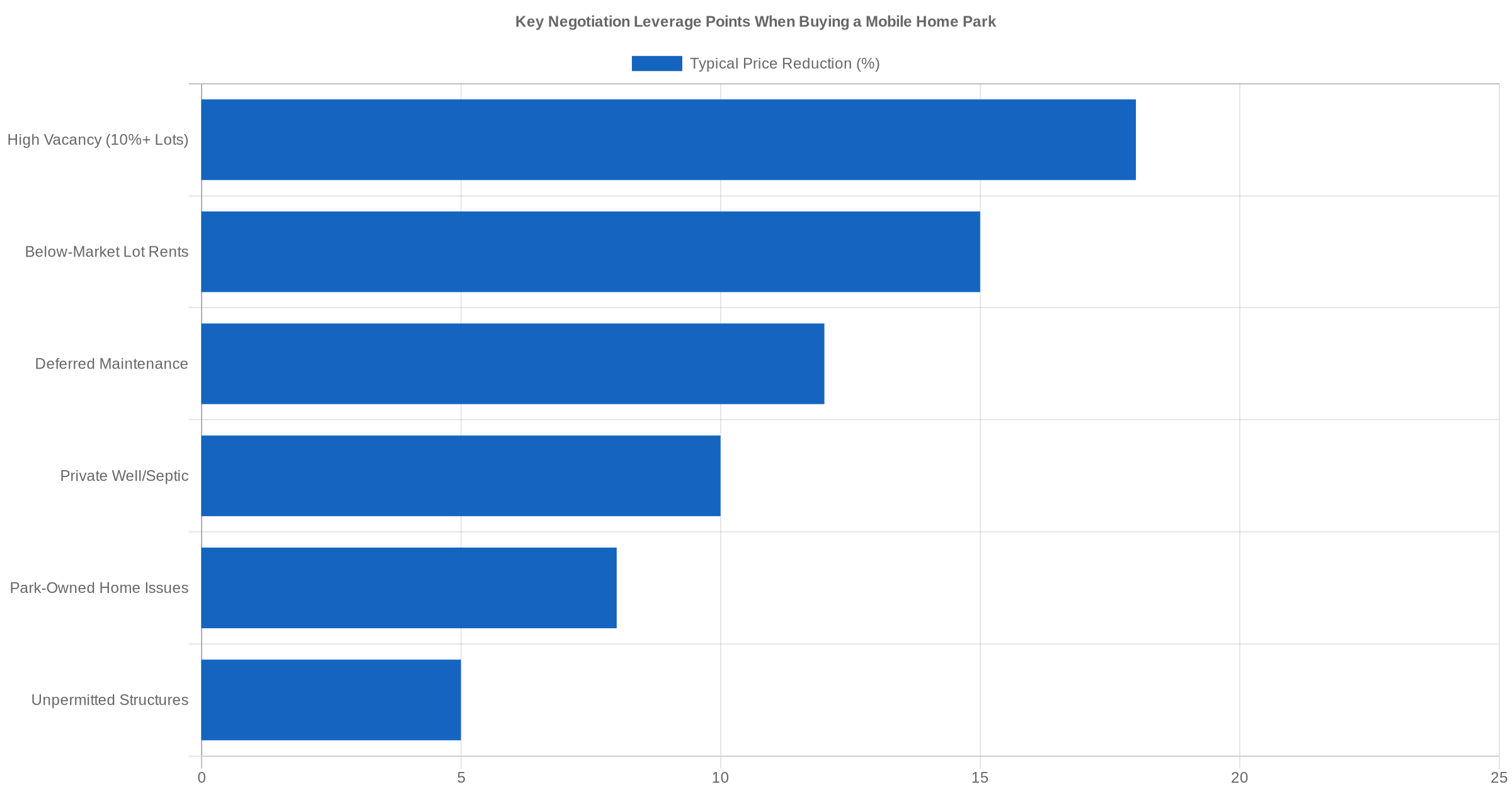
Price is one lever. Experienced mobile home park investors know there are several others — and they’re often more powerful.
Below-Market Lot Rents
If a mobile home park charges $275/month in lot rent while comparable communities in the same market charge $375, the seller may be pricing on “potential” — the future value once rents are raised. But you’re the one taking the execution risk to close that gap. Use below-market rents as a justified basis for a lower purchase price today, priced on current cash flow.
High Vacancy
Vacant lots generate no income. If a mobile home park has 25% vacancy, the seller shouldn’t price it as if those lots are occupied. Every vacant lot represents an infill execution cost — purchasing a home, installing it, marketing it, placing a tenant — that you’re absorbing. Vacancy should reduce the price meaningfully.
Deferred Maintenance
Roads in poor condition, aging water lines, failing electrical pedestals, overgrown common areas — all of these represent capital you’ll need to spend after closing. Get repair estimates during due diligence and use them as documented justification for a price reduction or seller credit at closing.
Seller Financing
Long-time family owners often prefer to spread out a taxable gain rather than trigger it all at once. Offering seller financing — where the owner carries a note at a reasonable interest rate (typically 5–7%) — can unlock better pricing, lower your required cash at close, and simplify the financing process. Ask for it even if you don’t initially think you need it. You may be surprised how often sellers are open to the conversation.
Extended Due Diligence Period
In mobile home parks, 60–90 days of due diligence isn’t a luxury — it’s a necessity. You need time to verify utility records, inspect infrastructure, survey lots, test water quality if you’re on a private well, review all leases, and complete third-party reports. If a seller is pushing for 30 days, ask why. Don’t let timeline pressure force you into an under-diligenced acquisition.
Two decades of hard-won lessons distilled into one free guide. Whether you’re evaluating your first deal or your fiftieth, these insights will sharpen your approach.
Step 4: How to Handle the Counter-Offer
Expect to go two to four rounds before a price is agreed. Here’s how to handle counters effectively:
Counter the logic, not just the number. If the seller counters $150K above your offer, don’t simply split the difference. Respond with documented rationale: “Our offer reflects actual trailing NOI of $X. To support your counter price, the property would need to generate $Y in NOI — and current operations don’t support that. Here’s what would need to change for us to get there.”
Use due diligence findings to re-trade if warranted. Even after an LOI is signed, discoveries during due diligence can justify a price reduction. Infrastructure issues, environmental findings, lower actual occupancy, or mobile homes in worse condition than represented are all legitimate grounds for renegotiation. Document everything as you find it.
Know your walk-away number before you start. Determine your maximum price before the first offer — and hold it. The deals that cost investors most are the ones where they kept stretching to close after falling in love with a property. Set the ceiling. Hold it.
Step 5: Protect Yourself in the Purchase Agreement
Negotiation doesn’t end at price agreement. How you structure the purchase contract determines how protected you are if something unexpected surfaces at or after closing.
Key protections to negotiate into every mobile home park purchase agreement:
- Representations and warranties on rent rolls, utility records, and occupancy levels
- Environmental indemnification — especially critical if the mobile home park has older septic systems, underground fuel storage, or neighboring industrial uses
- Tenant estoppels confirming lease terms in larger acquisitions
- Right to assign the contract to an entity not yet formed at signing
- Proration mechanics for lot rent and utilities at closing
- Survival period on representations and warranties (typically 12–24 months post-close)
Work with an attorney who has specific manufactured housing or mobile home park transaction experience. General real estate counsel regularly misses nuances in these deals — from lease assignment issues to utility easement problems.
Common Mistakes Buyers Make in Mobile Home Park Negotiations
After two decades of acquiring mobile home parks, these are the negotiation mistakes we see most often:
- Trusting seller-provided financials without verification — always re-underwrite from bank statements, actual utility bills, and physical occupancy counts
- Not asking about seller financing — it’s available more often than buyers assume, especially with long-time family owners
- Letting the seller’s broker control the due diligence pace — you set the timeline, not the broker representing the other side
- Skipping physical inspection of park-owned homes — these can represent significant hidden liability and deferred maintenance costs
- Agreeing on price before understanding utility infrastructure — private well and septic systems can represent $300K–$700K in future capital expenditures on a mid-size community
For more on what trips up first-time buyers, see our post on first-time mobile home park investor mistakes to avoid. And for a detailed walkthrough of what to verify before closing, see our mobile home park due diligence checklist.
The Bottom Line on Negotiating Mobile Home Park Deals
Negotiating a mobile home park acquisition well requires three things: solid pre-offer research, a disciplined underwriting floor, and the patience to work multiple levers beyond just the purchase price. The investors who close the best deals aren’t the most aggressive — they’re the most prepared.
Come to the table with verified data. Make offers you can defend. Protect yourself in the contract. And know when to walk away.
If you’re actively looking for your first — or next — mobile home park deal, start by getting your underwriting model dialed in before you make any offers. Know your target return, your maximum price, and the specific value-add thesis you’re pursuing. That foundation will make every negotiation sharper.
For more on evaluating mobile home park deals from start to finish, explore our full guide to investing in mobile home parks.
10 video modules, a 55-page master checklist, and 9 ready-to-use templates that walk you through every step of evaluating a mobile home park deal — from the first site visit to closing day.
Get the top 20 lessons from two decades of mobile home park investing — free.