Capital expenditure planning is one of the most overlooked disciplines in mobile home park investing — and one of the most expensive mistakes operators make. When a $150,000 road repair hits unexpectedly, or a water main failure requires $80,000 in emergency work, it’s not just a cash flow problem. It’s a return-killing surprise that erodes years of NOI gains in a single quarter.
The good news: experienced mobile home park operators plan for these moments long before they happen. This guide breaks down exactly how to budget for capital expenditures, what categories matter most, and how to build a reserve fund that protects your investment — and your investors — over the long haul.
For a complete framework on evaluating mobile home park deals from the ground up, see our Mobile Home Park Investing Guide.
What Counts as Capital Expenditure in a Mobile Home Park?
Capital expenditures (CapEx) are investments in long-lived assets — typically items with a useful life of more than one year that maintain or improve the value of the property. This is distinct from operating expenses (OpEx), which cover recurring costs like management fees, utilities, insurance, and routine maintenance.
In a mobile home park context, the major CapEx categories are:
- Roads and pavement — Asphalt resurfacing, pothole repairs, gravel base replacement, drainage improvements
- Water and sewer infrastructure — Main line replacements, lift station upgrades, meter installations, well or pump work
- Electrical systems — Pedestal replacements, panel upgrades, underground conduit, streetlight replacement
- Community structures — Clubhouse renovation, laundry facility upgrades, office/storage buildings
- Common area improvements — Landscaping, fencing, signage, playground equipment, mailbox structures
- Park-owned homes — If you carry any park-owned homes, major repairs, HVAC, roofing, and skirting replacement qualify as CapEx
Understanding the distinction matters for two reasons: CapEx gets depreciated over time (tax benefit) while OpEx is expensed immediately, and CapEx has a fundamentally different cash flow impact that requires advance planning rather than monthly accrual.
How to Estimate CapEx During Due Diligence
Most acquisition mistakes stem from underestimating CapEx at the time of purchase. A thorough mobile home park due diligence checklist will flag the major CapEx risks before you close, but you need a framework for estimating actual dollar exposure.
Here’s how experienced operators approach it:
1. Age the Infrastructure
Ask the seller when roads were last resurfaced, when the water and sewer lines were last replaced or inspected, and when electrical pedestals were last upgraded. If the answer is “I’m not sure” or “we patch as needed,” assume everything is near end of useful life and budget accordingly.
2. Hire the Right Inspectors
A general property inspector is not enough. For a mobile home park, you need:
- A licensed plumber to camera-inspect the main sewer lines
- An electrician to evaluate the distribution system
- A civil engineer or pavement contractor to assess road condition and drainage
These inspections typically cost $3,000–$8,000 total for a mid-size community — a small price compared to the cost of buying a property with $400,000 in deferred infrastructure work.
3. Use Per-Lot Benchmarks
Industry experience suggests a healthy mobile home park should budget roughly $400–$600 per lot per year for long-term CapEx reserves across all categories. The chart below shows how that typically breaks down by category.
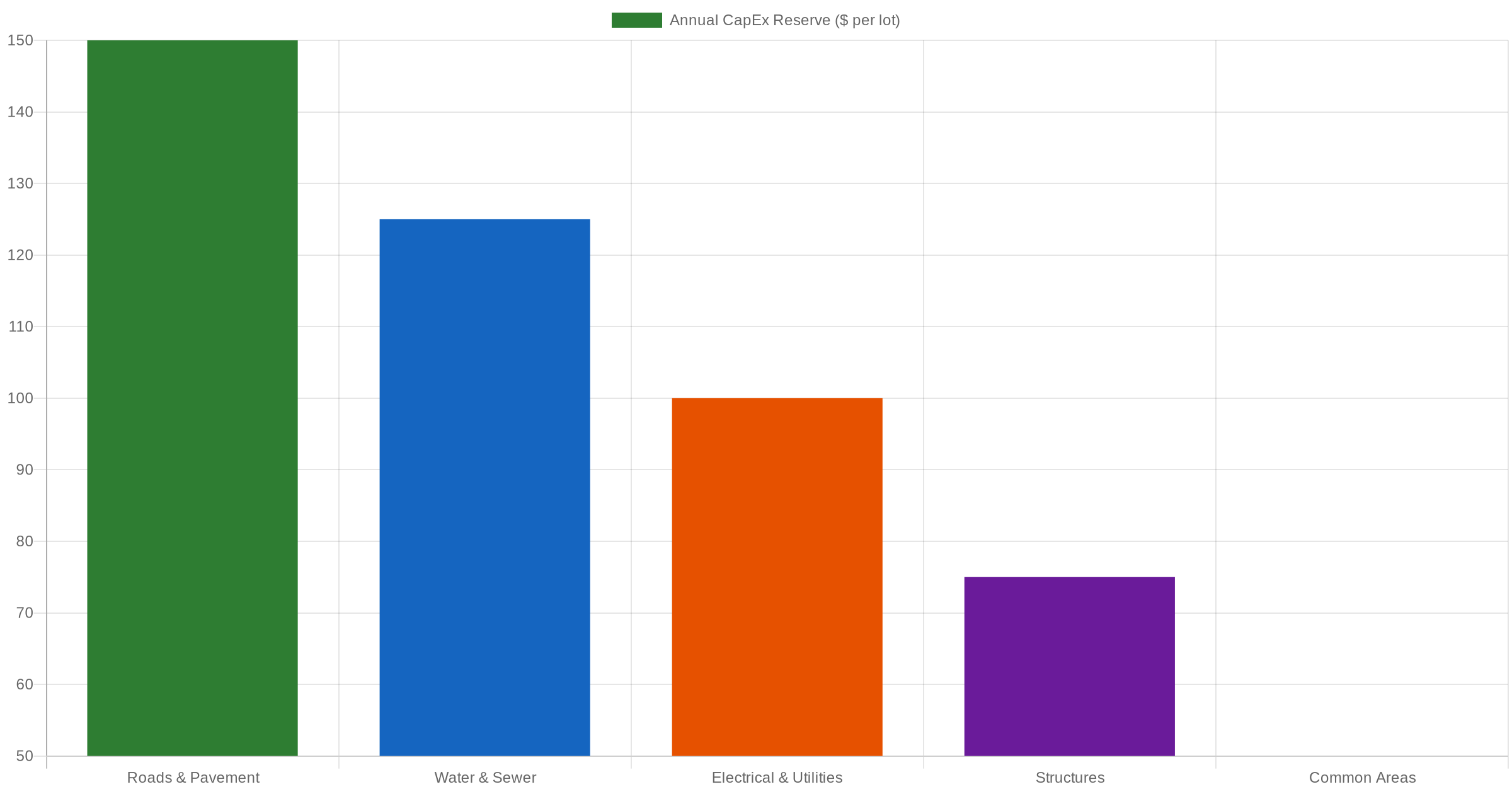
A 100-lot mobile home park, for example, should ideally carry a $40,000–$60,000 annual CapEx reserve. Parks with older infrastructure, private utilities, or deferred maintenance may require significantly more.
Two decades of hard-won lessons distilled into one free guide. Whether you’re evaluating your first deal or your fiftieth, these insights will sharpen your approach.
Building a CapEx Reserve Fund
The reserve fund is where planning meets execution. Here’s how to structure it:
Set a Monthly Reserve Contribution
Divide your annual CapEx budget by 12 and treat it as a fixed line item on your operating budget — just like management fees or insurance. This amount flows into a segregated reserve account, not the general operating account.
Example: A 120-lot mobile home park at $500/lot/year in reserves sets aside $5,000/month. Over three years, that’s $180,000 — enough to handle most mid-size road or utility projects without requiring a capital call or taking on debt.
Separate the Reserve Account
Keep CapEx reserves in a dedicated savings or money market account. Mixing reserves with operating cash is a common mistake — it creates the illusion of strong cash flow until the first major repair hits and the account is empty.
Prioritize by Risk and Age
Not all CapEx is equal. Rank your reserve deployment by:
- Safety and compliance risk (electrical hazards, failing lift stations, water contamination)
- Revenue protection (infrastructure that affects occupied lot rent collection)
- Curb appeal and leasing (road quality, signage, landscaping)
- Long-term value enhancement (clubhouse renovations, amenity additions)
This prioritization framework ensures your reserve dollars go to the highest-impact items first — not just the most visible ones.
CapEx Planning for Value-Add Mobile Home Parks
If you’re acquiring a value-add mobile home park — one with deferred maintenance, infrastructure issues, or below-market lot rents — CapEx planning requires a different approach than a stabilized community.
In a value-add scenario:
- Year 1–2 CapEx is front-loaded. You’re catching up on deferred maintenance while simultaneously bringing the property up to operating standards. Budget $800–$1,500+ per lot in the first two years if infrastructure is significantly deferred.
- CapEx and lot rent increases are linked. The investment thesis for most value-add mobile home parks involves raising rents to market — but that’s harder to execute if roads are crumbling or utilities are unreliable. Spending on infrastructure first supports the rent increase story.
- Model it in your underwriting. Our guide to stress-testing a mobile home park investment walks through how to model heavy CapEx scenarios and their impact on projected returns.
The operators who consistently outperform underwrite CapEx conservatively and are pleasantly surprised. The ones who get burned budget optimistically and get hit with surprises.
Common CapEx Surprises — and How to Avoid Them
Even well-underwritten mobile home parks can get hit with unexpected CapEx. The most common culprits:
- Sewer line root intrusion. Trees planted years ago grow roots into clay or cast iron sewer mains. A camera inspection during due diligence is the only reliable way to catch this before closing.
- Undersized electrical infrastructure. Older mobile home parks were built when average home electrical demand was much lower. As residents add HVAC systems, electric vehicles, and modern appliances, older panels and service lines can’t keep up.
- Road base failure. Surface patching on a failed road base is money wasted. Without a proper sub-base evaluation, you can spend $30,000 on resurfacing and need to do it again in two years.
- Storm drainage issues. Inadequate drainage leads to erosion, road damage, and in severe cases, flooding of occupied lots. This is particularly relevant in Southeast markets (NC, TN, GA, SC) where heavy rainfall is common.
A systematic approach to increasing mobile home park value accounts for these risks upfront rather than discovering them mid-hold.
How CapEx Affects NOI and Valuation
Here’s a nuance many newer investors miss: CapEx itself doesn’t appear in net operating income (NOI) calculations — but how you account for it directly affects how you’re valued.
When you sell a mobile home park, buyers will underwrite based on trailing NOI. If you’ve been funding reserves from NOI (effectively treating reserves as an operating expense), your NOI looks lower — and your asking price may suffer. But if you haven’t funded reserves and the property needs significant capital work, sophisticated buyers will simply deduct it from their offer.
The cleanest approach: maintain proper reserves, keep them separate from operating cash, and present them transparently in your financial package. Buyers who understand mobile home park operations will recognize this as a sign of disciplined management — and price accordingly.
For a deeper dive on how NOI flows into valuation, see our guide to calculating net operating income for a mobile home park.
Conclusion: CapEx Planning Is a Competitive Advantage
Disciplined capital expenditure planning separates professional mobile home park operators from amateur ones. It protects cash flow, avoids emergency borrowing, supports tenant retention, and directly impacts what a buyer will pay when you’re ready to exit.
The framework is simple: know your infrastructure, age your assets, set realistic per-lot reserves, fund them consistently, and prioritize by risk. Do this well, and CapEx stops being a source of anxiety and starts being a tool for driving long-term returns.
10 video modules, a 55-page master checklist, and 9 ready-to-use templates that walk you through every step of evaluating a mobile home park deal — from the first site visit to closing day.
Get the top 20 lessons from two decades of mobile home park investing — free.