The idea sounds appealing: buy a parcel of raw land, install infrastructure, and create a brand-new mobile home park community from the ground up. Control the design, pick the lot sizes, choose the utility setup, and build something exactly the way you want it.
In theory, it works. In practice, it’s one of the most difficult real estate development projects you can attempt in the current regulatory environment. That’s not a reason to dismiss it entirely — but it is a reason to understand exactly what you’re getting into before you write a check for raw land.
This guide breaks down what it costs to develop a mobile home park from scratch, the timeline you should expect, and why the overwhelming majority of experienced mobile home park operators — including Keel Team — focus on acquiring existing communities rather than building new ones.
Why Almost No New Mobile Home Parks Are Being Built
Before we get into the development process, it helps to understand the context. Across the entire United States, fewer than 20 new mobile home park communities are permitted and developed each year — out of roughly 45,000 existing communities. That’s a new supply rate of roughly 0.04% per year.
This isn’t an accident. It’s the result of a decades-long regulatory squeeze that makes new mobile home park development extraordinarily difficult in most markets:
- Zoning restrictions: Most municipalities have either downzoned land formerly available for manufactured housing communities, or simply don’t permit new mobile home park development at all. NIMBY (not-in-my-backyard) opposition is intense, and local governments often respond by classifying MHP zones as non-conforming uses.
- Entitlement risk: Even if you find a parcel that appears zoned appropriately, variance processes and conditional use permits are lengthy, expensive, and uncertain. You can spend $100,000+ in legal and engineering costs before knowing whether the project is viable.
- Infrastructure requirements: Modern permitting standards require engineered stormwater, road setbacks, utility separation, and environmental review — adding cost and time that didn’t exist in the 1950s and 1960s when most existing parks were built.
This supply constraint is actually one of the core investment theses for why mobile home parks are considered a strong asset class — but it also means that anyone trying to add to that supply faces enormous headwinds.
What Does It Actually Cost to Develop a Mobile Home Park from Scratch?
Cost estimates vary widely by state, market, and site conditions — but here’s a realistic per-lot breakdown for a ground-up development project based on current market data:
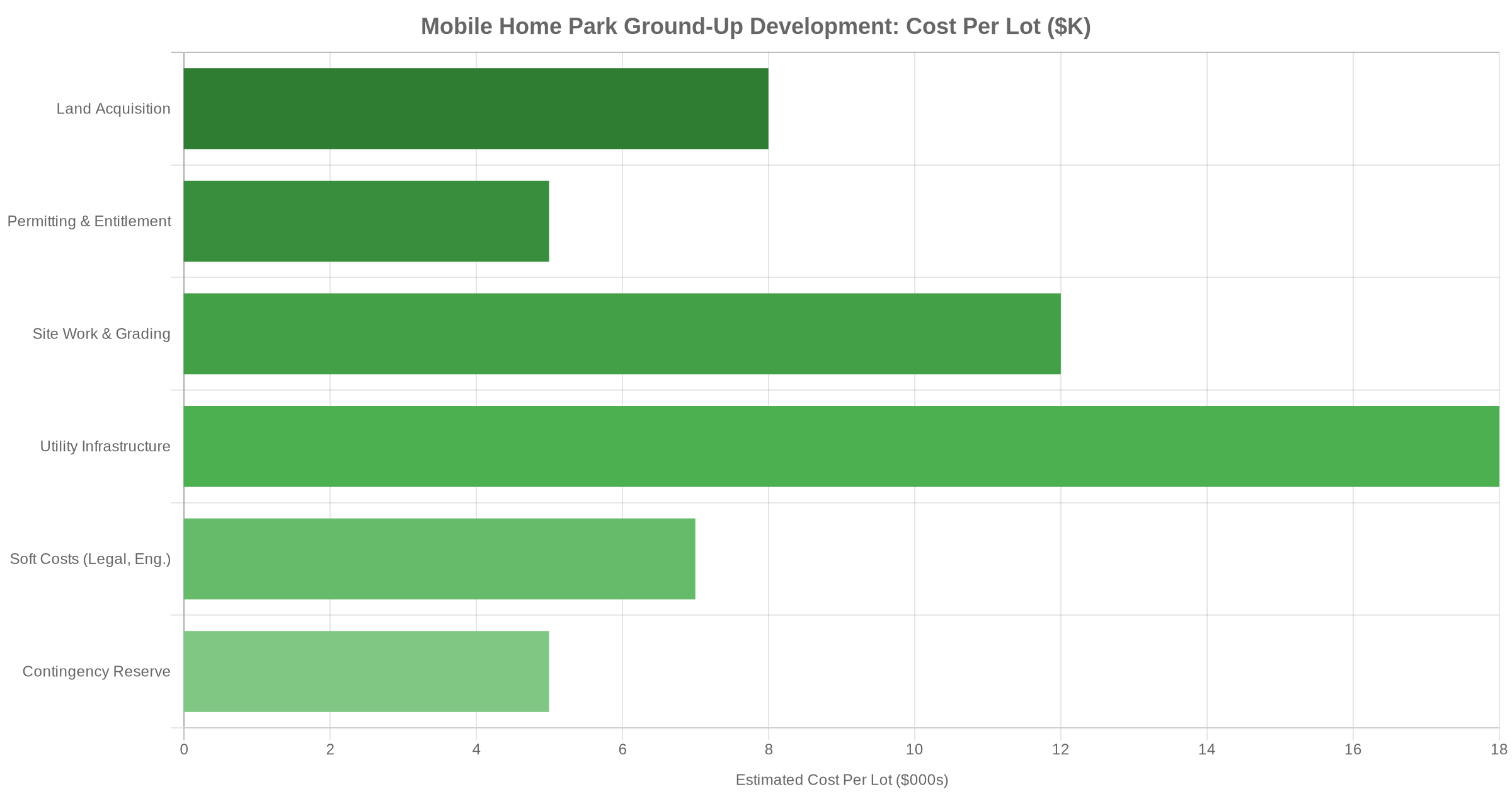
- Land acquisition: $6,000–$12,000 per lot (varies enormously by location)
- Permitting and entitlement: $4,000–$8,000 per lot (including legal, engineering studies, and application fees)
- Site work and grading: $10,000–$16,000 per lot (clearing, grading, road base, drainage)
- Utility infrastructure: $15,000–$25,000 per lot (water mains, sewer laterals or septic, electrical, gas if applicable)
- Soft costs: $5,000–$10,000 per lot (architect/engineer fees, project management, title, insurance)
- Contingency: 10–15% of total project cost
All-in estimate: $50,000–$75,000 per lot for a new development project, before any homes are placed or any marketing costs to attract residents.
Compare that to acquiring an existing mobile home park. Even in today’s compressed cap rate environment, you can often acquire existing lots in the Southeast — North Carolina, Tennessee, Georgia — for $25,000–$45,000 per lot on a value-add deal, with cash-flowing tenants already in place from day one. That gap matters enormously when you’re underwriting a deal and thinking about target cap rates.
The Mobile Home Park Development Timeline
Beyond the cost, the timeline is the other major differentiator. Here’s what a typical ground-up development looks like from initial land contract to stabilized occupancy:
- Site selection and due diligence: 2–4 months
- Entitlement and permitting: 6–18 months (or longer in complex markets)
- Site work and infrastructure construction: 6–12 months
- Home delivery, installation, and lease-up: 12–24 months to reach stabilized occupancy
Total timeline: 24–48 months from land purchase to stabilized, cash-flowing community.
During that entire period, you’re carrying land costs, financing costs, and soft costs — with zero rental income. For a 100-lot community at $60,000 per lot all-in, that’s $6 million deployed over multiple years before the first meaningful cash flow check arrives.
An acquisition of an existing community? You can close in 60–90 days and start collecting lot rent immediately.
Two decades of hard-won lessons distilled into one free guide. Whether you’re evaluating your first deal or your fiftieth, these insights will sharpen your approach.
Development vs. Acquisition: A Direct Comparison
| Factor | Ground-Up Development | Acquiring Existing Community |
|---|---|---|
| All-in cost per lot | $50,000–$75,000 | $25,000–$55,000 |
| Time to first cash flow | 24–48 months | 60–90 days (at close) |
| Financing availability | Construction loans only; limited lenders | Agency debt (Fannie/Freddie), community banks, CMBS |
| Entitlement risk | High — can lose years and $100K+ | Minimal — existing use rights |
| Stabilized cap rate | 6–9% (if executed well) | 5–10% depending on tier and market |
The Major Barriers to Ground-Up Mobile Home Park Development
Even if the numbers pencil, you’ll face obstacles that don’t exist in virtually any other asset class:
1. Zoning and Community Opposition
Finding land that is both properly zoned and politically approvable for a new mobile home park community is exceedingly rare. Many jurisdictions have effectively banned new developments through exclusionary zoning, minimum lot size requirements, and prohibition on manufactured housing in residential zones. Even when a developer has a legal path forward, local opposition can drag processes out for years.
2. Utility Access and Infrastructure Costs
Utility infrastructure — particularly sewer and water — is often the single largest cost driver in a new mobile home park development. Properties with access to city water and city sewer are far more expensive or harder to entitle, while properties on well and septic carry ongoing maintenance exposure and frequently create financing obstacles. For a deep dive on infrastructure considerations, see our guide on mobile home park financing options.
3. Construction Financing Complexity
Most traditional lenders don’t offer construction-to-perm products for manufactured housing communities. Developers typically rely on community bank construction loans with shorter terms, higher rates, and personal guarantee requirements. Once stabilized, refinancing into agency debt is possible — but the path there is capital-intensive and operationally demanding.
4. Lease-Up Risk and Market Absorption
Building 80 or 100 new lots is one thing. Filling them is another. Mobile home residents who own their homes and have been in a community for years aren’t looking to move. New lease-up requires attracting residents who either purchase new manufactured homes or move existing homes — both of which involve substantial logistics and cost.
When Does Ground-Up Development Actually Make Sense?
It’s not impossible. There are scenarios where ground-up development creates value that acquisition cannot replicate:
- Markets with extreme supply constraints and high lot rents: If local market rents support $700–$900+/month per lot, development economics can work even at elevated all-in costs.
- Infill expansion on land adjacent to an existing community: Adding lots to an already-operating community you own is substantially lower risk than greenfield development, since entitlements, utilities, and management infrastructure are already in place.
- States with more developer-friendly zoning: Some rural markets in the Southeast, Midwest, and Plains states still permit manufactured housing community development with manageable entitlement timelines.
- Long hold horizon investors: Developers willing to hold 10+ years can absorb the development timeline and often exit into a premium stabilized asset with a cost basis lower than market value.
Why Keel Team Focuses on Acquiring Existing Communities
After two decades of investing in mobile home parks, Keel Team’s strategy has consistently centered on acquiring and improving existing communities rather than developing from raw land. The core reasons are straightforward:
Immediate cash flow. Existing residents are paying lot rent on day one. There’s no 36-month lease-up period or construction carry. For a properly underwritten acquisition, you’re generating income within 90 days of close.
Known infrastructure. You can inspect the roads, utilities, and infrastructure before closing. In a ground-up development, you’re estimating costs on paper — reality often diverges.
Financing depth. Agency lenders (Fannie Mae, Freddie Mac) will finance existing stabilized mobile home park communities. They generally won’t finance ground-up development. That access to lower-cost capital significantly improves long-term returns.
Established community dynamics. Long-tenured residents, an existing reputation in the local market, and known regulatory history are all assets. You’re acquiring a going concern, not a blank slate.
Value-add opportunity without development risk. Most existing communities have identifiable paths to value creation — increasing below-market lot rents, filling vacant lots, converting park-owned homes to tenant-owned homes, or improving infrastructure — without the entitlement and construction risk of ground-up development.
What to Look for in Land Suitable for a Mobile Home Park
If you’re determined to pursue ground-up development, here are the site characteristics that actually make it viable:
- Existing manufactured housing zoning or agricultural zoning that allows manufactured housing communities by right — not by conditional use permit
- City water and city sewer access within 500 feet of the parcel (avoiding private well/septic dramatically improves financing and long-term operations)
- Flat to gently sloping topography — significant grading costs can kill development economics
- Access to a primary road — secondary or tertiary road access creates infrastructure costs and may be unacceptable to lenders
- Parcel size appropriate for 80–150 lots — smaller projects rarely justify the fixed development costs; larger projects increase execution risk
- Proximity to employment centers — manufactured housing communities thrive within commuting distance of service-sector employment, manufacturing, and healthcare jobs
10 video modules, a 55-page master checklist, and 9 ready-to-use templates that walk you through every step of evaluating a mobile home park deal — from the first site visit to closing day.
Conclusion: Development Is Possible, But Acquisition Is Usually Smarter
Ground-up mobile home park development is a legitimate real estate strategy — but it’s a developer’s game, not an investor’s game. The timelines are long, the entitlement risk is real, and the capital requirements are substantial compared to acquiring an existing, cash-flowing community at a comparable cost per lot.
For most mobile home park investors, the better path is finding an existing community with upside: below-market rents, vacant lots, deferred maintenance, or operational inefficiencies that a disciplined operator can address. That’s where the risk-adjusted returns are most compelling, and where two decades of operating experience translates into immediate value creation.
If you’re exploring either path — development or acquisition — the fundamentals of underwriting, valuation, and due diligence are the same. The difference is how much uncertainty you’re willing to carry before the first rent check arrives.
Frequently Asked Questions
How much does it cost to develop a mobile home park from scratch?
All-in development costs typically range from $50,000 to $75,000 per lot depending on land prices, utility access, permitting complexity, and market. Utility infrastructure (water, sewer, electrical) is usually the largest single cost category at $15,000–$25,000 per lot.
How long does it take to build a mobile home park?
From land purchase to stabilized occupancy, expect 24 to 48 months. The entitlement and permitting phase alone can take 6–18 months in most markets, before a shovel hits the ground.
Is it harder to finance a new mobile home park development than an acquisition?
Yes, significantly. Agency lenders (Fannie Mae, Freddie Mac) don’t provide construction financing for ground-up mobile home park development. Developers rely on community bank construction loans, which carry higher rates and shorter terms. Once stabilized, refinancing to agency debt is typically possible.
Why are so few new mobile home parks being built?
Zoning restrictions, NIMBY opposition, and the complexity of obtaining entitlements have effectively limited new mobile home park supply to fewer than 20 new communities per year nationally. This supply constraint — roughly 0.04% annual new supply — is one of the key structural advantages of the asset class for existing community owners.
What’s the difference between buying raw land for a mobile home park vs. acquiring an existing community?
Acquiring an existing community delivers immediate cash flow, established financing options (including agency debt), known infrastructure, and existing residents — with far less execution risk than ground-up development. Raw land development requires permitting, entitlement, construction, and a multi-year lease-up period before generating meaningful income. Most experienced investors focus on acquisitions for these reasons.
Get the top 20 lessons from two decades of mobile home park investing — free.