70% of Mobile Home Parks With Private Water Systems Are Violating Safe Drinking Water Rules — What Every Investor Needs to Know
Andrew Keel
[wpbread]
A July 2025 investigation by the Associated Press dropped a number that should stop every mobile home park investor in their tracks: nearly 70% of manufactured housing communities that run their own water systems have violated safe drinking water rules at least once in the past five years.
That’s not 7%. It’s 70%.
And for context: the violation rate for cities is 48%. For larger towns, 57%. Mobile home parks — a real estate asset class that millions of investors are actively chasing right now — are the worst-performing category in the entire country for safe drinking water compliance.
If you’re acquiring parks, operating parks, or passively investing in mobile home park syndications and you haven’t added “private utility audit” to your due diligence checklist as a first-class item, this article is for you.
What the AP Investigation Found
The AP analyzed EPA data from its Safe Drinking Water Information System, covering violations by water systems of all sizes across the country. Mobile home parks with private water systems stood out — and not in a good way.
More than half of parks with their own water systems failed to perform required testing for at least one contaminant, or failed to properly report results, in the past five years. Beyond that, mobile home parks are far more likely to be repeat offenders compared to other types of water systems.
Some parks don’t appear in EPA’s database at all — meaning they may go entirely unregulated. AP reporters found parks in Southern California where residents had been drinking water with high arsenic levels for years without anyone knowing.
In Michigan, Iowa, and other states, residents reported taps running dry, discolored water that “looks like coffee or tea,” laundry being stained, and genuine fear about opening their mouths in the shower.
Here’s the part that makes this especially complicated for investors: when residents have problems with the water, it can be very difficult for them to leave. Manufactured homes are expensive and logistically difficult to move. Residents often own their home but rent the land — making them what one sociologist called “halfway homeowners.” They’re stuck. And in that situation, they sue, they organize, and they talk to reporters.
Why This Problem Is So Common in Mobile Home Parks
Mobile home parks are disproportionately old infrastructure. Most communities were built between the 1950s and 1970s, when private well and septic systems were common and regulatory oversight was minimal. As those communities aged, their infrastructure aged with them — often without the capital investment or management expertise needed to maintain compliance.
When a large company or investment group acquires a park, they’re not just buying a real estate investment. In many cases, they’re acquiring a small water utility — one that comes with EPA monitoring requirements, state health department oversight, testing schedules, and potential enforcement liability.
The gap between what buyers think they’re acquiring and what they’re actually inheriting is where the problems start.
There’s also a technical wrinkle: some parks get water from a nearby town, which can be perfectly safe at the park boundary — but become contaminated if the park’s internal piping is substandard or poorly maintained. The EPA doesn’t track water quality once it’s on private property, so these problems can go completely undetected until a resident complains or a journalist investigates.
What Responsible Operators Are Doing Differently
The operators who avoid these issues aren’t just lucky — they’re systematic.
They do real utility due diligence before buying. This means going beyond a Phase I environmental assessment and actually testing the water. A comprehensive water quality lab panel — one that goes beyond the EPA minimum required tests — takes 2–3 weeks and costs a few hundred dollars. For a deal where you’re investing hundreds of thousands or millions, that’s not optional. It’s table stakes.
It also means pulling the park’s EPA SDWIS compliance history (it’s public and free), contacting the local health department, and having the distribution system physically inspected by a licensed professional. Not just verified on paper — actually inspected.
They pursue utility conversion when possible. For parks with private well and septic, conversion to city water and city sewer eliminates ongoing compliance liability, removes the park from the regulatory risk category, and is a genuine capital improvement that supports lot rent increases. Yes, it costs money upfront. But for parks located near municipal infrastructure, it’s often one of the highest-ROI improvements an operator can make.
They maintain rigorous ongoing compliance programs. For parks that must maintain private systems and can’t convert, the responsible operators implement testing schedules that exceed minimums, budget for system maintenance as a line item, document everything, and build direct relationships with their state health department’s small water system division.
The Deal-Level Implications
Here’s the practical impact for investors evaluating a deal right now:
If the park has a private well: Get a full water quality panel beyond the EPA minimum. Review the last 5 years of testing records. Pull the EPA SDWIS database entry. If the records are thin or missing, treat it as a red flag — not a negotiating chip.
If the park has a private septic system: Get an independent engineer inspection. Ask about pumping frequency, number of tanks, capacity relative to occupancy. Understand who maintains it and what the maintenance history looks like. Septic issues are expensive — and replacing a failed system can run $50,000–$200,000+ depending on the park size.
If the park has a private wastewater treatment plant or lagoon: These are the highest-risk utility systems in the asset class. High maintenance requirements, active regulatory oversight, expensive failures, and in some states, municipalities are actively phasing out lagoon systems entirely. Price this risk aggressively or avoid it.
If the park gets water from an outside source: Don’t assume that’s clean. The quality at the park boundary isn’t the same as the quality at the tap if the internal piping is old, lead-containing, or poorly installed.
The good news: all of this is knowable before you close. The information exists. The tests can be done during your due diligence period. Every one of these issues discovered during due diligence is either a price adjustment, a deal-killer, or a capital plan item. Discovering them after closing is expensive in a different category entirely. For a full utility inspection checklist and acquisition due diligence framework, see the Mobile Home Park Due Diligence Playbook.
The Bottom Line
The AP investigation put mobile home park water quality on the national radar. Regulatory scrutiny is increasing — Colorado already passed a law requiring testing at every mobile home park, and other states are following. As an investor or operator, the time to get ahead of this is now, not when the EPA sends a violation notice.
Buying a park with a private water system isn’t inherently a problem. Buying one without fully understanding what you’re taking on is.
Keel Team owns and operates 50+ manufactured housing communities. Our acquisition criteria specifically prioritize city water and city sewer to minimize infrastructure liability and protect residents. Want to learn more about how we evaluate utility risk in a deal? Contact us here.
📋 The MHP Due Diligence Playbook
10 video modules, a 55-page master checklist, and 9 ready-to-use templates that walk you through every step of evaluating a mobile home park deal — from the first site visit to closing day.
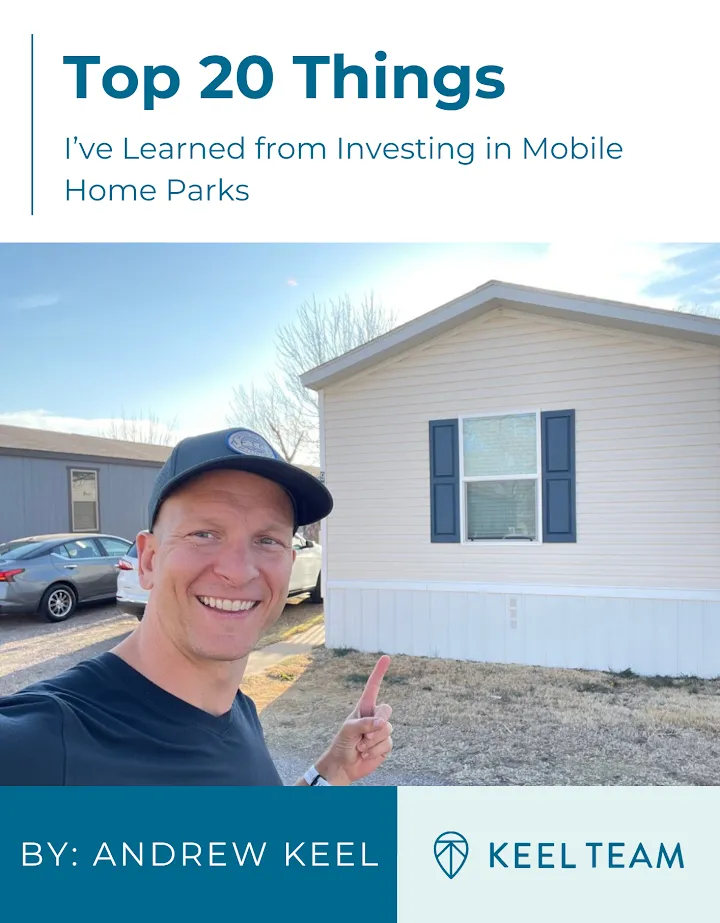
📘 Free eBook: Top 20 Things I’ve Learned from Investing in Mobile Home Parks
Two decades of hard-won lessons distilled into one free guide. Whether you’re evaluating your first deal or your fiftieth, these insights will sharpen your approach.
Andrew is a passionate commercial real estate investor, husband, father and fitness fanatic. His specialty is in acquiring and operating manufactured housing communities. Visit AndrewKeel.com for more details on Andrew's story.