If you’re looking to buy a mobile home park in 2026, the market you choose may matter more than the specific deal you find. The same 100-lot community can generate dramatically different returns depending on local lot rent levels, population growth, regulatory climate, and the depth of off-market deal flow available in that area.
This guide ranks the 10 best cities and metro areas for mobile home park investing in 2026 — with specific cap rate benchmarks, lot rent data, and what’s driving buyer demand in each market. Every market on this list sits in the Southeast or Mid-South, where conditions for mobile home park investing are strongest heading into the second half of 2026.
Why Market Selection Matters in Mobile Home Park Investing
National averages tell only part of the story. Nationally, mobile home park occupancy sits near 93–94% and average lot rents have reached approximately $752 per month — but those figures mask wide variation by geography.
In high-growth Southeast metros, lot rents have risen 5–8% annually while occupancy has remained above 95%. In slower Midwest markets, lot rent growth is modest and deal flow is thinner. For investors seeking the combination of cash flow, appreciation potential, and deal availability, the Southeast is the strongest region in 2026.
When evaluating a market, focus on four core factors:
- Population growth: More people means more demand for affordable workforce housing
- Employment base: Diverse economies sustain lot rent levels through economic cycles
- Regulatory climate: Landlord-friendly states protect net operating income from legislative risk
- Deal flow: Active markets with motivated sellers and accessible off-market inventory
The 10 Best Cities for Mobile Home Park Investing in 2026
1. Charlotte, NC — High Growth, Deep Inventory
Charlotte has become one of the most competitive mobile home park acquisition markets in the Southeast. The Charlotte-Concord-Gastonia MSA has added over 100,000 residents in the past five years, driving sustained demand for affordable housing. Stabilized mobile home park communities in the Charlotte metro typically trade at cap rates of 6.5–7.5%, with value-add opportunities available in the 7.5–9.0% range. Lot rents in the $350–$500 range remain significantly below what surrounding rental housing commands, creating meaningful upside in communities with long-tenured ownership and below-market rents.
2. Raleigh-Durham, NC — Research Triangle Demand
The Research Triangle (Raleigh-Durham-Chapel Hill) is one of the fastest-growing metros in the U.S. by both population and per-capita income. Strong job creation in technology, life sciences, and higher education sustains demand for workforce housing across the income spectrum. Mobile home park communities within 20–40 miles of downtown Raleigh are increasingly scarce, which makes existing communities exceptionally defensible assets. Stabilized assets in the Raleigh metro typically trade at 6.5–7.0% cap rates.
3. Greensboro-Winston-Salem, NC — Value and Volume
The Triad is one of the most investor-friendly markets in North Carolina. Cap rates remain higher than the Charlotte or Raleigh metros — typically 7.5–9.0% — deal flow is active from a large base of family-owned communities, and lot rents in the $250–$400 range offer meaningful mark-to-market upside with disciplined management. The Triad benefits from a large manufactured housing population with long roots in the region, creating a stable, low-turnover tenant base.
4. Asheville, NC — Tourism Economy, Constrained Supply
Asheville’s combination of mountain tourism, in-migration from northeastern metros, and severely constrained new housing supply makes mobile home park communities here among the most defensible in the state. Communities near Asheville often report occupancy rates above 97%, and lot rents have risen faster here than almost anywhere else in North Carolina. Stabilized assets in the Asheville MSA typically trade at 6.5–7.0% cap rates — compressed by strong buyer demand and limited supply of available communities.
5. Nashville, TN — Premier Southeast Growth Market
Nashville is a tier-one mobile home park market. Population growth has been explosive — the Nashville MSA added roughly 100 people per day during the early 2020s — and the regulatory environment remains landlord-friendly. Demand for affordable housing is intensifying as median home prices in the Nashville area have more than doubled since 2018. Mobile home park communities within 45 minutes of downtown Nashville trade at 6.5–7.5% cap rates. Outlying counties like Rutherford, Wilson, and Williamson offer value-add deals at 7.5–8.5%.
6. Knoxville, TN — Affordable Entry, Strong Fundamentals
Knoxville offers one of the best value propositions in the Southeast for mobile home park investors. Entry prices are lower than Nashville, cap rates remain healthy at 7.0–8.5%, and the University of Tennessee anchors a diversified, stable economic base. The Knoxville MSA has seen consistent population growth without the overbuilding pressures affecting larger metros, and off-market deal flow from long-tenured family owners remains active. This is a market where patient, relationship-driven buyers can find exceptional deals.
7. Chattanooga, TN — Underrated and Under-the-Radar
Chattanooga is one of the most overlooked mid-tier markets in the Southeast. The city’s economic resurgence — anchored by Volkswagen Manufacturing, Amazon distribution, and a growing remote-worker population — has created sustained demand for workforce housing. Cap rates in the Chattanooga market typically land in the 7.5–8.5% range, with some value-add opportunities available above 9.0%. This remains a buyer’s market with meaningfully less institutional competition than Nashville or Charlotte.
8. Greenville-Spartanburg, SC — Automotive Industry Anchor
The Greenville-Spartanburg MSA hosts one of the most diverse industrial economies in the Southeast, anchored by BMW Manufacturing, Michelin North America, and a growing logistics and distribution sector. Workforce housing demand is durable across economic cycles, and South Carolina’s landlord-friendly regulatory environment creates favorable conditions for mobile home park operators. Stabilized cap rates typically range from 7.0–8.0%, with value-add opportunities in the 8.0–9.5% range.
9. Charleston, SC — Coastal Demand, Tight Supply
Charleston sits at the premium end of the South Carolina market. Strong in-migration from the Northeast, a robust military and defense employment base, and limited developable land have pushed all forms of housing — including manufactured housing — toward sustained, structural demand. Stabilized mobile home park communities in the Charleston metro typically trade at 6.8–7.5% cap rates. Entry prices are higher than inland South Carolina, but the demand fundamentals are among the strongest in the Carolinas.
10. Atlanta, GA — Scale Opportunity in a Mega-Market
Atlanta is a large, fragmented mobile home park market — which creates both significant opportunity and real complexity. The greater Atlanta metro contains hundreds of communities, many under legacy ownership with substantial value-add potential. Cap rates vary widely, from sub-7% for Class A stabilized assets to 8–10% for rural Tier-3 communities. Investors with strong local relationships and rigorous underwriting can find exceptional deals; the market is too large to navigate effectively without a defined sub-market focus and local deal sourcing relationships.
Two decades of hard-won lessons distilled into one free guide. Whether you’re evaluating your first deal or your fiftieth, these insights will sharpen your approach.
Cap Rate Comparison: Top 10 Markets at a Glance
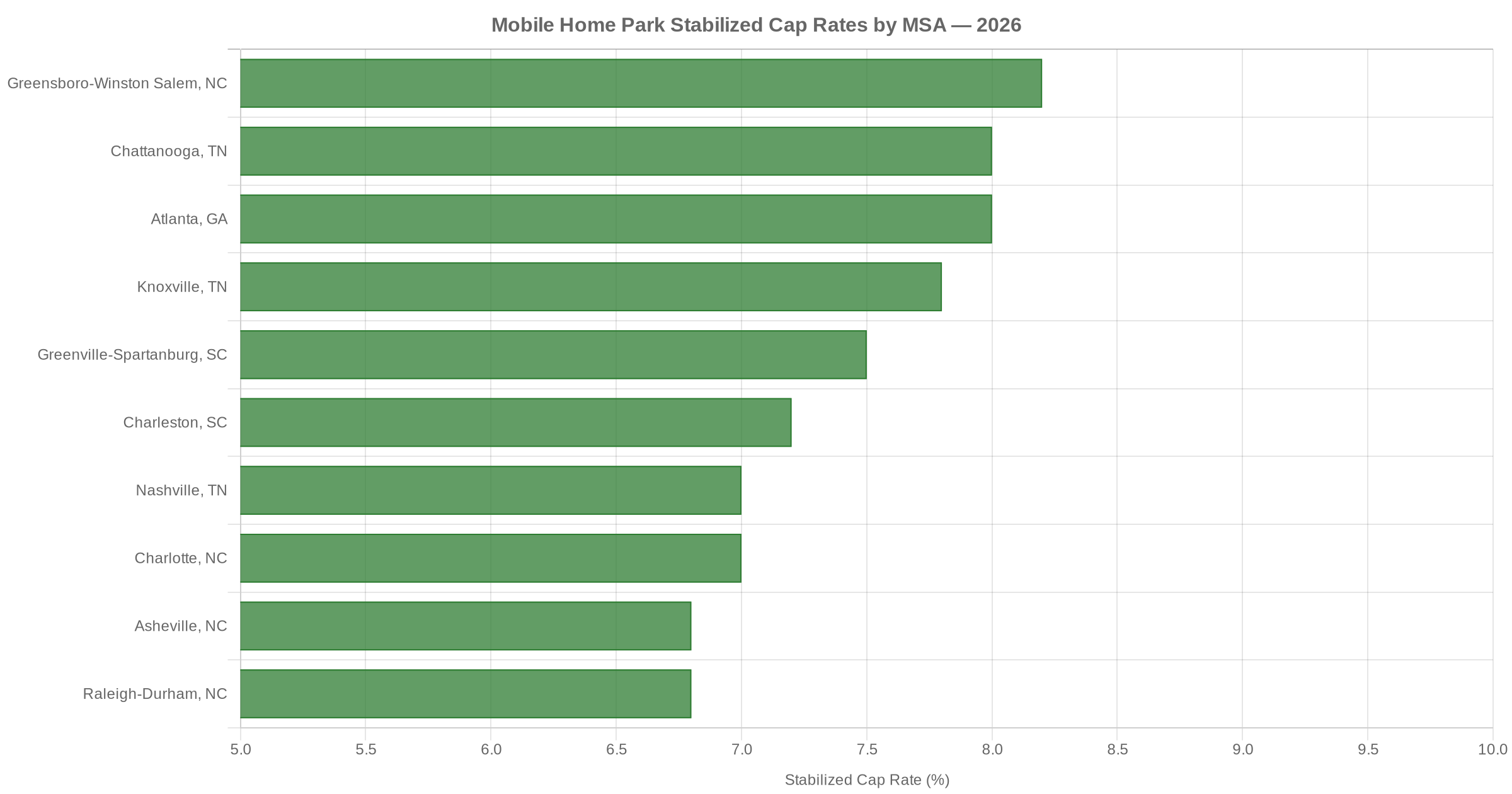
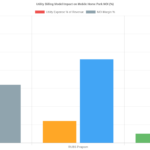
The chart above reflects typical cap rates for stabilized mobile home park communities in each MSA as of mid-2026. Value-add deals in all markets run 50–150 basis points higher. Premium Class A assets in high-growth metros like Charlotte, Raleigh, and Nashville can compress toward 6.0–6.5% in competitive bidding situations.
What the data makes clear: secondary markets within the Southeast (Greensboro, Chattanooga, Knoxville) still offer cap rates in the 7.5–8.5% range — well above what you’d find in gateway coastal markets or major Midwest cities. This spread reflects the combination of institutional under-coverage, lower entry prices, and active deal flow from family-owned communities that have never been publicly listed.
How to Use This Market Ranking in Your Underwriting
Market cap rates are a starting point, not a destination. When underwriting a specific community in any of these markets, go deeper on:
- Lot rent vs. local rental comps: Mobile home park lot rent should be 35–50% of local apartment rents. Higher ratios signal meaningful pricing power on lot rent increases.
- In-place rent vs. market rent: Legacy-owner communities often have lot rents 20–40% below market. This is where value-add upside lives.
- Utility infrastructure: City water and city sewer dramatically outperform well/septic systems in both operating costs and lender eligibility. Prioritize public utility communities.
- Proximity to employment: Target communities within 30 miles of an MSA with 100,000+ population and a diversified employment base.
- Occupancy and tenant-owned home ratio: Communities with 85%+ occupancy and 70%+ tenant-owned homes are the most operationally efficient and financeable.
For a complete framework on evaluating individual deals, see our Mobile Home Park Due Diligence Checklist and our guide to Mobile Home Park Cap Rates by State in 2026.
Conclusion: Choose Your Market Before You Choose Your Deal
In mobile home park investing, a great deal in a weak market will nearly always underperform an average deal in a strong market. The 10 MSAs on this list share a common profile: growing populations, landlord-friendly regulatory environments, durable employment bases, and active deal flow from motivated sellers who have owned their communities for decades.
North Carolina, Tennessee, Georgia, and South Carolina remain the highest-priority markets for mobile home park acquisition in 2026. Within those states, the cities ranked above offer the best combination of entry pricing, upside potential, and competitive dynamics for independent operators willing to do the relationship work required to source deals off-market.
For more on deal sourcing in these markets, read our guide to Finding Off-Market Mobile Home Parks.
10 video modules, a 55-page master checklist, and 9 ready-to-use templates that walk you through every step of evaluating a mobile home park deal — from the first site visit to closing day.
Frequently Asked Questions
What is the best city for mobile home park investing in 2026?
For operators prioritizing deal flow and value-add upside, Greensboro-Winston-Salem (NC), Knoxville (TN), and Chattanooga (TN) offer the best combination of cap rates, entry pricing, and off-market opportunity. For operators focused on long-term appreciation and market depth, Charlotte and Nashville lead the list.
What cap rate should I expect when buying a mobile home park in the Southeast?
Stabilized mobile home park communities in major Southeast MSAs typically trade at 6.5–8.5% cap rates, depending on market tier, asset quality, utility infrastructure, and occupancy. Value-add deals can trade at 8.0–10%+ in secondary and tertiary markets. Premium assets in high-growth metros like Charlotte and Nashville compress toward 6.0–7.0%.
Are there still off-market mobile home park deals available in these markets?
Yes — particularly in mid-tier markets like Greensboro, Knoxville, and Chattanooga. Many communities in the Southeast remain under family ownership with aging owners who have never listed their property publicly. Direct outreach campaigns targeting long-tenured owners remain the most effective strategy for sourcing off-market deals in all of these markets.
How does Atlanta compare to Charlotte and Nashville for mobile home park investing?
Atlanta offers more raw deal volume but requires more localized expertise. The metro is large and fragmented, cap rate ranges are wide, and navigating the market without strong local relationships is difficult. Charlotte and Nashville offer somewhat tighter markets but more predictable underwriting benchmarks and stronger institutional demand that supports exit valuations.
What is the minimum deal size worth targeting in these markets?
Most independent operators find that communities with 50+ total lots represent the minimum viable deal size from a management-to-return standpoint. Communities with 70+ lots and 35+ occupied homes in target MSAs are typically eligible for agency debt financing through Fannie Mae or Freddie Mac programs, which significantly expands both the buyer pool at exit and the available capital stack at acquisition.
Get the top 20 lessons from two decades of mobile home park investing — free.