If you’re exploring mobile home park investing, you’ll face one of the most fundamental decisions in real estate: do you own a mobile home park directly, or invest passively through a syndication? Both paths can generate strong returns — but they work very differently, require different skills, and suit different types of investors.
This guide breaks down the key differences between mobile home park syndication and direct ownership so you can decide which path aligns with your goals, capital, and lifestyle.
What Is Direct Mobile Home Park Ownership?
Direct ownership means you find, acquire, and operate a mobile home park yourself — or with a small partner group. You control every aspect of the investment: sourcing the deal, arranging financing, managing operations, and deciding when to sell. Most direct owners either self-manage day-to-day or hire a property manager while staying closely involved in major decisions. Either way, the accountability falls entirely on you.
Who Direct Ownership Is Best For
- Investors with time to dedicate to finding deals and managing operations
- Those who want full control over strategy, tenants, and capital improvements
- Operators who want to build long-term wealth through appreciation, loan paydown, and value-add execution
- Entrepreneurs who enjoy the hands-on nature of running a real estate business
What Is Mobile Home Park Syndication?
A mobile home park syndication pools capital from multiple passive investors — called limited partners (LPs) — to acquire a mobile home park under the control of a professional operator (the general partner, or GP). As a passive investor, you contribute capital and receive a proportional share of cash flow and profits, without managing anything day-to-day.
Syndications are typically structured under SEC Regulation D exemptions — most commonly 506(b) — which means participation is generally limited to investors who have a pre-existing relationship with the sponsor. The GP handles everything: acquisitions, financing, operations, and the eventual exit.
Who Syndication Is Best For
- Investors who want real estate exposure without day-to-day management
- High-income professionals — doctors, attorneys, executives — looking for passive income
- Those who lack the time, expertise, or desire to source and operate deals themselves
- Investors who want to diversify across multiple markets, operators, and deal types
Capital Requirements: How Much Do You Need?
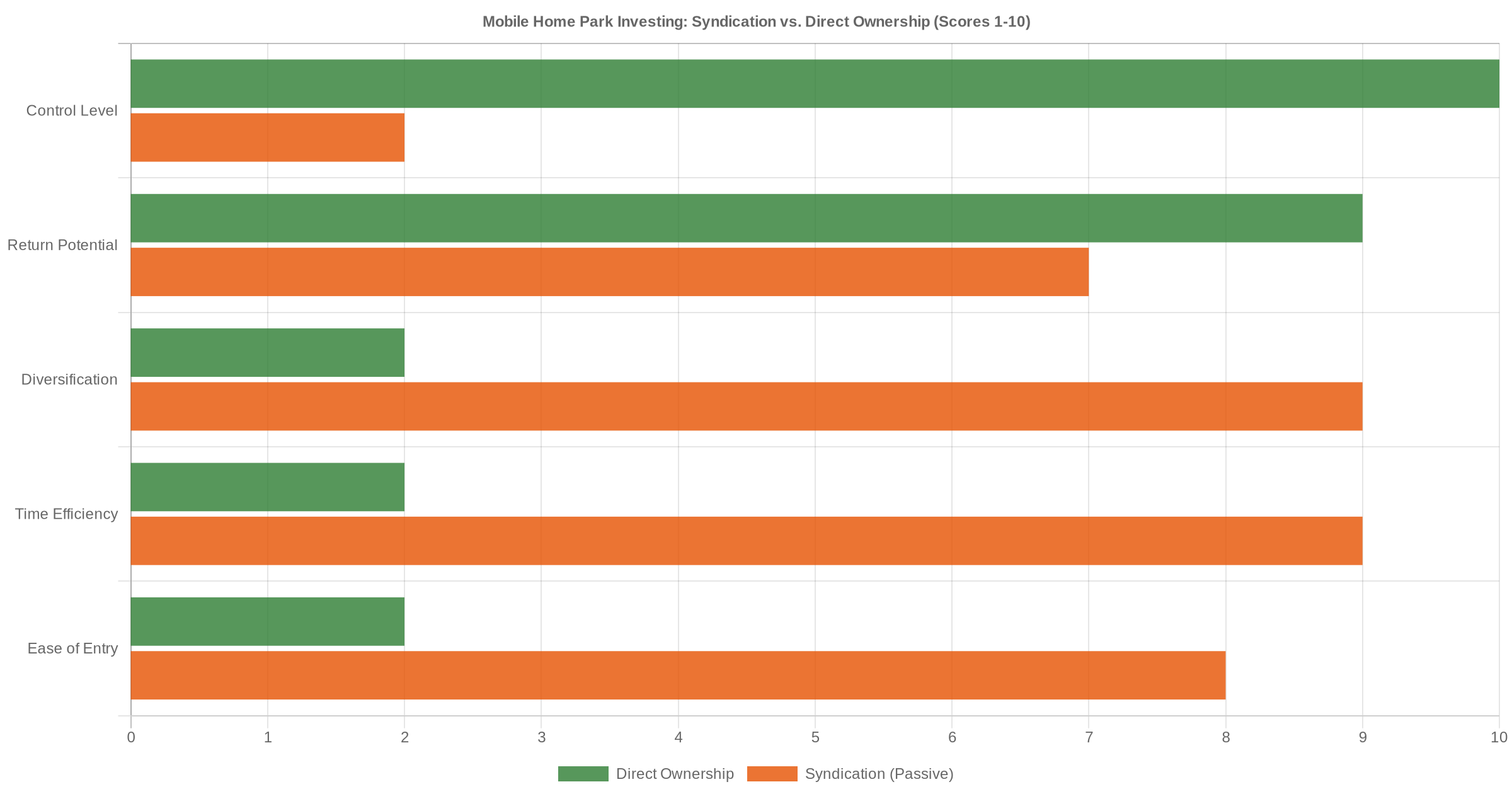
Direct mobile home park ownership requires a significantly larger upfront commitment. Acquiring even a modest 50-lot mobile home park in a secondary market can require $500,000 to $2 million in equity, depending on the deal size, financing terms, and property condition. You’re also responsible for capital reserves and unexpected expenses throughout the hold period.
In a syndication, the minimum investment is usually $50,000 to $100,000 — sometimes lower. The sponsor pools capital from multiple investors, so no single LP has to absorb the full acquisition cost. This makes mobile home park syndication accessible to a much broader range of accredited investors who want real estate exposure without a seven-figure buy-in.
Time Commitment: Passive vs. Active
Direct ownership is far more time-intensive. Finding off-market deals, running due diligence, arranging financing, managing a property manager, overseeing lease-up campaigns, and handling capital improvements can consume 20 or more hours per week for an active owner-operator — especially in the early years.
Passive syndication investing typically requires just a few hours upfront: reviewing the offering documents, conducting operator due diligence, and wiring funds. After that, most passive investors spend a few hours per quarter reviewing investor updates and K-1 forms. For busy professionals, this is the key appeal of the syndication model.
Two decades of hard-won lessons distilled into one free guide. Whether you’re evaluating your first deal or your fiftieth, these insights will sharpen your approach.
Control: Who Makes the Decisions?
Direct owners have complete control. You decide when to raise rents, which capital projects to fund, whether to sell, and how to handle tenant issues. This autonomy is a major advantage for experienced operators who trust their own judgment and want to execute a specific business plan without interference.
In a syndication, limited partners have very limited control. The GP makes all operating decisions. Before investing, you need to be comfortable with the operator’s track record and strategy — because once you’re in, you’re largely along for the ride. That’s why evaluating the operator carefully before you invest is so critical in the syndication model.
Returns: What Can You Expect?
Direct owners capture 100% of the upside — appreciation, cash flow, depreciation benefits — but also absorb 100% of the risk. Strong operators who buy well and execute efficiently can generate very attractive returns, often 15-20%+ annualized on well-managed deals over a 5-10 year hold.
Syndication investors share returns with the GP through a waterfall structure that typically includes a preferred return (often 7-8%) and profit splits upon sale. After fees and promote, passive investors in well-run mobile home park syndications have historically targeted 12-16% annualized returns — competitive with direct ownership, especially after accounting for the time savings and risk diversification.
Diversification: Spreading Risk Across Deals
One of the most compelling advantages of syndication is diversification. With $200,000 in capital, a passive investor could participate in four different deals across multiple states, operators, and market cycles — spreading risk in a way that’s nearly impossible with direct ownership at the same capital level.
Direct owners, especially those starting out, typically concentrate their capital in one or two properties. That concentration can pay off enormously — or expose them to outsized downside if a single deal underperforms.
Tax Benefits: Both Paths Offer Advantages
Both investment paths offer meaningful real estate tax advantages, including depreciation pass-throughs that can shelter a significant portion of income. Direct owners have more flexibility in structuring cost segregation studies and timing deductions. Passive investors receive their share of depreciation through a K-1 at tax time, which can offset passive income from the investment.
Keep in mind that passive losses from syndications generally can only offset passive income — an important distinction from active operator losses, which may be more broadly applicable depending on your situation. Always consult a CPA who specializes in real estate before making tax-driven investment decisions.
Risk Profile: Understanding the Downside
Direct Ownership Risks
- Concentration risk: One bad deal can significantly damage your overall portfolio
- Operational risk: Mismanagement, unexpected capital expenditures, or a poor acquisition can wipe out returns
- Liquidity risk: Direct real estate is illiquid — selling takes months and involves significant transaction costs
- Financing risk: If rates rise or refinancing falls through, your debt structure can compress or eliminate returns
Syndication Risks
- Operator risk: You’re betting heavily on the GP’s skill, integrity, and judgment
- Lack of control: You can’t change course if the strategy isn’t working
- Illiquidity: Most mobile home park syndications have 3-7 year hold periods with no early exit option
- Fee drag: Acquisition fees, asset management fees, and profit splits reduce your net return versus direct ownership
Which Path Is Right for You?
There’s no universal right answer — it depends on your goals, capital, time, and risk tolerance.
Choose direct ownership if you have the time and appetite to operate, you’re building a career as a real estate operator, you want maximum control and upside, and you’re prepared for a steep learning curve. The rewards can be substantial for those who put in the work.
Choose syndication if you want passive income without the operational headaches, you want to diversify across deals and operators, or your capital generates better returns elsewhere — for example, reinvested in your business or other high-yield assets.
Many sophisticated investors do both. They own and operate their own deals while also participating passively in syndications run by operators in markets or asset types they don’t cover themselves. This hybrid approach combines the control and upside of direct ownership with the diversification and passivity of the syndication model.
Whichever path you choose, thorough due diligence is non-negotiable. The best returns in mobile home park investing come from disciplined analysis — not luck or timing.
If you’d like to learn more about mobile home park investing and which approach might fit your situation, feel free to reach out — we’re happy to have a conversation.
10 video modules, a 55-page master checklist, and 9 ready-to-use templates that walk you through every step of evaluating a mobile home park deal — from the first site visit to closing day.
Get the top 20 lessons from two decades of mobile home park investing — free.