If you own a mobile home park and have ever thought about selling — or just want to know what your asset is worth — you need to understand how buyers value these properties. Unlike single-family homes, mobile home parks are priced as income-producing businesses, not comparable sales. That distinction matters enormously when it comes to setting expectations and negotiating a fair deal.
This guide breaks down the primary valuation methods buyers use, the key factors that drive price up or down, and what current cap rate benchmarks look like in 2026.
Why Mobile Home Parks Are Valued Differently Than Other Real Estate
Most residential real estate is valued by comparable sales — what did similar homes in the area sell for recently? Mobile home parks don’t work that way. There are relatively few transactions, every park is operationally unique, and the primary driver of value is net operating income (NOI), not square footage or bedroom count.
Buyers — whether individual investors or institutional funds — are purchasing a stream of income. They pay a price today that reflects what they believe that income stream is worth over time, adjusted for risk. That’s the foundation of the income approach to mobile home park valuation, and it’s how virtually every serious buyer underwrites a deal.
The Primary Valuation Method: Cap Rate
The capitalization rate (cap rate) approach is the industry-standard method for valuing mobile home parks. The formula is simple:
Value = Net Operating Income ÷ Cap Rate
For example, if your mobile home park generates $150,000 in annual NOI and buyers in your market are pricing similar assets at a 7% cap rate, your park would be valued at approximately $2.14 million ($150,000 ÷ 0.07).
The cap rate represents the buyer’s required rate of return on a hypothetical all-cash purchase. A lower cap rate means buyers are willing to accept less return for the perceived quality and stability of the asset — and a higher cap rate reflects more risk or more value-add potential. Even a 1–2 percentage point shift can mean hundreds of thousands of dollars in value:
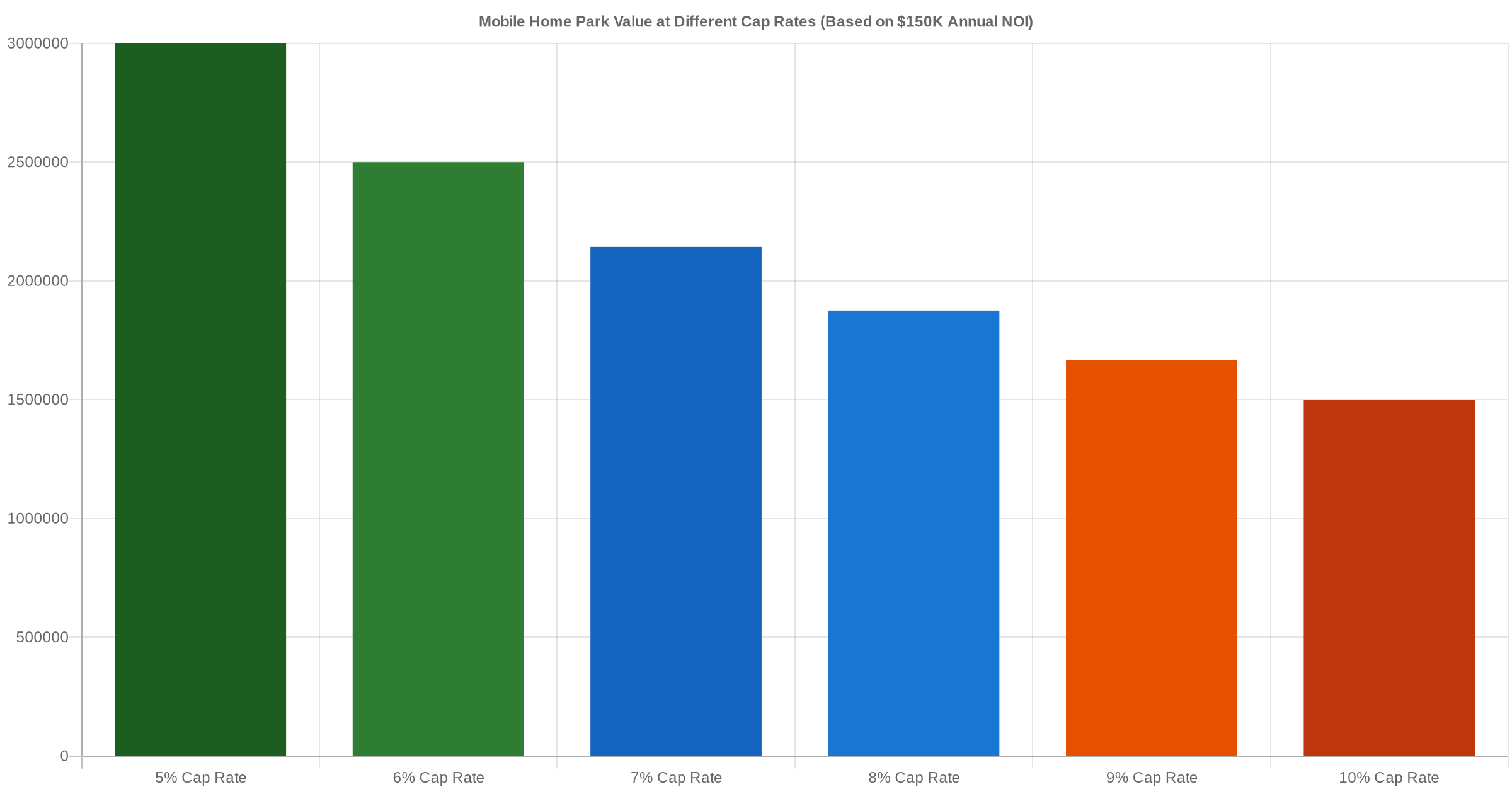
This is why understanding your market’s prevailing cap rate environment — and knowing where your park fits within it — is critical before you list or negotiate.
Step 1: Calculate Your Gross Income
Gross potential income (GPI) is everything your mobile home park could collect if 100% of lots were occupied at market rent. Start here:
- Count all income-producing lots (occupied and vacant)
- Multiply by your current monthly lot rent
- Add any ancillary income: park-owned home rents, laundry, storage, parking, late fees
- Multiply by 12 for an annual figure
Then subtract vacancy and credit loss — typically 5–10% for stabilized parks — to arrive at your effective gross income (EGI).
Step 2: Calculate Your Net Operating Income (NOI)
From effective gross income, subtract all operating expenses. Note: debt service (mortgage payments) and capital expenditures are not included in NOI. Common expense categories include:
- Property taxes
- Insurance
- Management fees (typically 8–12% of EGI — even if you self-manage, buyers will add this back)
- Maintenance and repairs
- Utilities (water, sewer, electric for common areas)
- Administrative and legal costs
Stabilized mobile home parks typically run expense ratios of 30–45% of EGI. Higher ratios often indicate operational inefficiencies or deferred maintenance — and buyers will price that risk into the cap rate they offer.
Your NOI is the single most important number in any mobile home park valuation. Buyers will scrutinize it closely and often recast it to reflect how they would operate the property, not how the current owner operates it. Understanding what a recast will look like before you enter negotiations is a significant advantage.
Two decades of hard-won lessons distilled into one free guide. Whether you’re evaluating your first deal or your fiftieth, these insights will sharpen your approach.
Key Factors That Affect Your Mobile Home Park’s Value
Beyond the raw NOI number, buyers evaluate several qualitative and structural factors that influence the cap rate they’re willing to accept — and therefore the price they’ll pay.
Utility Infrastructure
This is arguably the biggest value driver after income. Mobile home parks on city water and city sewer command a significant premium over parks with well water, septic systems, or private utility infrastructure. Lagoons and private wastewater treatment plants are considered liabilities by most institutional buyers and can substantially reduce value or deter sophisticated capital entirely.
Occupancy Rate
Stabilized parks (85%+ occupied) trade at lower cap rates (higher price multiples) than value-add parks with significant vacancy. However, sophisticated buyers will pay for vacant upside if the infrastructure is in place. A park at 60% occupancy with 40 vacant pad-ready lots could attract buyers willing to underwrite an infill story — but they’ll build in a discount for execution risk.
Home Ownership Structure
Tenant-owned homes (TOH) are generally preferred over park-owned homes (POH). POH require more active management, ongoing maintenance, and capital investment. A high POH ratio often signals that the current owner has been absorbing abandoned homes — buyers will want to understand the plan for transitioning those homes back to tenant ownership and will price in that operational burden accordingly.
Lot Rent Relative to Market
If your lot rents are below market rate, buyers see upside — but they’ll underwrite conservatively on how quickly and by how much rents can be raised without creating vacancy. Parks with significant below-market rent can sometimes attract a compressed cap rate because of the embedded growth potential, but only if the operator demonstrates a credible and achievable path to close the gap.
Location and MSA Access
Mobile home parks within an hour of a major metropolitan area with strong employment and population growth consistently command better pricing than rural parks. Proximity to hospitals, major employers, and retail corridors matters. Buyers evaluate the long-term tenant demand story: is the local population growing, is employment stable, are working families choosing to stay?
Current Cap Rate Benchmarks by Park Quality (2026)
Cap rates vary based on asset quality, location, and market conditions. Based on 2026 transaction data and current buyer sentiment:
- Class A / Premium Stabilized (city utilities, 90%+ occupancy, institutional quality): 4.5–5.5%
- Class B / Stabilized (city utilities, 80–90% occupancy, some deferred maintenance): 6.0–7.0%
- Value-Add / Lease-Up (city utilities, significant vacancy, below-market rents): 7.5–9.0%
- Distressed / Turnaround (private utilities, high vacancy, major deferred maintenance): 9.0–12.0%+
The Southeast — particularly North Carolina, Tennessee, Georgia, and South Carolina — continues to see strong buyer demand and competitive pricing driven by population growth and limited new supply. Parks in these markets with solid fundamentals tend to trade toward the lower end of their cap rate tier. For broader market context, see our Mobile Home Park Market Data 2026 overview.
For a deeper understanding of how cap rates are applied in deal analysis, our guide on Mobile Home Park Cap Rates Explained covers the mechanics in detail.
What Buyers Are Actually Looking For
Understanding what buyers scrutinize helps you present your park more effectively and anticipate where negotiations will go. Experienced buyers — whether independent operators or institutional funds — will focus on:
- Trailing 12-month financials — Not just rent rolls, but actual bank statements and expense records. Buyers recast income statements to normalize one-time expenses and owner-specific costs.
- Infrastructure condition — Roads, water and sewer lines, electrical, and common area assets. Deferred maintenance shows up directly in the cap rate offered.
- Lease agreements — Are leases month-to-month or long-term? What are the notice periods for rent increases? Do leases contain any non-standard clauses that could limit a new owner’s flexibility?
- Regulatory compliance — Zoning, operating permits, any pending violations or open code issues. This is especially important in states with active tenant protection legislation.
- Market rent data — Buyers will independently verify that your lot rent is at or below market by researching competing parks in the area.
If you’re planning to sell, spending 3–6 months cleaning up your financials, addressing deferred maintenance, and thoroughly documenting your operations will directly improve your offer price. For a complete walkthrough of the selling process, see How to Sell a Mobile Home Park: What Every Owner Should Know.
Common Mistakes That Reduce Your Mobile Home Park’s Value
Sellers regularly leave money on the table by making avoidable mistakes during the marketing and negotiation process.
Overstating NOI
Adding back personal expenses, using pro forma income that hasn’t been achieved, or failing to account for management costs (if you self-manage) will create friction during due diligence. Buyers will recast your numbers and arrive at a lower figure — which means negotiations often start from a position of distrust. Present realistic, auditable NOI from the beginning.
Not Running a Competitive Process
Accepting the first offer without running a competitive process almost always leaves value on the table. Even if you prefer to sell directly to a specific buyer, getting two or three bids establishes market pricing and gives you negotiating leverage that a single-offer process never provides.
Skipping Pre-Sale Repairs
Obvious infrastructure issues — deteriorating roads, leaking water lines, electrical code violations — give buyers an easy reason to reduce their offer during the inspection period. Strategic capital investments ahead of a sale often return 3–5x their cost in improved offer price or reduced renegotiation risk. Fix the obvious problems before you go to market.
Conclusion
Valuing a mobile home park comes down to one core equation: NOI divided by cap rate. But what drives your NOI — and which cap rate the market assigns to your asset — depends on dozens of operational, structural, and locational factors that experienced buyers will examine closely.
Whether you’re a seller trying to maximize your exit price, or a buyer trying to understand whether a listing is priced fairly, this same framework applies. Get your NOI right, understand the cap rate your asset deserves, and you’ll have a foundation for any mobile home park valuation conversation.
10 video modules, a 55-page master checklist, and 9 ready-to-use templates that walk you through every step of evaluating a mobile home park deal — from the first site visit to closing day.
Frequently Asked Questions
How do I find out what cap rate buyers are using in my market?
The best sources are recent comparable sales in your state, conversations with commercial real estate brokers who specialize in manufactured housing communities, and industry reports from firms like Berkadia, CBRE, or Marcus & Millichap that track manufactured housing transaction data. Cap rates vary meaningfully by region — Southeast markets like North Carolina and Tennessee are generally trading at tighter cap rates than Midwest or rural markets due to stronger population growth and buyer competition.
Should I include park-owned homes in my sale price?
Yes, but they’ll typically be valued separately from the real property. Buyers generally assign $5,000–$25,000 per park-owned home depending on condition and age, because each home represents ongoing maintenance liability. Some buyers prefer to exclude park-owned homes from the transaction or renegotiate price based on home conditions discovered during inspection.
How long does it typically take to sell a mobile home park?
Well-priced mobile home parks with clean financials and strong fundamentals typically go under contract within 30–90 days of active marketing. Due diligence periods usually run 30–60 days. Total timeline from listing to closing is commonly 90–180 days, though this varies based on financing complexity, transaction structure, and buyer type.
Does below-market lot rent add to the sale price?
It can — but buyers will discount it for execution risk. Below-market rents represent potential value, but sophisticated buyers underwrite conservatively on how quickly and by how much rents can be increased without triggering vacancy. If your rents are 20–30% below market, a buyer will typically price in some of that upside but won’t pay full credit for it until it’s been achieved and proven stable.
What is a financial recast, and why does it matter for sellers?
A recast is when a buyer adjusts your reported operating expenses to reflect how a new owner would run the property. They’ll typically add management fees if you self-manage, remove personal expenses incorrectly run through the business, and normalize any one-time items. The recasted NOI is what they use to establish value — so understanding what your park’s financials look like after recast, before you enter negotiations, is a meaningful advantage for any seller.
Get the top 20 lessons from two decades of mobile home park investing — free.