When investors first look at a mobile home park deal, they’re usually focused on gross income — lot rent multiplied by occupied lots. But the real value of a mobile home park isn’t built on revenue alone. It’s built on what’s left after the bills are paid. That’s your net operating income (NOI), and it’s what determines your cap rate, your purchase price, and ultimately your returns.
Mobile home park operating expenses are often understated by sellers and misunderstood by first-time buyers. Knowing what you’re actually going to spend — and how to benchmark it against industry norms — is one of the most critical skills in mobile home park investing.
What’s a Typical Operating Expense Ratio for a Mobile Home Park?
Unlike apartments — which typically run 45–55% expense ratios — mobile home parks have some of the lowest operating expense ratios in commercial real estate. A well-run, tenant-owned-home community on city water and sewer can often achieve expense ratios of 30–40% of gross revenue.
That low ratio is one of the core reasons mobile home park investments generate such attractive NOI margins compared to other asset classes. But it’s not automatic — it depends heavily on the park’s infrastructure, utility setup, and management quality.
Parks with park-owned homes, private well and septic systems, or significant deferred maintenance will see expense ratios climb toward 50–60% or higher. That’s exactly why understanding the breakdown matters before you make an offer.
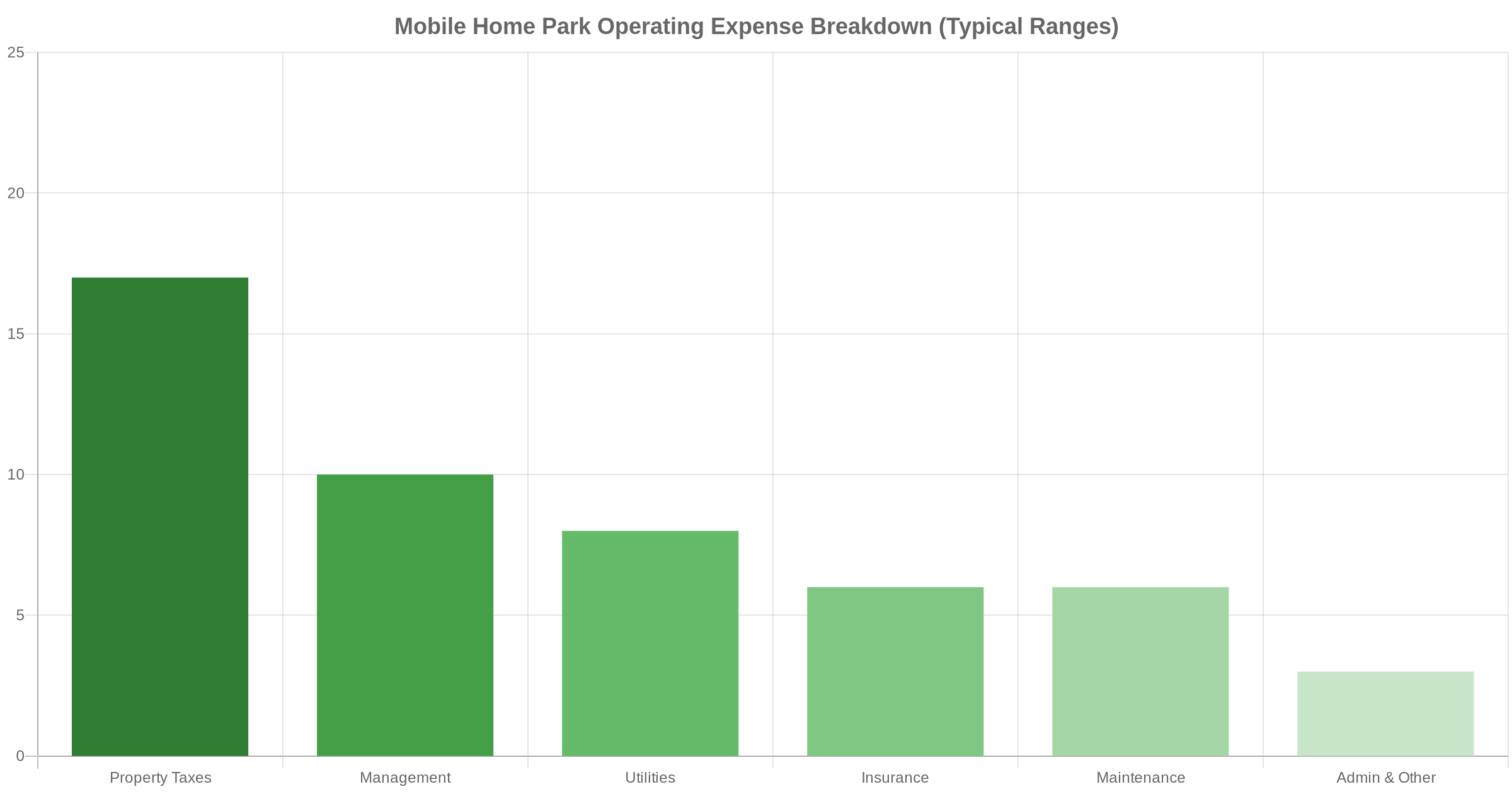
The Major Mobile Home Park Operating Expense Categories
1. Property Taxes
Property taxes are typically the largest single operating expense for a mobile home park, often running 10–20% of gross revenue depending on the state and county. North Carolina, Tennessee, and Georgia — markets where Keel Team actively invests — generally have more favorable property tax environments than northern states like Illinois or New Jersey.
One critical note: many states assess mobile home parks based on income, meaning your tax bill could increase meaningfully after a value-add plan raises NOI. Always request the current tax bill and research how reassessments work in that county before you close.
2. Insurance
Mobile home park insurance typically runs $4,000–$12,000 per year for a mid-sized community, though larger parks or those in hurricane or flood zones can run significantly higher. Standard coverage includes:
- General liability (required by most lenders)
- Property damage (for park-owned structures — roads, clubhouse, utility infrastructure)
- Workers’ compensation (if you have on-site employees)
- Umbrella coverage for additional protection
One important note: individual tenant homes are not covered by the park’s property policy. Tenants are responsible for insuring their own homes — which is one of the many advantages of a tenant-owned-home model.
3. Property Management
If you’re not self-managing, expect to pay a third-party management fee of 8–12% of gross revenue. For a 100-lot park collecting $60,000 per month in lot rent, that’s $5,800–$7,200 per month — a meaningful impact on NOI.
Self-managing is possible, particularly for operators who build systems and hire on-site managers, but it requires real infrastructure. On-site manager costs — salary plus housing allowance — typically run $1,500–$3,000 per month depending on the market. Even if you self-manage, always normalize your underwriting to include a market-rate management fee so you have an accurate picture of true economic performance.
4. Utilities
This is where park infrastructure has the biggest impact on operating costs:
- City water and sewer with submeter billing: If you bill tenants directly for water and sewer usage through individual submeters, the utility expense to the park is near zero. This is the most desirable setup.
- City water and sewer absorbed by the park: If the park pays the master meter and doesn’t bill back, costs can run $5,000–$20,000 or more per month depending on park size — a significant drag on NOI.
- Private well and septic: These parks incur ongoing testing, maintenance, and unpredictable repair costs. A pump replacement or septic system failure can run $20,000–$50,000 or more. This is one of the primary reasons experienced operators prioritize city utilities in their buying criteria.
- Common area electricity: Street lighting, signage, and office power typically runs $200–$800 per month for a mid-sized community.
Two decades of hard-won lessons distilled into one free guide. Whether you’re evaluating your first deal or your fiftieth, these insights will sharpen your approach.
5. Maintenance and Repairs
For a tenant-owned-home community on city utilities, routine maintenance is relatively low — primarily roads, common areas, and any park-owned utility infrastructure. Budget $500–$2,000 per month for a well-maintained 80–100 lot community.
Parks with park-owned homes add a significant maintenance burden. A single delinquent or abandoned home can cost $3,000–$15,000 to remediate — removal, cleanup, and refurbishment before re-occupying. This is why underwriting needs to include a detailed assessment of the park-owned home inventory, condition, and age before you finalize your offer price.
6. Administrative and Other Costs
- Accounting and bookkeeping: $500–$1,500 per month
- Legal (evictions, contracts, title issues): $1,000–$3,000 per year on average for a stabilized community
- Marketing and advertising: $200–$500 per month for a park with vacant lots to fill
- Property management software: Tools like Rent Manager or AppFolio typically run $150–$500 per month
- Capital expenditure reserves: Not technically an operating expense, but experienced operators set aside $100–$300 per lot per year for long-term infrastructure planning
How Operating Expenses Affect NOI and Valuation
This is where operating expense knowledge translates directly into dollars. Mobile home parks are typically valued using the income capitalization approach:
Value = NOI ÷ Cap Rate
If a seller presents a park with $300,000 in gross revenue and claims $180,000 NOI (a 40% expense ratio), but your due diligence reveals actual expenses closer to $210,000 — that’s $30,000 in missing NOI. At a 7% cap rate, that expense discrepancy represents a $428,000 overvaluation.
This is exactly why proper mobile home park underwriting always reconstructs expenses from scratch rather than trusting seller proformas. Verify every line item. Request 12 months of bank statements, utility bills, tax statements, and insurance invoices. Model what the bank statements show — not what the seller says.
Expense Red Flags to Watch for During Due Diligence
Suspiciously Low Expense Ratios
If a seller is showing an expense ratio below 30%, be skeptical. They may be self-managing without allocating a market-rate management fee, skipping necessary reserves, or simply not disclosing all costs. Always normalize to include a market-rate management fee — even if you plan to self-manage — to get a true picture of economic performance.
Deferred Maintenance
A community that looks clean may have deferred significant capital work. Road resurfacing, water line replacements, electrical upgrades — these can run $50,000–$500,000 or more depending on park size and infrastructure age. Budget these as year-one or year-two capital expenditures in your acquisition model, separate from operating expenses, but make sure they’re in your return assumptions.
Utility Absorption Without Billing Back
Many older mobile home park operators never implemented submeter billing and absorb water and sewer costs for the entire community. Converting to submeter billing is low-hanging fruit — it can reduce utility expense from $8,000–$15,000 per month to near zero, immediately boosting NOI. But if a seller’s asking price already assumes this conversion has occurred and it hasn’t, you’re paying for a value-add that you still have to execute yourself.
Expense Ratio Benchmarks at a Glance
Use these benchmarks when evaluating any mobile home park deal:
- 30–35%: Excellent. Tenant-owned homes, city utilities with submeter billing, professional management, 90%+ occupancy.
- 35–45%: Normal for most well-run parks. Some utility absorption or slightly older infrastructure.
- 45–55%: Higher risk. Park-owned homes, private utilities, or management challenges. Investigate thoroughly before proceeding.
- 55%+: Proceed with caution. Structural issues or significant deferred maintenance are likely present.
For a deeper look at how expense ratios affect cap rates and valuations, see our guide to calculating net operating income for a mobile home park.
How Experienced Operators Reduce Operating Expenses Over Time
The best mobile home park operators don’t just buy good assets — they actively work to improve expense ratios after acquisition. Common strategies include:
- Submeter billing rollout: Shift utility costs from the park to residents where legally permitted, eliminating one of the largest operating expenses
- RUBS (Ratio Utility Billing System): An interim step that allocates shared utility costs proportionally to residents while individual meters are being installed
- Right-sizing management: Build on-site systems and staffing models that reduce reliance on expensive third-party management over time
- Preventive maintenance programs: Catch small infrastructure issues before they become expensive failures — road crack sealing is far cheaper than full road replacement
- Vendor renegotiation at scale: Operators with multiple communities can negotiate better rates on insurance, landscaping, and maintenance contracts
The Bottom Line on Mobile Home Park Operating Expenses
Operating expenses are where deals are won or lost. A seller’s proforma is a marketing document — due diligence is where you find the truth. Model conservatively, verify every line item, and always use market-rate assumptions even where current costs appear lower.
The good news: mobile home parks remain one of the most operationally efficient asset classes in commercial real estate. When you buy right and operate well, the expense ratios — and the returns they generate — are genuinely hard to match in other real estate sectors.
For a comprehensive look at how to evaluate mobile home park investments from the ground up, explore our mobile home park investments guide.
10 video modules, a 55-page master checklist, and 9 ready-to-use templates that walk you through every step of evaluating a mobile home park deal — from the first site visit to closing day.
Get the top 20 lessons from two decades of mobile home park investing — free.