One of the biggest misconceptions about growing a mobile home park portfolio is that adding more communities means proportionally adding more staff, cost, and complexity. Operators who believe that tend to stay small — not because they lack capital, but because they never built the infrastructure to support scale.
The most successful mobile home park operators don’t scale headcount alongside their portfolio. They scale systems. Here’s how it’s done.
Why Operations Define Your Returns at Scale
Mobile home parks offer a structural advantage over other real estate asset classes: tenants own their homes, which means far less interior maintenance burden for the operator. Turnover runs around 2–3% annually versus 47% for apartment communities. The management intensity is genuinely lower.
But lower intensity doesn’t mean zero intensity. At scale — managing hundreds of lots across multiple markets — even small inefficiencies multiply. A single-park operator can afford to improvise. A multi-park operator cannot. Operational systems stop being optional once you’re managing 200+ lots.
The Right Team Structure for Multi-Park Operations
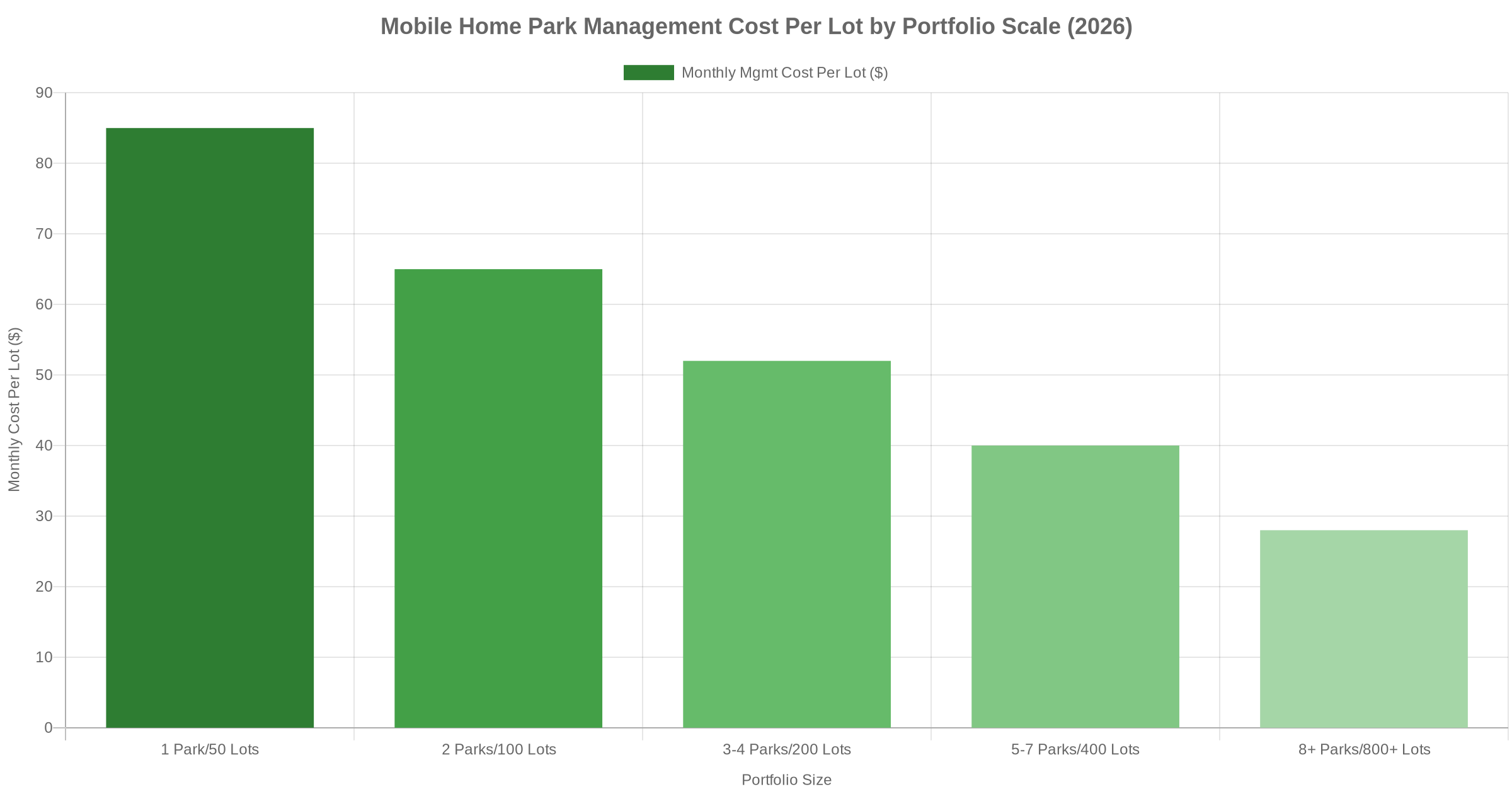
The most common mistake early-stage mobile home park operators make is staffing like a hotel chain — a full-time, salaried manager at every community. For a 50-lot park, that’s typically $40,000–$55,000 in annual labor, eating 10–15% of gross revenue before a single maintenance ticket is filed.
Operators who scale efficiently use a layered model instead:
- Regional manager (covers 3–6 parks): Handles vendor relationships, escalations, site visits, and rent collection oversight. One strong regional manager can cover 200–400 lots.
- Part-time community caretaker (on-site): A trusted community resident paid $800–$1,500/month to maintain common areas, handle basic maintenance, and flag issues early. Eyes and ears, not a full payroll line item.
- Centralized back office: Lease renewals, accounting, compliance, and rent processing handled from a central hub — either internally or through a third-party administrator.
- On-call vendor network: Pre-vetted plumbers, electricians, and handymen on 1099 relationships with defined response times. Not full-time hires.
This structure keeps total labor cost in the 25–35% of gross revenue range rather than 40–55% — a difference that compounds dramatically across a portfolio of ten or more communities.
For a deeper look at what on-site management responsibilities actually look like, see: What Does a Mobile Home Park Manager Actually Do?
Property Management Software Built for Mobile Home Parks
Off-the-shelf apartment management platforms don’t map cleanly to mobile home park operations. The workflows are different: you’re tracking lot rent against resident-owned homes, managing utility billing across shared infrastructure, and dealing with chattel loan complications that apartment software doesn’t know exist.
The most widely used platforms among mobile home park operators in 2026:
- RentManager: The industry standard for portfolios of 200+ lots. Handles lot rent, utility billing sub-metering integrations, maintenance work orders, and resident ledgers in one system. Steeper setup curve but built specifically for this asset class.
- Yardi Breeze Premier: More accessible for mid-size operators. Improved utility billing functionality and a cleaner interface than RentManager. Good fit for 100–500 lots.
- Buildium: Used by smaller operators, particularly those managing a mix of asset types. Simpler and cheaper, but lighter on manufactured housing-specific features.
- Custom spreadsheet systems: Common at 1–3 parks. They work — until they don’t. The transition to real software is almost always reactive and painful.
The right software isn’t about features — it’s about adoption. The best system is the one your team will actually use consistently.
Utility Billing: The Operations Lever Most Operators Miss
In older mobile home park communities, owners often pay master-metered water and sewer and roll the cost into lot rent. At scale, this is a significant margin leak. When utility costs spike, the operator absorbs it entirely.
Converting to sub-metered utilities — or implementing RUBS (Ratio Utility Billing Systems) — is among the highest-ROI operational improvements available. A 100-lot community spending $8,000/month on water and sewer can often recapture $6,000–$7,500 of that through billing residents directly, immediately improving NOI without raising headline lot rent.
Platforms like Metron-Farnier, NWP Services, and Conservice specialize in manufactured housing utility billing — handling meter reading, bill generation, and delinquency tracking without adding to internal staff workload.
For more on how utility conversions and other improvements affect overall park value, see: How to Increase the Value of a Mobile Home Park: 7 Value-Add Strategies That Work
Two decades of hard-won lessons distilled into one free guide. Whether you’re evaluating your first deal or your fiftieth, these insights will sharpen your approach.
Remote Monitoring Technology That Extends a Lean Team
Modern mobile home park operators use technology to multiply the reach of a small team:
- Remote water meter monitoring: Systems like Badger Meters and Sensus notify operators instantly when usage spikes — catching leaks before they become expensive emergencies.
- Security cameras and remote gate access: Centrally monitored entrance cameras and remotely controlled gate systems reduce security incidents without on-site security staff. DKS DoorKing and LiftMaster systems are common in manufactured housing communities.
- Online rent payment portals: When 90%+ of residents pay online, manual check processing disappears, autopay reduces delinquency, and every transaction has a clean digital record.
- Digital work order systems: Maintenance requests submitted via text or resident portal, routed to on-call vendors, and tracked to completion — no phone tag required.
KPIs Every Multi-Park Operator Should Track Weekly
At scale, you can’t be on-site at every community every week. The numbers have to tell the story. Experienced multi-park operators track a consistent KPI dashboard across their portfolio:
- Occupancy rate: Weekly snapshot across all communities. Any park below 85% triggers a defined action plan.
- Collection rate: Percentage of lot rent collected by the 10th of each month. Target is 95% or higher.
- Delinquency aging: Residents 30/60/90+ days past due. A leading indicator for eviction volume and cash flow risk.
- Maintenance cost per lot: Month-over-month comparison by community. Spikes flag deferred maintenance or unreliable vendors.
- NOI vs. budget: Monthly actuals against projections. Variance over 5% triggers a review call.
A clean monthly dashboard covering these metrics lets a regional manager oversee six communities as effectively as a traditional operator oversees one.
When to Outsource vs. Build In-House
Smaller portfolios — one to three mobile home parks — often benefit from third-party property management, especially if the owner is out-of-market. Firms that specialize in manufactured housing (as opposed to apartment-focused managers) can handle daily operations while the owner focuses on acquisitions and capital deployment.
As portfolios grow beyond five to six communities, the economics typically shift. Third-party management fees of 5–10% of gross revenue, compounded across a large portfolio, represent meaningful NOI leakage that an internal team can eliminate. Most sophisticated operators internalize management operations somewhere between 400 and 800 total lots.
The decision isn’t binary — hybrid models are common. Some operators manage operations in-house in their core market while outsourcing outlier communities in secondary markets where building a local team isn’t yet economical.
Conclusion: Build the Infrastructure Before You Need It
The operators who scale mobile home park portfolios efficiently share a common trait: they invest in systems, software, and team structure ahead of growth — not after it. Reactive infrastructure always costs more than proactive infrastructure.
For passive investors evaluating mobile home park operators, operational infrastructure is one of the most important and most overlooked diligence points. An operator managing 10 communities on spreadsheets and gut instinct is a fundamentally different risk profile than one running a centralized system with real-time KPI visibility across the entire portfolio.
Operational excellence isn’t just an internal efficiency — it’s a return driver. Lower management overhead directly improves NOI, which directly drives asset value. At scale, the operational gap between the best and average operators can represent 2–3 full cap rate points of value.
To understand how operators are evaluated from a passive investor’s perspective, read: How to Evaluate a Mobile Home Park Operator Before You Invest
10 video modules, a 55-page master checklist, and 9 ready-to-use templates that walk you through every step of evaluating a mobile home park deal — from the first site visit to closing day.
Frequently Asked Questions
What property management software do mobile home park operators use?
The most widely used platforms in 2026 are RentManager (the industry standard for larger portfolios), Yardi Breeze Premier (better for mid-size operators), and Buildium (for smaller or mixed-asset portfolios). The right choice depends on portfolio size and whether your team will consistently use the system.
How many mobile home parks can one regional manager oversee?
A strong regional manager can typically oversee 3–6 mobile home park communities covering 200–400 total lots. The range depends on geographic proximity, community size, and the strength of on-site caretakers at each location.
What is RUBS in mobile home park utility billing?
RUBS stands for Ratio Utility Billing System. It’s a method of allocating master-metered utility costs to residents based on a formula (usually occupancy or square footage). It’s a stepping stone between owner-paid utilities and full sub-metering, and it significantly reduces the owner’s utility expense burden.
When should a mobile home park operator switch from outsourced to in-house management?
The economics generally favor in-house management once a portfolio exceeds 400–800 total lots. At that scale, third-party management fees (5–10% of gross revenue) represent enough total cost to justify hiring a dedicated internal operations team. Below that threshold, outsourcing often makes more financial and operational sense.
What KPIs should multi-park operators track weekly?
The five most important weekly KPIs for mobile home park operators are: occupancy rate, collection rate (% of lot rent collected by the 10th), delinquency aging (30/60/90+ days), maintenance cost per lot, and NOI vs. budget variance. These five metrics provide early warning on virtually every operational problem before it becomes a financial one.
Get the top 20 lessons from two decades of mobile home park investing — free.