Most people who dream about retirement are actually dreaming about one thing: enough passive income to cover their life without punching a clock. But very few people ever do the actual math.
How much passive income do you actually need to retire — and what does it take to generate it? In this breakdown, we walk through the numbers, the strategies, and why an increasing number of investors are turning to mobile home park investing as the engine to get there.
Start With Your Number: What Does Retirement Actually Cost?
Before you can build a passive income strategy, you need to know your target. The question isn’t “how much can I save?” — it’s “how much monthly income do I need my money to generate?”
For most households, retirement expenses fall into three buckets:
- Core living expenses — housing, food, utilities, transportation, healthcare
- Lifestyle expenses — travel, dining, hobbies, entertainment
- Contingency buffer — healthcare inflation, home repairs, family support
A modest retirement in a lower-cost region might require $4,000–$6,000 per month. A comfortable retirement for a professional accustomed to a $200K+ income often requires $10,000–$15,000 per month. Some target even higher.
Here’s a simple framework to find your number:
- Add up your current monthly expenses
- Remove work-related costs (commuting, professional wardrobe, childcare)
- Add projected healthcare costs (Medicare doesn’t cover everything)
- Add a 10–15% buffer for inflation and the unexpected
That final number is your monthly passive income target. It might be $7,500. It might be $12,000. Wherever it lands — that’s what your investments need to produce every single month, without you doing anything to earn it.
The Math Behind Passive Income and Capital Requirements
Once you have your monthly target, the math gets straightforward. The question becomes: at what rate of return does your invested capital generate that income?
This is where asset class selection matters enormously. A savings account at 5% interest, a dividend portfolio at 3%, or a real estate investment yielding 8% preferred distributions will all require dramatically different amounts of capital to produce the same monthly income.
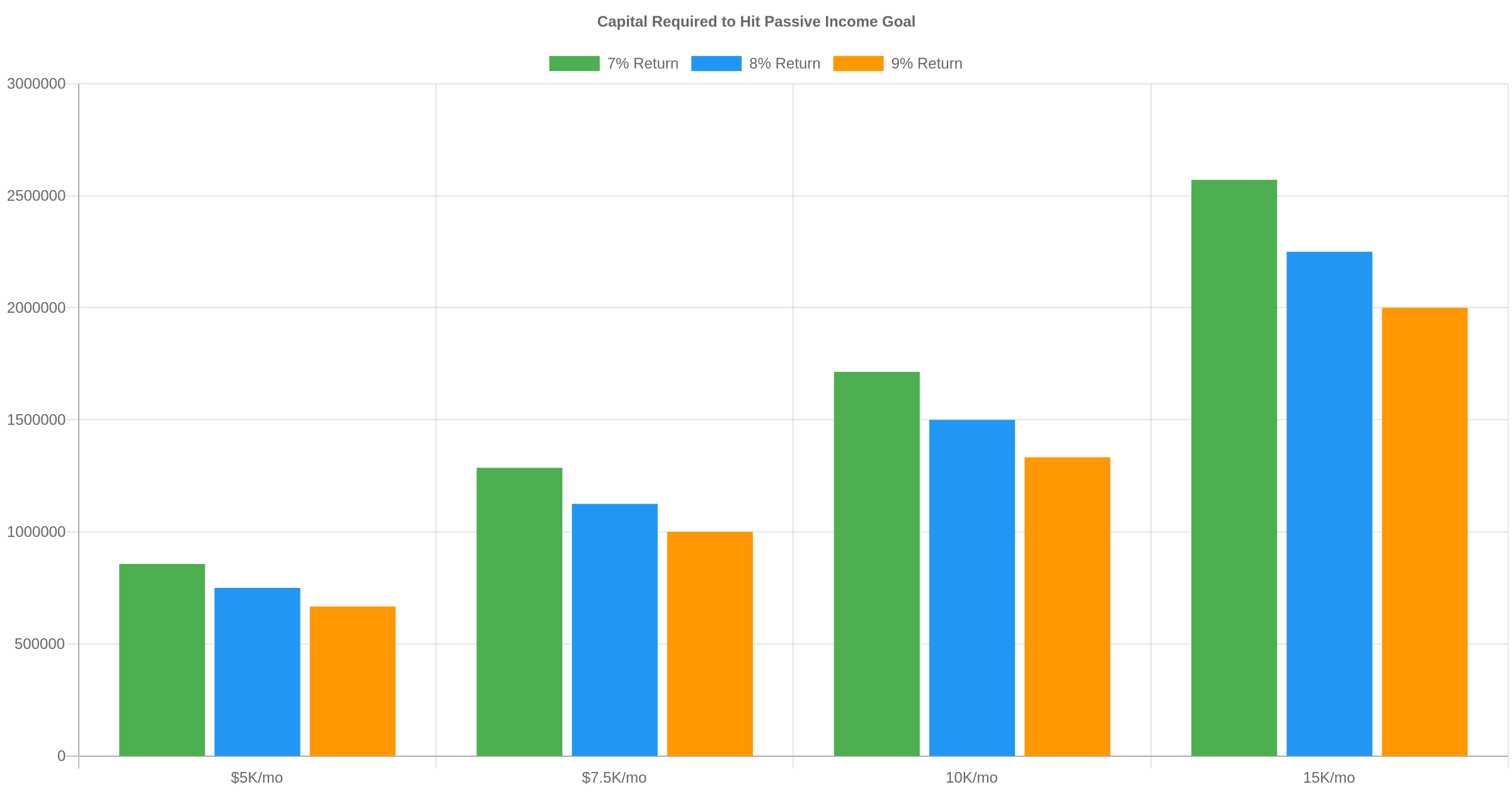
Here’s how the math breaks down across different return scenarios:
| Monthly Goal | Annual Income | At 7% Return | At 8% Return | At 9% Return |
|---|---|---|---|---|
| $5,000 | $60,000 | $857,000 | $750,000 | $667,000 |
| $7,500 | $90,000 | $1,286,000 | $1,125,000 | $1,000,000 |
| $10,000 | $120,000 | $1,714,000 | $1,500,000 | $1,333,000 |
| $15,000 | $180,000 | $2,571,000 | $2,250,000 | $2,000,000 |
The difference between a 7% return and a 9% return on a $10,000/month goal is $381,000 in capital required. That’s why the asset class you choose — and the returns it generates — isn’t just a detail. It can shave years off your path to financial independence.
Why Traditional Passive Income Strategies Fall Short
Most people build their passive income strategy around one or more of the following:
- Dividend stocks — Average yield: 1.5–3%. Volatile. Dividends can be cut.
- Bond ladders — Yield: 4–5%. Low volatility but inflation-exposed. No principal growth.
- REITs — Average dividend yield: 4–5%. Publicly traded, correlated with stock market swings.
- Single-family rentals — Gross yields of 5–8%, but net yield after vacancy, repairs, property management, and taxes often drops to 3–5%. Also requires active involvement or management overhead.
- Savings accounts / CDs — Rates fluctuate with Fed policy. No inflation protection.
None of these are inherently bad. But when your goal is generating $10,000/month in truly passive income — income that doesn’t require your time — the math gets difficult at 3–5% yields. You need $2.4M to $4M in capital just to cover that target. And many of these strategies don’t keep pace with inflation over time.
Two decades of hard-won lessons distilled into one free guide. Whether you’re evaluating your first deal or your fiftieth, these insights will sharpen your approach.
How Mobile Home Park Investing Fits Into a Passive Income Strategy
Mobile home park investing — specifically through passive LP positions in syndications — offers a return profile that differs meaningfully from the asset classes above.
Here’s what a typical mobile home park syndication structure looks like for a limited partner (passive investor):
- Preferred return: 7–8% annually, paid quarterly from property cash flow
- Equity upside: 70/30 or 80/20 split above the preferred return on sale
- Hold period: Typically 3–7 years
- Total return target: 12–16% IRR (varies by deal and operator)
- Minimum investment: Typically $50,000–$100,000 per deal
The preferred return functions as recurring passive income. If you invest $1,000,000 across multiple mobile home park syndications at an 8% preferred return, you’re generating $80,000 per year — or roughly $6,667 per month — without active involvement in operations, maintenance, or tenant management.
For someone with a $7,500/month retirement target, that same $1,000,000 at 9% preferred covers most of the goal. Adding equity upside from eventual sales can meaningfully exceed the baseline income stream.
What makes mobile home park syndications particularly suited to retirement income planning is the underlying asset’s stability. National occupancy in manufactured housing communities sits at 93–94%, up from 85% a decade ago. New supply is virtually nonexistent — only 0.04% of the existing stock is added annually, compared to 3.8% for apartments. And during the 2008 financial crisis and COVID-19, mobile home park net operating income remained positive while apartments declined. That stability matters when you’re depending on distributions to pay your bills.
How to Build a Passive Income Stack That Gets You to Retirement
No single deal or investment gets most investors to their retirement number overnight. The realistic path is building a passive income stack over time. Here’s how experienced investors approach this:
1. Define Your Retirement Income Target
Use the framework above. Be specific. “Enough to retire” is not a number. $9,500 per month (covering $5,500 in core expenses plus $4,000 in lifestyle and buffer) is a number.
2. Audit Your Current Passive Income
Add up everything that pays you without your active labor: rental income, dividends, distributions from existing investments, side business income you’re not operationally involved in. This is your baseline. The gap between baseline and target is what your new investments need to close.
3. Pick Your Vehicle Based on Return Profile
If your gap is $8,000/month and you have $1M to deploy, you need a 9.6% yield. That points you toward higher-yield real estate structures — not dividend stocks. Mobile home park syndications and direct acquisitions can operate in that range. Apartments and single-family rentals in most markets cannot deliver that net of expenses.
4. Diversify Across Deals and Operators
Rather than deploying $1M into a single mobile home park deal, experienced passive investors spread across 3–5 syndications with different operators, geographies, and hold timelines. This smooths distribution timing (deals in different years of their lifecycle) and reduces operator-specific risk. You can read more about this approach in our guide to building a mobile home park syndication portfolio.
5. Reinvest Until You Hit the Number
Many investors on the path to retirement reinvest distributions from earlier deals into new syndications, compounding their passive income stack until it crosses their target threshold. When deal exits return capital (often with equity upside), that capital gets redeployed into new opportunities — continuing the cycle.
If you’re new to the mechanics of how mobile home park syndications work, our guide to GP/LP structure and waterfall distributions breaks down exactly how returns flow from the property to passive investors.
What the Tax Picture Looks Like
One dimension that makes mobile home park syndications particularly attractive for retirement income planning is the tax treatment — specifically depreciation.
In a typical mobile home park syndication, the general partner conducts a cost segregation study that front-loads depreciation into the early years of ownership. This depreciation flows through to limited partners on their K-1s as a “paper loss,” which can offset passive income from the investment itself — or other passive income sources.
For investors who are still working and receiving W-2 income while building their passive income stack, bonus depreciation can also offset active income in certain situations (particularly for real estate professionals or high-income earners who qualify under IRS passive activity rules). You can learn more about how depreciation and tax treatment work in our post on the tax advantages of mobile home park investing.
The point: the after-tax value of a 7–8% preferred return from a mobile home park syndication often exceeds the after-tax value of a 5% dividend yield — even if the pre-tax numbers look closer than they are.
10 video modules, a 55-page master checklist, and 9 ready-to-use templates that walk you through every step of evaluating a mobile home park deal — from the first site visit to closing day.
Conclusion: Know Your Number, Then Build to It
Retirement isn’t about a savings balance — it’s about monthly cash flow that replaces your active income. The sooner you translate your retirement goal into a specific monthly income target, the easier it becomes to reverse-engineer the capital and return rate required to hit it.
For investors who want to build meaningful passive income with a return profile higher than traditional vehicles offer, mobile home park investing — particularly through well-structured syndications — has emerged as a serious part of the answer. National occupancy is near all-time highs, new supply is constrained by zoning and development economics, and lot rents continue to grow in most markets. The structural tailwinds that support stable distributions are as strong as they’ve been in decades.
If you want to understand the full picture of what passive mobile home park investing looks like from the LP side, start with our guide on active vs. passive mobile home park investing and what to expect in year one as a limited partner.
Frequently Asked Questions
How much passive income do I need to retire comfortably?
Most financial planners target replacing 70–90% of your pre-retirement income with passive sources. For someone earning $150,000/year, that’s $8,750–$11,250 per month in passive income. Your specific number depends on your lifestyle, location, and healthcare costs. Start by calculating your actual monthly expenses rather than using a percentage rule.
Can mobile home park syndications replace a salary?
Not overnight — but over time, yes. An investor who deploys $1.5M across multiple mobile home park syndications at an 8% preferred return would receive $120,000 annually ($10,000/month) in distributions. That number grows as equity upside from exits is reinvested into new deals.
How do preferred returns work in a mobile home park syndication?
A preferred return is a guaranteed-first distribution rate paid to limited partners before the general partner (operator) receives any profit split. If a deal offers a 7% preferred return and you invest $200,000, you receive $14,000 per year ($1,167/month) in distributions before the GP gets any carried interest. This payment comes from the property’s cash flow — primarily monthly lot rent from residents.
What is the minimum investment for passive mobile home park investing?
Most mobile home park syndications have minimum investment thresholds of $50,000–$100,000. Some larger institutional offerings start higher. This means you can begin building a passive income stack with a single six-figure investment and scale up over time as distributions and exits return capital.
How safe is passive income from a mobile home park syndication?
No investment is risk-free. However, manufactured housing communities have demonstrated strong NOI resilience — positive every year since 2007, through both the 2008 financial crisis and COVID-19. Key risk factors to evaluate include the operator’s track record, the property’s utility infrastructure, occupancy rate at acquisition, and the debt structure of the deal. Our guide on mobile home park investment risk covers how to identify and mitigate the five biggest risks passive investors face.
Get the top 20 lessons from two decades of mobile home park investing — free.