Mobile home parks have earned a reputation as one of the most resilient and cash-flow-friendly real estate asset classes. But that doesn’t mean they’re challenge-free. Before you invest — whether actively or passively — it’s worth understanding the real obstacles operators face on the ground, and why experienced teams are better positioned to navigate them than first-timers.
This post breaks down the most common challenges in mobile home park investing, what drives each one, and how seasoned operators mitigate the risks.
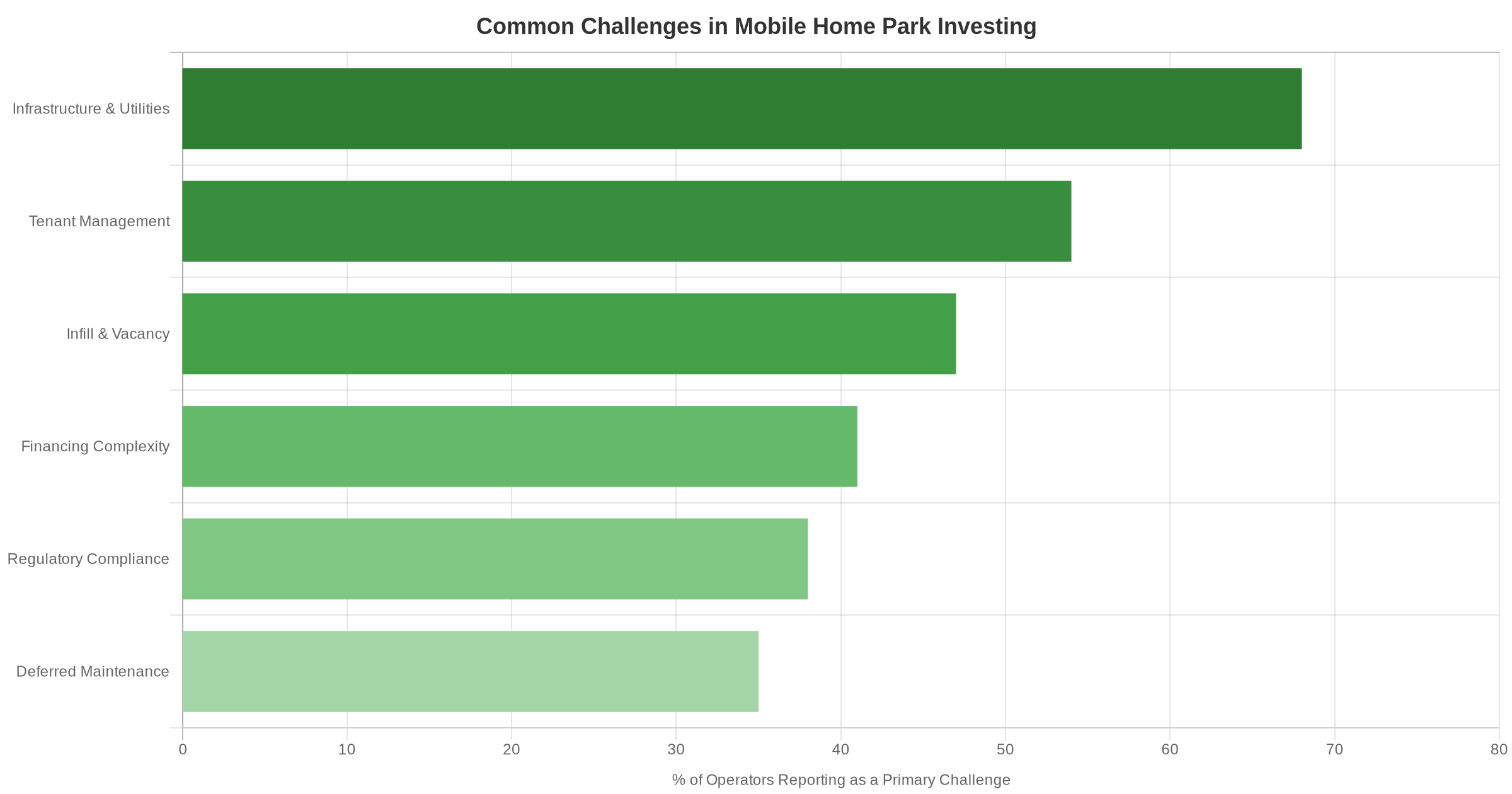
1. Infrastructure and Utility Issues
Aging infrastructure is the number one headache for mobile home park operators — and the most expensive. Many parks were built decades ago with private water systems, septic fields, or outdated electrical panels that were never designed to carry modern loads.
The two most critical utility considerations:
- Water and sewer: Parks on city water and city sewer are dramatically easier to manage. Parks with private wells or lagoon-style wastewater systems carry significant operational and regulatory risk — including EPA violations, mandatory upgrades, and unforeseen remediation costs.
- Electrical systems: Older parks often have pedestal-style electrical systems where the park owns the wiring up to the home. Upgrading these can run $2,000–$5,000 per pad.
How experienced operators handle it: Thorough due diligence before closing always includes a licensed engineer’s inspection of all utility systems. At Keel Team, we only target parks with city water and city sewer — not one or the other. This single filter eliminates an entire category of expensive infrastructure surprises before we even make an offer.
2. Infill and Vacancy
A mobile home park with 40% vacant lots isn’t generating 40% of its potential income — it’s generating zero from those lots while still incurring property taxes, lawn care, and maintenance on the empty spaces. Infill (filling vacant lots with new residents and homes) is both the primary value-creation opportunity and one of the most complex operational challenges in the business.
The challenge: sourcing affordable homes, coordinating delivery and setup, securing home financing for residents, and navigating local permitting can stretch timelines significantly. A park with 30 vacant lots might realistically take 2–3 years to reach stabilization.
How experienced operators handle it: Operators who buy used homes, partner with manufactured home retailers, or use direct-financing programs (where the park funds the home sale to the resident) can accelerate infill. Underwriting assumptions must bake in realistic infill timelines — not optimistic projections.
3. Tenant Management and Community Culture
Mobile home park residents own their homes but rent the land beneath them. This creates a fundamentally different landlord-tenant dynamic than apartment management. Most residents are long-term — often 5, 10, or 20+ years — which is one of the asset class’s great strengths. But it also means that when community issues arise, they tend to be entrenched.
Common tenant management challenges include:
- Lease enforcement in communities with historically lax management
- Addressing residents who violate community rules (parking, home maintenance, pets)
- Managing the eviction process for non-payment, which varies significantly by state
- Navigating inherited community dynamics from prior ownership
How experienced operators handle it: A structured onboarding process — clear community rules, updated leases, consistent enforcement from day one — resets expectations quickly after acquisition. Operators who communicate proactively, invest in amenities, and treat residents with respect see faster stabilization and fewer conflicts. Understanding tenant protection laws by state is also essential for staying compliant during turnarounds.
📘 Free eBook: Top 20 Things I’ve Learned from Investing in Mobile Home Parks
Get the hard-won insights from years of buying and operating manufactured housing communities — covering due diligence, financing, tenant management, and more.
4. Financing and Capital Access
Mobile home park financing has improved significantly over the past decade, but it remains more complex than financing a single-family rental or small apartment building. Lenders evaluate parks differently based on lot count, occupancy, utility systems, and whether homes are park-owned or tenant-owned.
Key financing challenges include:
- Agency debt eligibility: Fannie Mae and Freddie Mac have specific criteria — parks generally need 50+ lots, strong occupancy, and city utilities to qualify for agency-backed programs with the most favorable terms.
- Appraisal complexity: A park with a mix of tenant-owned homes and park-owned homes may be appraised differently than an all-tenant-owned community, complicating the loan-to-value calculation.
- Capital reserves: Lenders often require significant reserves, especially for value-add parks with infill potential and deferred maintenance.
For a deeper look at this topic, see our full breakdown of mobile home park financing options, covering agency debt, community bank loans, and seller financing.
How experienced operators handle it: Teams with an established track record and existing lender relationships access better terms. First-time buyers often face higher rates or more restrictive structures — one reason why passive investment through an experienced syndicator can be advantageous for investors who aren’t ready to navigate lender relationships directly.
5. Deferred Maintenance and Capital Expenditure Surprises
When a mom-and-pop operator sells a mobile home park after 20 or 30 years, deferred maintenance is almost always part of the package. Roads, common area lighting, landscaping, fencing, signage, and community buildings may all need meaningful investment. Addressing deferred maintenance quickly improves resident satisfaction and signals new management’s commitment to the community.
How experienced operators handle it: Detailed due diligence that includes a thorough physical walkthrough helps identify deferred maintenance items before closing. Smart buyers build a capital expenditure budget into their acquisition underwriting — typically $500–$2,000 per lot for a value-add park — so there are no surprises post-close.
6. Regulatory and Zoning Compliance
The regulatory environment for mobile home parks is evolving. Across multiple states, legislators are advancing bills related to tenant right-of-first-refusal, rent increase notice requirements, and displacement protections. While most of these laws don’t dramatically change operations for responsible operators, they do add compliance complexity that new entrants may underestimate.
Local zoning is also a persistent concern. Non-conforming parks — those that don’t meet current zoning standards — can face restrictions on expansion or redevelopment that affect long-term value. Understanding a park’s zoning history before closing is non-negotiable.
How experienced operators handle it: Stay current on state legislation in your target markets, maintain transparent communication with residents, and retain local attorneys who specialize in manufactured housing law for compliance guidance.
What Drives Investment in Mobile Home Parks Despite These Challenges?
Despite the challenges above, mobile home park investing continues to attract serious capital — and for good reason. The structural advantages of the asset class are difficult to find elsewhere in real estate:
- Very low tenant turnover: Mobile home park residents relocate at roughly 2.2% annually, compared to approximately 47% for apartment tenants. Once a resident is established, they tend to stay for years or decades.
- Near-zero new supply: Roughly 20 new mobile home park communities are permitted each year out of approximately 45,000 existing parks nationwide. Zoning barriers and community opposition make new supply effectively impossible in most markets.
- Recession resilience: Mobile home park net operating income has been positive every year since 2007 — through the 2008 financial crisis (when mobile home park communities posted +1.5% vs. apartments at -5.6%) and through the COVID-19 pandemic.
- Strong cap rates: Well-operated parks in target markets trade at cap rates that offer meaningfully better risk-adjusted returns than comparable multifamily assets in many regions.
The investors and operators who succeed in mobile home parks are the ones who go in with eyes open, do the work during due diligence, and manage communities with intention. The challenges are real — but they’re manageable for experienced operators with the right systems, market knowledge, and capital structure.
Conclusion
Mobile home park investing is not a passive, hands-off experience for active operators. But for passive investors participating in a well-managed syndication, many of these challenges are handled entirely by the operating team. The key is partnering with operators who have the track record, systems, and market presence to anticipate and mitigate these risks before they become problems.
If you’re still building your foundation of knowledge in this space, our free ebook covers the 20 most important lessons learned from years of buying and operating mobile home parks — written for investors who want real-world insights, not textbook theory.
📋 The Mobile Home Park Due Diligence Playbook
10 video modules, a 55-page master checklist, and 9 ready-to-use templates that walk you through every step of evaluating a mobile home park deal. Know exactly what you’re buying before you close.
Frequently Asked Questions
What is the biggest challenge in owning a mobile home park?
For most operators, infrastructure — particularly aging utility systems like private water, septic fields, or outdated electrical — is the costliest and most operationally complex challenge. Parks with city water and city sewer avoid the most significant infrastructure risks and are far easier to operate and finance.
Are mobile home parks hard to manage?
Mobile home parks are operationally simpler than apartment buildings in many respects — residents own their homes, so the operator isn’t responsible for home maintenance and repairs. However, community management including tenant relations, rule enforcement, and infill coordination requires dedicated effort and strong systems, particularly during the first 12–24 months after acquisition.
What is the vacancy rate for mobile home parks?
National occupancy for manufactured housing communities is approximately 94%, up from 86.5% a decade ago. Value-add parks acquired from mom-and-pop operators often carry higher vacancy at acquisition — typically 70–85% — with infill as the core value-creation strategy during the hold period.
What is driving investment in mobile home parks?
The combination of near-zero new supply, very low tenant turnover (2.2% vs. ~47% for apartments), consistent NOI growth through economic downturns, and strong affordable housing demand from 20 million+ Americans living in manufactured housing communities makes mobile home parks a structurally compelling investment asset class. Institutional capital has increasingly recognized this, adding further credibility to the sector.
How do I avoid common mobile home park investing mistakes?
Thorough due diligence is the first and most important line of defense. A comprehensive inspection of all utility systems, review of lease agreements and historical financials, market-rate lot rent analysis, and a realistic infill plan are all critical before closing. Our Mobile Home Park Due Diligence Checklist covers all 25 key verification points every buyer should complete.
📘 Want to Go Deeper? Get Our Free eBook
Download our free guide covering the top 20 things learned from years of investing in mobile home parks — written for investors who want real insights, not theory.
10 video modules, a 55-page master checklist, and 9 ready-to-use templates that walk you through every step of evaluating a mobile home park deal — from the first site visit to closing day.