If you own mobile home parks and you’re still running master-metered utilities billed back to tenants through RUBS, you need to read this. Not next month. Now.
The regulatory environment around utility billing in manufactured housing communities has shifted dramatically over the past 18 months. What worked for decades as an accepted operating practice — Ratio Utility Billing Systems, or RUBS — is now under direct legislative attack in multiple states. And the investors who don’t see it coming are going to get crushed.
What Is RUBS and Why Has It Been So Common?
RUBS is simple: the park owner pays the master water, sewer, or electric bill for the whole property, then divides that cost among residents based on a formula — usually by unit count, occupancy, or square footage. It has been a standard practice in older parks where individual meters were not installed. It gave operators a way to pass through utility costs without the capital expense of submetering every pad.
For a lot of operators, it has also been a profit center. Bill $80/month per site in utilities, keep whatever is not consumed. Scale that across 100 lots and you have added real NOI.
That era is ending.
The Legislative Domino Has Started Falling
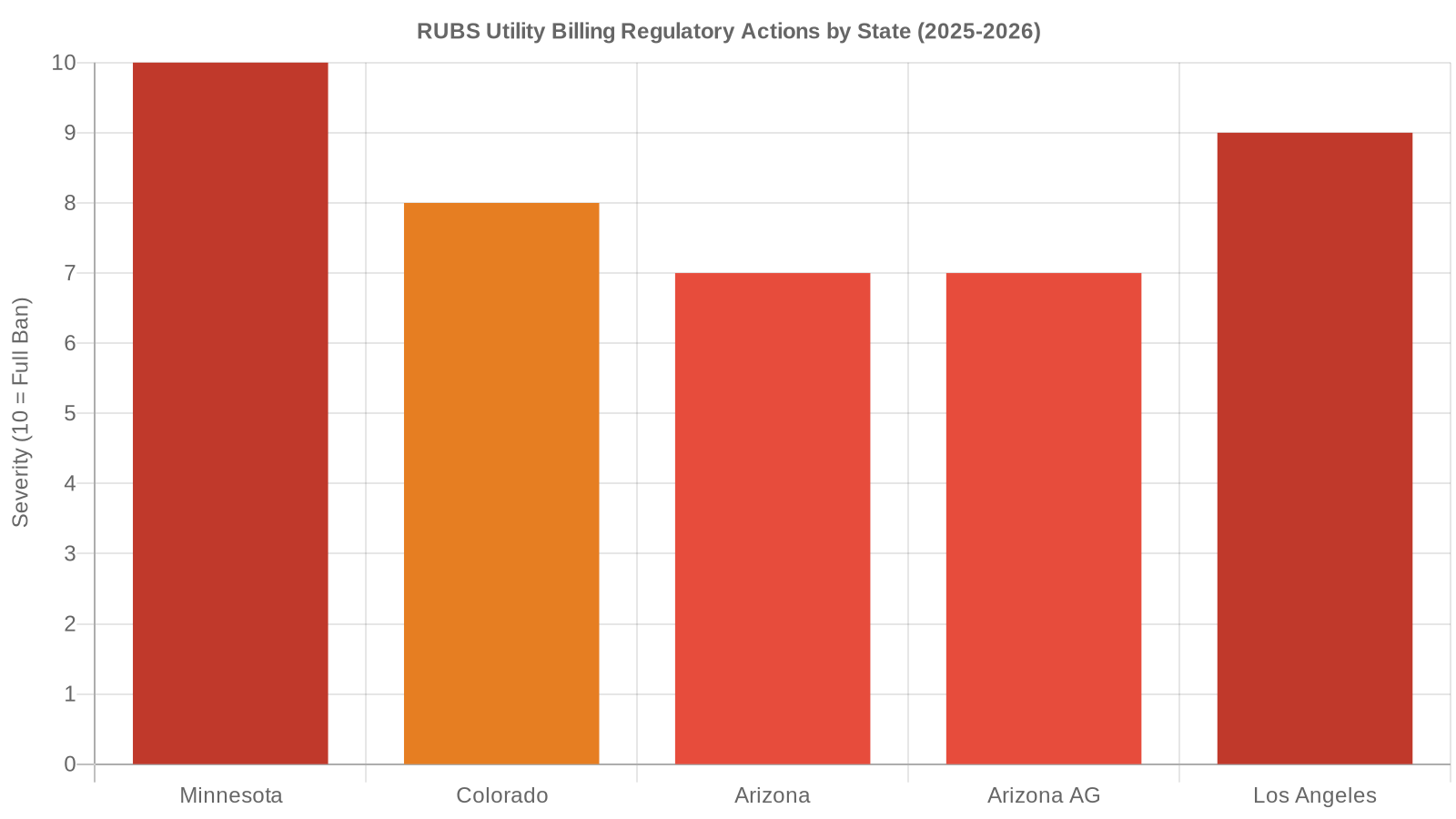
Minnesota fired the first shot: effective January 1, 2025, the state banned RUBS entirely for electricity. Natural gas and water billing are now subject to strict mandated formulas. Submetered properties in Minnesota now fall under Public Utilities Commission oversight. Administrative markups on utility costs are prohibited.
Colorado followed with HB 25-1090 in 2025. RUBS is still permitted for existing properties, but only under narrow, documented conditions with full transparency to residents. New construction permitted after July 1, 2027 will require individual metering for gas, electric, and water.
Arizona’s Attorney General issued a formal consumer alert in August 2025, reminding all mobile home park operators of their submetering and billing obligations under state law. The message was blunt: overbilling tenants on utilities now exposes you to consumer fraud liability.
And in Los Angeles, class-action lawsuits are already underway against landlords using RUBS. The city is actively considering a full prohibition.
This is not a fringe legislative trend. It is moving state by state, pushed by tenant advocacy organizations who have discovered that RUBS is an easy legislative target.
What This Means for Your NOI
Here is the hard math. If you own a 100-site park where you are currently billing $60/month per site in utility bill-backs through RUBS, that is $72,000/year in revenue. If your state bans RUBS and you have not submetered, you lose that revenue stream entirely. At a 6% cap rate, that is $1.2 million in lost asset value.
Submeter conversion costs $800 to $2,500 per site depending on infrastructure. On 100 sites, that is $150K to $250K all-in. That is a real capital event — but far less painful than eating $1.2M in lost equity or getting hit with a class-action from tenants claiming overbilling.
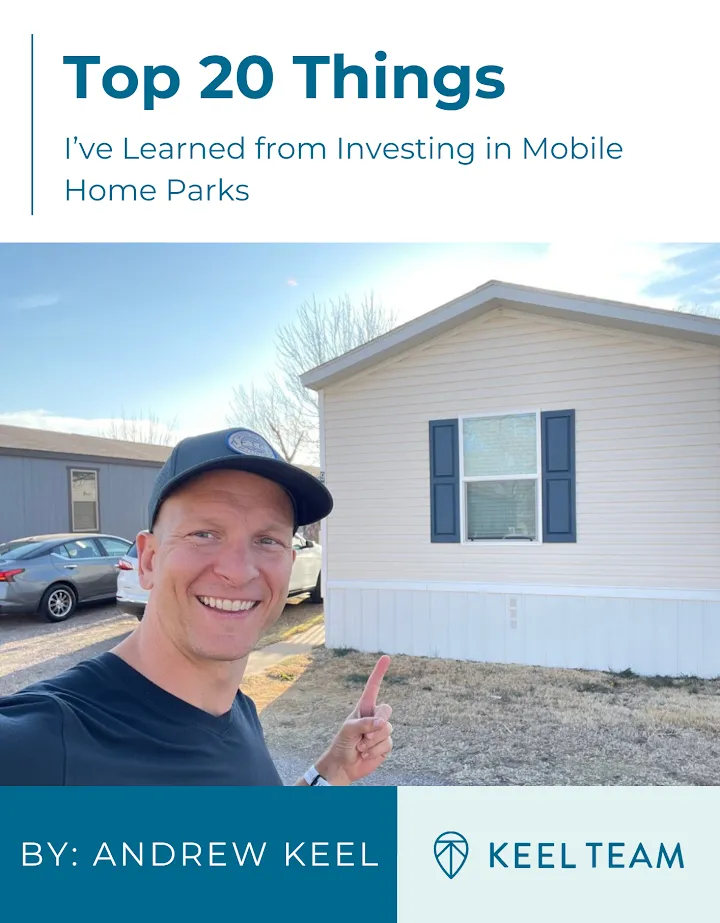
Two decades of hard-won lessons distilled into one free guide. Whether you’re evaluating your first deal or your fiftieth, these insights will sharpen your approach.
Download the Free eBook →
The Smart Operator’s Move
Audit every park you own by state. Know your regulatory exposure before it finds you. States with active RUBS legislation or pending bills include Minnesota, Colorado, Arizona, California, Washington, and New York. Get a legal review of your current billing practices if you operate in any of these states.
Model the submeter conversion economics. For most parks, submeter conversion is a 3 to 5 year payback through reduced water waste, elimination of billing disputes, and protection from regulatory fines. It also increases the marketability of your park to institutional buyers who increasingly require submetered utilities.
View the regulatory chaos as a buying opportunity. Operators in Minnesota and Colorado right now are facing compliance complexity they never signed up for. Some of them are sellers. Parks with known RUBS exposure scare off most buyers — but if you understand the operational solution, you can negotiate favorable prices and capture the upside post-conversion. This due diligence framework is part of what we cover in our Mobile Home Park Due Diligence Playbook.
Move to a third-party utility billing service. Companies like Metron and Synergy Utility Billing handle the billing, the resident communication, and the compliance documentation for $3 to $8 per site per month. The legal liability transfer alone is often worth the cost.
The Bigger Picture
The manufactured housing sector is still one of the strongest asset classes in commercial real estate. The two largest publicly traded manufactured housing community REITs guided to 5% rent growth for 2026, and both are running near-full occupancy. Institutional capital is back in the market — one REIT deployed $457 million across 14 communities in a single quarter in late 2025.
But the operating environment is getting more complex. The days of passive mailbox money from a master-metered park are over. Investors who win in the next decade will be the ones who embrace operational complexity as a moat — because the operators who cannot handle it will sell to those who can.
Utility billing compliance is not glamorous. But getting ahead of it is the unsexy, blocking-and-tackling work that separates the operators who build lasting portfolios from those who sell in a fire sale.
Andrew Keel is the founder of Keel Team Real Estate Investments, one of the most active private operators of affordable manufactured housing communities in the Southeast and Midwest.
10 video modules, a 55-page master checklist, and 9 ready-to-use templates that walk you through every step of evaluating a mobile home park deal — from the first site visit to closing day.
Get the Playbook →
Get the top 20 lessons from two decades of mobile home park investing — free.
Download the Free eBook →