It is one of the most common calls I get from investors who are new to mobile home parks:
“Andrew, I just closed on a 75-lot park. Everything looked good on paper. Then we discovered the water lines are original galvanized from 1968. We got a quote to replace them. It is $180,000.”
My answer is always the same: Did you camera the sewer lines? Did you pressure-test the water mains? Did you pull the electrical permits?
The answer is almost always no. And that is the problem.
After acquiring and operating dozens of mobile home park communities across the Southeast and Midwest, I can tell you with confidence: the single biggest value destroyer in mobile home park acquisitions is not bad tenants, bad management, or bad markets. It is infrastructure you did not know about until after you closed.
Why General Commercial Inspectors Fail Mobile Home Park Buyers
The standard commercial real estate inspection process was designed for office buildings, retail centers, and apartment complexes. It works reasonably well for properties where the infrastructure is visible, documented, and relatively modern.
Mobile home parks are different in almost every material way.
The majority of parks currently on the market were built between the 1940s and the 1980s. Their infrastructure reflects that era: galvanized steel water mains, Orangeburg or clay composite sewer lines, 30-amp electrical pedestals, and in rural areas, private septic systems and lagoons. A general commercial inspector who has not worked specifically on mobile home park properties will walk the property, see homes, see a road, see an office — and completely miss the deteriorating infrastructure that is 3 feet underground or inside an aging electrical pedestal.
This is not a knock on inspectors. It is a structural gap in how mobile home park due diligence is typically performed.
The Infrastructure Time Bombs You Are Not Looking For
Galvanized Steel Water Lines
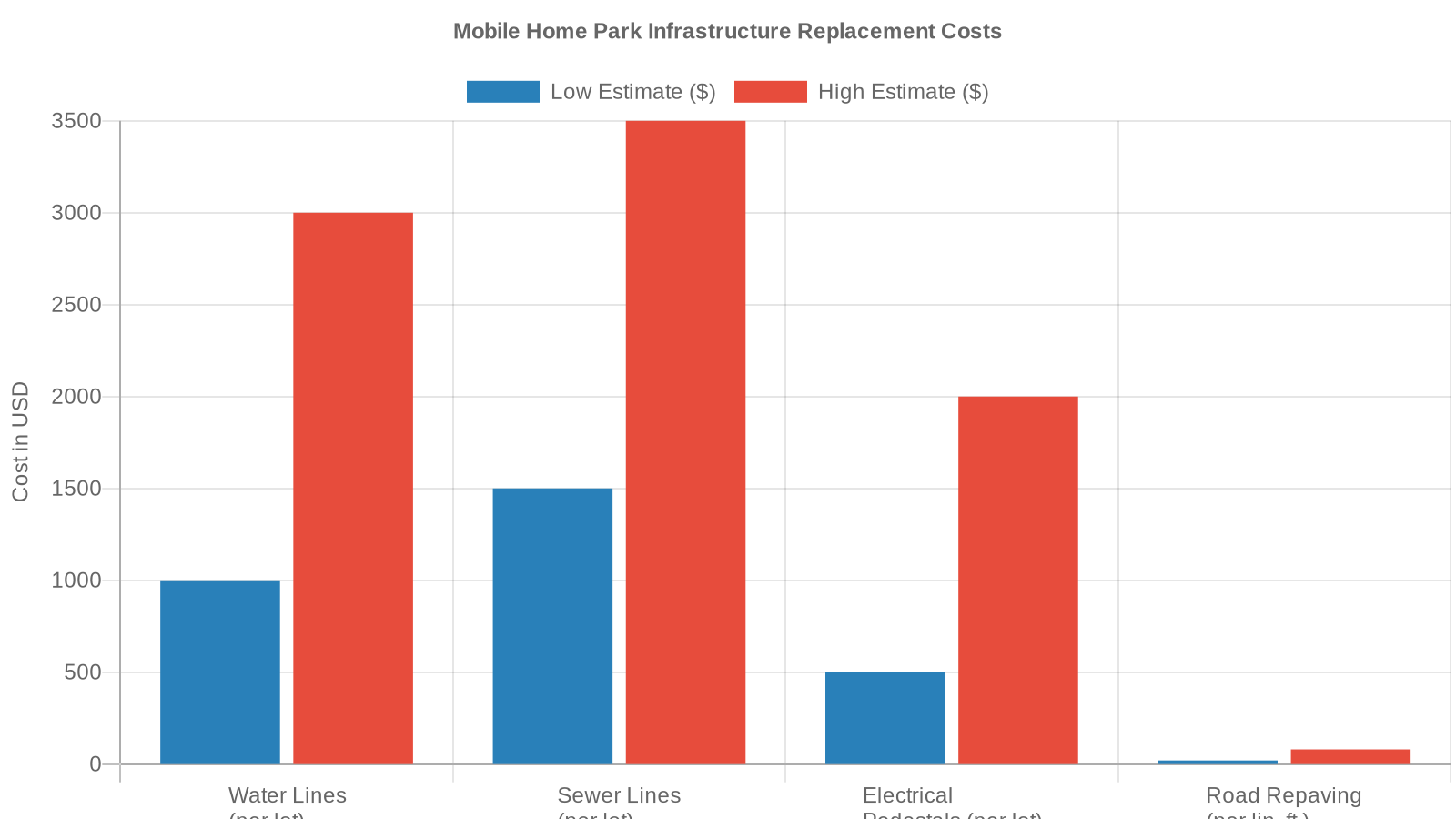
Parks built before 1970 commonly used galvanized steel piping for water distribution. Galvanized pipes corrode from the inside out. By the time you see low water pressure or rust-colored water, the pipes are already compromised. Replacement runs $1,000 to $3,000 per lot installed — meaning a 100-lot park with galvanized infrastructure represents $100K to $300K in unfunded capital expenditure that is not showing up in the seller pro forma.
How to catch it: Pressure-test the water mains. Check water loss ratios — if the park is consuming more water than the meter reads to residents, there are leaks. More than 15% unaccounted water loss is a red flag. Get a licensed plumber with mobile home park experience to assess the material and condition of distribution lines.
Orangeburg and Clay Sewer Lines
Orangeburg pipe — a tar-paper composite used widely from the 1940s through the 1970s — has a design life of around 50 years. Most of it is now 60 to 80 years old. It does not fail gradually. It collapses. Clay pipe has its own failure mode: root intrusion.
Either way, you are looking at collapsed sewer lines, sewage backup into homes, and potential environmental liability if contamination reaches groundwater.
How to catch it: Camera every sewer main in the park. A CCTV sewer scope costs $500 to $2,000 for a whole park and will tell you exactly what is down there. This is non-negotiable on any park built before 1985. Do not close without it.
Aging Electrical Infrastructure
Many parks built before 1990 have 30-amp or 50-amp electrical pedestals. Modern double-wide homes require 200-amp service. If residents are running modern HVAC systems and appliances on 30-amp pedestals, you are looking at tripped breakers, overloaded systems, and fire risk. Insurance carriers are increasingly scrutinizing electrical infrastructure in manufactured housing communities, and some are declining coverage on parks with outdated pedestals.
How to catch it: Pull the electrical permits on the park. Test amperage at a sample of pedestals. Hire a licensed electrician to assess the electrical system — not a general handyman.
Private Septic, Lagoons, and Wastewater Treatment Plants
Parks with private wastewater infrastructure rather than municipal sewer hookup carry serious operational and regulatory risk. EPA violations can result in fines up to $10,000 per day. Decommissioning a failing lagoon system can run $200K to $500K. Our policy at Keel Team: avoid parks with private wastewater unless there is a clear, permitted municipal sewer connection in the near-term pipeline.
Building Your Mobile Home Park Due Diligence Protocol
Here is the framework we use at Keel Team for every acquisition — and the foundation of our Mobile Home Park Due Diligence Playbook:
Phase 1 (Pre-LOI): Request utility bills, water loss data, and any existing inspection reports. Review county permit records for infrastructure upgrades. Ask the seller: when were the water lines, sewer lines, and electrical pedestals last replaced? The answers — and the evasions — are informative.
Phase 2 (Under Contract): Commission a mobile home park-specific infrastructure inspection. This means a licensed plumber for water and sewer, a licensed electrician for the electrical system, and a civil engineer if there are any questions about roads, grading, or drainage. CCTV scope every sewer main. Pressure-test the water distribution system.
Phase 3 (Pricing): Model every identified deficiency into your pro forma. If the water lines need replacement, use the actual contractor estimate — not a placeholder. If you cannot get an estimate before closing, budget $1,500/lot as a conservative line item. Negotiate a seller credit or price reduction for identified deficiencies, or structure an escrow holdback.
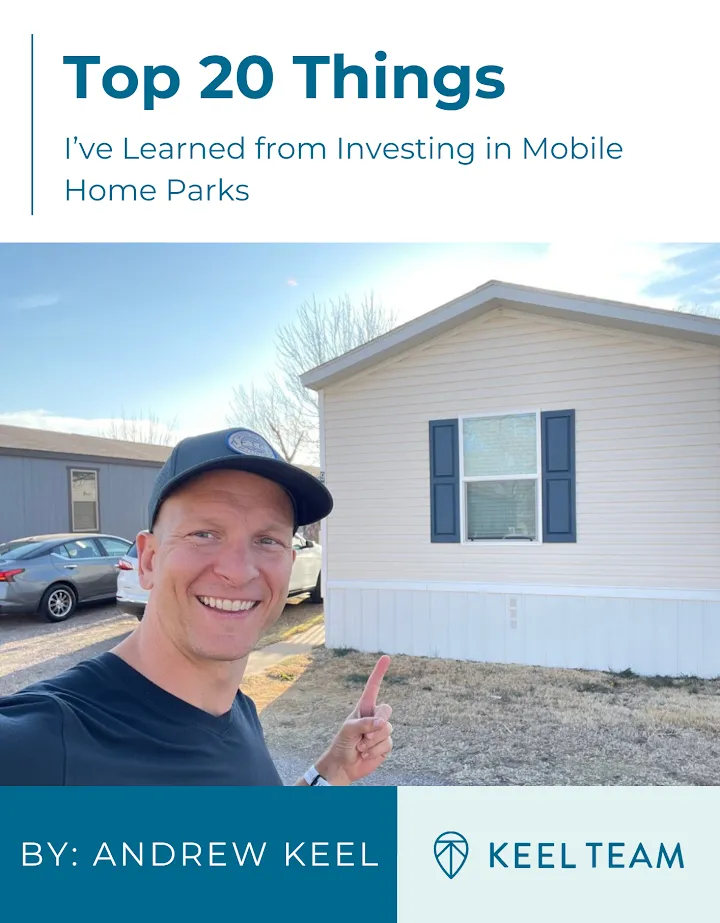
Two decades of hard-won lessons distilled into one free guide. Whether you’re evaluating your first deal or your fiftieth, these insights will sharpen your approach.
Download the Free eBook →
The Counter-Intuitive Opportunity
Some of our best acquisitions have been parks with known infrastructure problems.
When a park has a documented infrastructure issue, most buyers walk away. The competition disappears. The seller — often a mom-and-pop operator who does not have the capital or expertise to fix the problem — becomes motivated. You can negotiate a price that reflects the known repair cost plus a meaningful discount for risk and operational complexity.
If you have contractor relationships, construction management experience, and the capital reserves to execute the repair — and most institutional buyers do not — you can create equity that was not there before. This is one of the structural advantages that smaller, operationally sophisticated operators have over institutional capital. We can handle complexity that makes larger buyers flinch.
The Bottom Line
Mobile home park investing is a phenomenal asset class — resilient cash flow, near-zero new supply, strong demand fundamentals driven by the affordable housing crisis. The 2026 outlook is solid, with the major manufactured housing community REITs guiding to 5% rent growth and institutional capital actively acquiring.
But this is not a passive investment. It rewards operators who do the unglamorous work of genuinely understanding what they are buying before they buy it.
Skipping infrastructure due diligence to save $2,000 in inspection costs and close faster is how you inherit a $180,000 problem. Take the time. Do it right.
Andrew Keel is the founder of Keel Team Real Estate Investments, one of the most active private operators of affordable manufactured housing communities in the Southeast and Midwest.
10 video modules, a 55-page master checklist, and 9 ready-to-use templates that walk you through every step of evaluating a mobile home park deal — from the first site visit to closing day.
Get the Playbook →
Get the top 20 lessons from two decades of mobile home park investing — free.
Download the Free eBook →