If you’re still billing residents using a Ratio Utility Billing System — splitting water, sewer, or electric costs proportionally without individual meters — you may be sitting on a six-figure liability and not know it.
In October 2025, a California property management company settled a RUBS-related lawsuit for $495,000. In early 2026, an Ohio Supreme Court ruling reclassified submetering companies in manufactured housing communities as public utilities subject to state rate oversight. Connecticut banned RUBS outright. Minnesota banned it for electricity. Arizona’s Attorney General is actively securing refunds for residents.
The legal tide is turning — fast. And it’s not just coastal states anymore.
What RUBS Is (And Why Operators Have Been Using It)
RUBS — Ratio Utility Billing — is how most older mobile home parks handle utility recovery. Instead of installing individual meters for each space, the park receives one master water or electric bill, then splits that cost among residents using a formula based on occupancy, square footage, or lot size.
It made sense in the 1980s and 90s. Submetering was expensive. Infrastructure was hard to retrofit. RUBS was a practical workaround.
But there are three serious problems with RUBS in 2026:
- Residents can’t control their bill. If there’s a leak on the other side of the park, everyone’s bill goes up. Tenants have no ability to conserve their way to a lower payment.
- It’s increasingly being used to disguise rent increases. Regulators noticed. When lot rent is capped by law but utility RUBS charges are not, some operators have been quietly raising total resident cost through the utility line. Courts are now calling this what it is.
- State law is rapidly evolving. What was legal in your state in 2022 may not be legal today. And the list of restricted states is growing quarterly.
The States to Watch Right Now
- Connecticut: RUBS banned for residential properties (Supreme Court, 2024)
- Minnesota: RUBS banned for electricity; restricted for water and gas (January 2025)
- Arizona: AG consumer protection enforcement active; resident refunds secured (mid-2025)
- California: Active litigation; LA considering banning RUBS in rent-controlled areas
- Washington: New billing requirements tied to rent control framework (May 2025)
- Ohio: Submetering companies now treated as regulated utilities (April 2026)
North Carolina, Tennessee, Georgia, South Carolina — the Southeast remains largely permissive for now. But “for now” is doing a lot of work in that sentence. Once enough states move, federal guidance often follows. If you own mobile home parks in North Carolina specifically, also review the new North Carolina Mobile Home Park Act (SB518), which adds additional compliance layers to your operational checklist.
Two decades of hard-won lessons distilled into one free guide. Whether you're evaluating your first deal or your fiftieth, these insights will sharpen your approach.
Download the Free eBook →
What Operators Should Do Right Now
Step 1: Get a legal opinion on your current exposure.
This is a $500–1,500 call with an attorney who knows landlord-tenant law in your state. Worth every dollar. Ask specifically: (a) Has your state restricted RUBS in any way? (b) Could your current billing structure be characterized as an undisclosed rent increase? (c) What’s the retroactive exposure window?
Step 2: Conduct a billing audit.
Pull your last 24 months of utility billing data. Are residents’ RUBS charges increasing faster than your actual master utility bill? That spread will be the first thing a plaintiff’s attorney looks at. This audit should be part of your ongoing mobile home park valuation and due diligence process — especially on acquisitions where the seller has been using RUBS for years.
Step 3: Get serious about submetering.
Modern wireless submeter systems have come a long way. Non-invasive clamp-on meters can be installed without digging up infrastructure. Total cost runs $150–$500 per space depending on your park’s age and pipe configuration. At 100 spaces, you’re looking at $15,000–$50,000 — which sounds like a lot until you model the NOI lift.
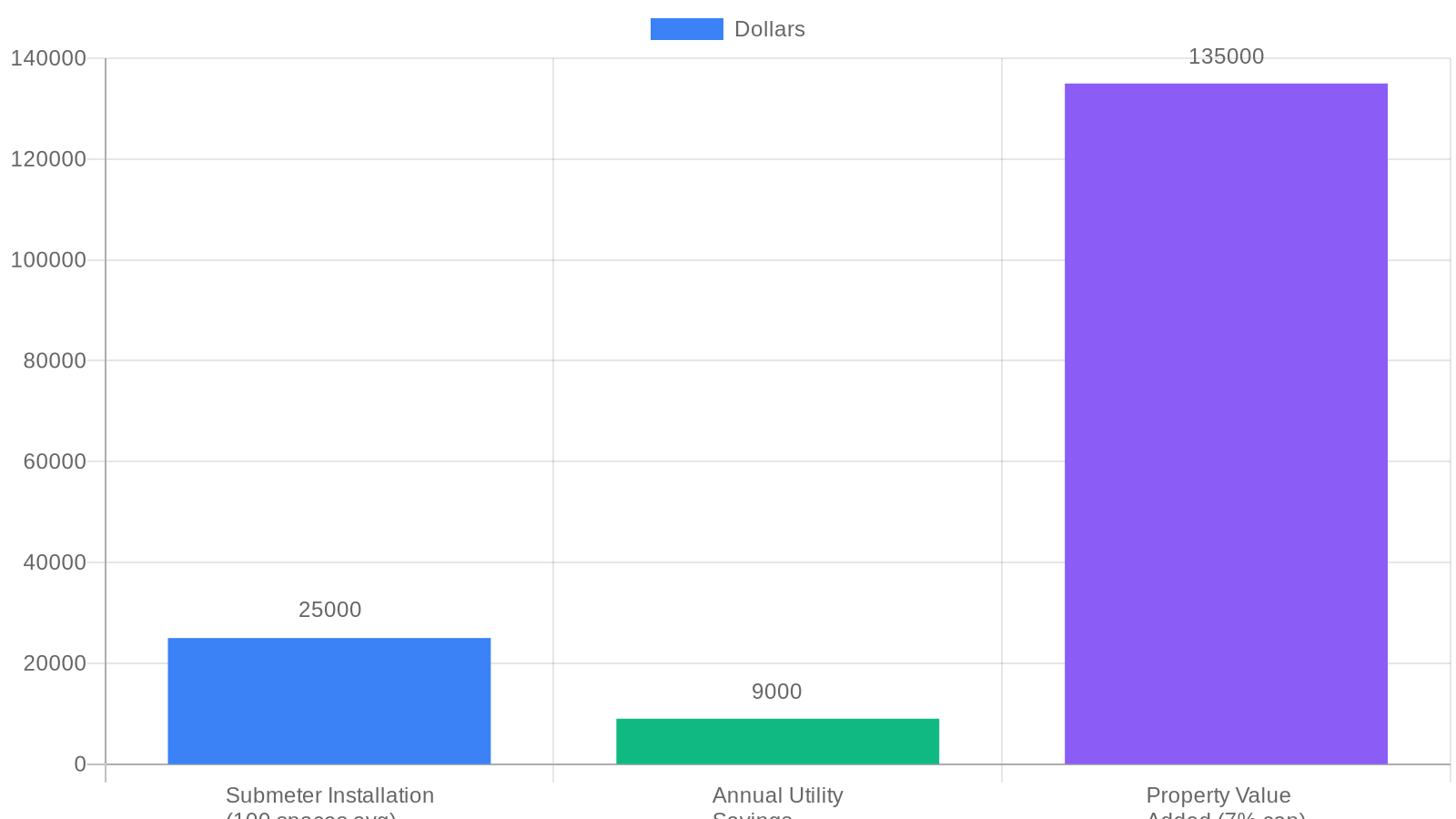
Here’s the math that usually changes minds: Once residents are individually metered, average water consumption drops 15–40%. Pair that with full cost recovery, and a 100-space park commonly sees $7,500–$12,000/year in utility savings. At a 7% cap rate, that’s $107,000–$171,000 in added property value. The submeters pay for themselves in 18–24 months.
Understanding how utility cost recovery affects NOI also feeds directly into deal pricing. For a full breakdown of how cap rates and NOI interact in mobile home park valuations, see our guide to mobile home park cap rates in 2026.
Step 4: Plan the resident communication.
The biggest mistake operators make is switching residents to submetering without a communication strategy. Residents who feel blindsided complain to regulators. Residents who feel informed accept the change. Send a letter 90 days out. Explain why you’re switching. Show them how the new system benefits them — they pay for what they use, not their neighbor’s habits. Offer a FAQ. Have your property manager ready to take calls.
The Bottom Line
RUBS isn’t inherently predatory. But the regulatory environment has shifted, and operators who haven’t updated their approach are carrying legal risk they don’t realize. The parks that transition to submetering now — before they’re forced to — come out ahead: better NOI, better compliance posture, and better resident relationships.
Don’t wait for the lawsuit. Get ahead of it.
For a comprehensive mobile home park due diligence framework — including utility billing audits, infrastructure checks, and compliance checklists — see the Keel Team Mobile Home Park Due Diligence Playbook.
Frequently Asked Questions
Is RUBS legal in North Carolina and Tennessee?
As of mid-2026, RUBS remains largely legal in North Carolina and Tennessee. The Southeast is one of the last regions where operators retain significant flexibility in utility billing. However, the regulatory landscape is shifting nationally, and operators should get a current legal opinion before relying on RUBS at any mobile home park.
What is the difference between RUBS and submetering?
RUBS (Ratio Utility Billing System) allocates a shared master utility bill among residents using a formula — typically based on occupancy or square footage — without individual meters. Submetering installs individual meters at each space so residents pay only for their own actual consumption. Submetering is considered more legally defensible and typically reduces overall consumption by 15–40%.
How much does it cost to retrofit submeters at a mobile home park?
Modern wireless submeter systems cost approximately $150–$500 per space depending on the park’s age and pipe configuration. For a 100-space mobile home park, expect $15,000–$50,000 total. The investment typically pays for itself within 18–24 months through utility savings and improved cost recovery — and it adds meaningful value to the property at exit.
Can a RUBS dispute result in retroactive liability?
Yes. In several recent cases, courts and state attorneys general have ordered operators to refund residents for RUBS charges collected over multiple years. The retroactive window varies by state but is typically 2–4 years. A billing audit covering the past 24 months is an essential first step in assessing your exposure.
Should I disclose RUBS practices when selling a mobile home park?
Yes, and buyers should be actively asking about it during due diligence. RUBS liability has become a material item in mobile home park transactions — undisclosed RUBS lawsuits or pending regulatory actions can affect deal pricing, representations and warranties, and post-close indemnification obligations. Buyers should request the last 24 months of utility billing records and confirm there are no pending resident complaints or attorney general inquiries.
Get the top 20 lessons from two decades of mobile home park investing — free.
Download the Free eBook →
Andrew Keel is the founder of Keel Team Real Estate Investments, which owns and operates 50+ mobile home parks across the United States. For questions about utility billing compliance or submeter transition strategies, visit keelteam.com.