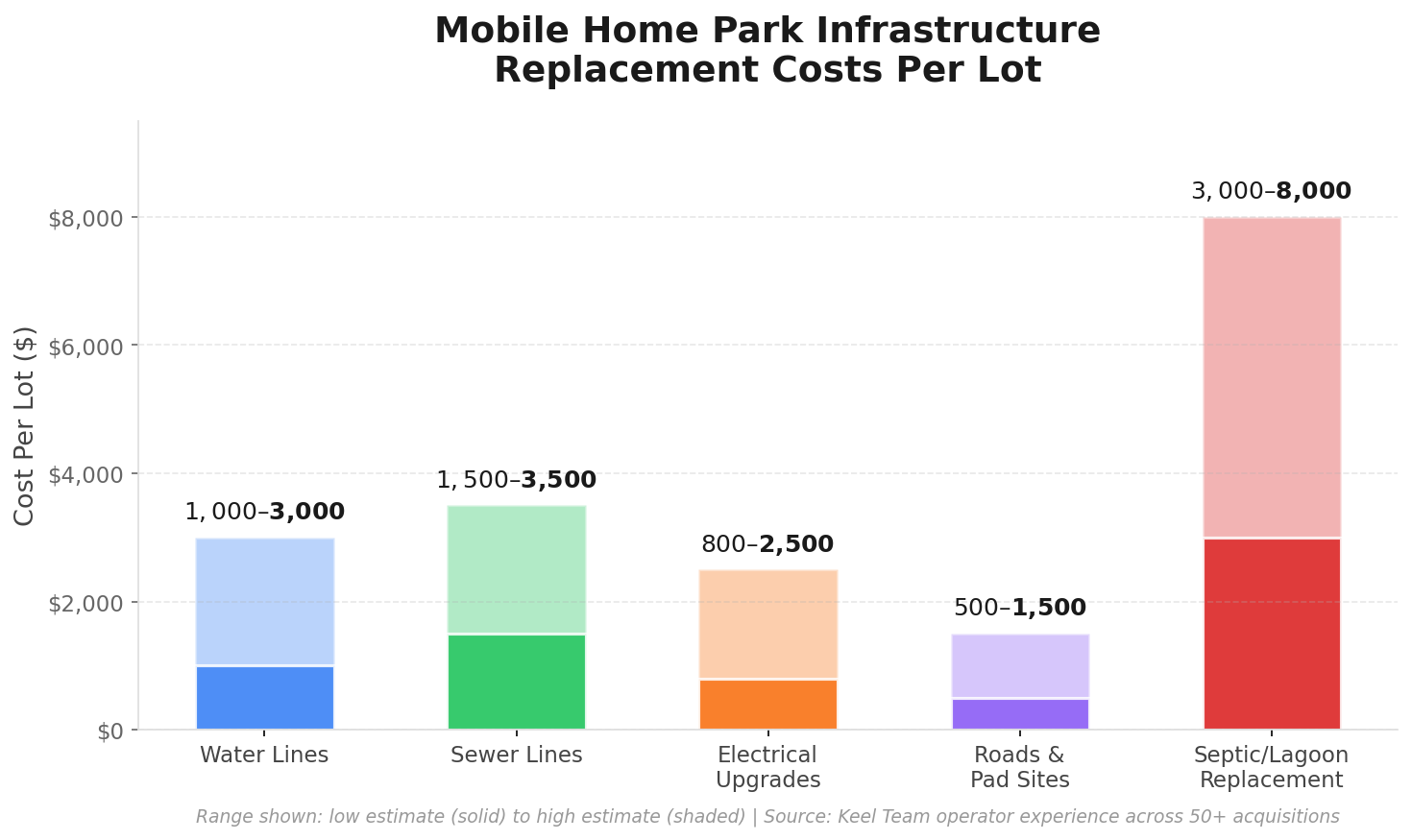
Every investor who’s been in mobile home parks long enough has a story. It usually starts the same way: “The deal looked perfect on paper.” And it ends with a six-figure repair bill they didn’t see coming.
I’ve heard variations of this story dozens of times — from operators who bought parks in Tennessee, North Carolina, Georgia, and beyond. The culprit is almost always the same: aging utility infrastructure that was invisible during due diligence.
This is the problem we don’t talk about enough in the manufactured housing community investing world. So let’s fix that.
The Scale of the Problem Is Bigger Than You Think
Here’s a number that should get your attention: more than 60% of the approximately 44,000 manufactured home communities in the United States were built during the 1970s and 1980s. That means the water lines, sewer mains, and utility laterals running under the ground at most parks you’ll look at are 40 to 55 years old.
Cast iron pipes. Galvanized steel. Clay tile sewer lines. These materials were standard in their day. Today, they’re ticking time bombs.
The problem isn’t just age — it’s concealment. When you acquire a master-metered park (where the owner pays a single water bill for the entire community), high water costs and slow leaks are absorbed into operating expenses and normalized. The seller didn’t “hide” anything; they just adapted. Leaks get baked into the P&L. Deferred maintenance becomes a line item that gets rationalized. And a buyer looking at a trailing 12-month P&L has no way to see it without specifically digging.
What Happens When the Infrastructure Fails
Infrastructure failures at manufactured home communities can end careers and wipe out deals.
At the minor end, you’re looking at a water main break that costs $15,000–$40,000 to repair and requires emergency service that disrupts 30–60 residents simultaneously. At the major end, you’re facing full main line replacement, state EPA involvement, potential consent orders, and the possibility of losing your operating permit.
The regulatory angle is getting worse, not better. State environmental agencies have been increasing inspections of older manufactured housing communities, particularly around wastewater disposal. If your park has a failing septic system or aging sewer lines bleeding into groundwater, you are a target.
The Master Meter Trap
Let’s talk specifically about master-metered water systems — because this is where most operators get hurt.
With a master meter, you receive one bill from the utility for the entire park’s water consumption. Your residents pay no direct water costs. This was standard practice when most parks were built. The problem is that it creates a system where residents have zero incentive to conserve water, and minor leaks can go undetected for months or years.
Here’s what I’ve seen firsthand: parks where water was running $3,000–$5,000 per month on a master meter, converted to individual submetering. Within 90 days of submetering, water consumption drops 25–40%. Residents — when they’re paying their own bill — suddenly fix dripping faucets and report running toilets. The behavioral change is immediate.
The math on submetering conversion is usually compelling. At $1,000 per lot for submeter installation on a 60-lot park, you’re spending $60,000. If you were paying $4,000/month in water costs and consumption drops 35%, you save $1,400/month — getting to breakeven in about 43 months. In a stabilized park you plan to hold for 5–10 years, that’s a clear win.
How to Catch Infrastructure Problems Before You Close
Add these steps to your due diligence protocol on every deal. (We’ve formalized a complete version of this process in our Mobile Home Park Due Diligence Playbook.)
1. Video Camera Inspection of Sewer Mains and Laterals
This is non-negotiable. A professional CCTV sewer inspection will run $1,500–$3,500 depending on park size. It will show you cracks, root intrusions, offset joints, and bellying (low spots that trap solids). If the seller refuses to allow this, walk away — or price the risk into your offer accordingly.
2. Water Line Pressure Test
Have a licensed plumber pressure-test the main water distribution lines. An abnormal pressure drop indicates leaks. Compare the master meter’s daily usage against theoretical consumption (average American uses ~80–100 gallons/day; mobile home residents typically less). A significant gap is a red flag.
3. Water Bill Reconciliation
Pull 24 months of utility bills from the seller. Calculate average monthly cost per occupied lot. Anything above $30–$50/lot/month should prompt deeper investigation. High consumption relative to occupancy often means unreported leaks or meter tampering.
4. Septic System Inspection (if not on city sewer)
We will not acquire parks without city water and city sewer — and this is exactly why. Private septic systems and lagoons at manufactured home communities are a regulatory and financial liability that compounds over time. If you’re evaluating a park without city sewer, budget for a full septic assessment and get quotes on the cost of connection to municipal sewer.
5. Age and Material Identification
Ask for any utility as-built drawings or permit records. If the park was built in 1975 and there are no records of utility upgrades, assume you have 50-year-old infrastructure that needs evaluation.
The Modern Alternative to Full Replacement: CIPP Relining
One thing many manufactured home community operators don’t know: you don’t always have to excavate and replace aging pipes. Cured-In-Place Pipe (CIPP) lining is a trenchless rehabilitation technology that inserts a resin-impregnated liner into existing pipes and cures it in place, creating essentially a new pipe inside the old one.
CIPP relining typically costs 40–60% of full excavation and replacement. It’s less disruptive to residents, faster to execute, and effective for both water and sewer lines. If your video inspection shows significant but not catastrophic deterioration, relining may be the right call. Get quotes from CIPP contractors in your market before assuming you need a full replacement — it could mean the difference between a $50,000 repair and a $120,000 nightmare.
The Bottom Line
Aging infrastructure isn’t a reason to avoid mobile home parks. It’s a reason to do your homework. The operators who’ve built durable, cash-flowing portfolios in this space are the ones who know what they’re looking for before they close — and price it correctly when they find it.
Every due diligence checklist for a manufactured housing community should include a sewer inspection, a water pressure test, a utility bill review, and a master meter analysis. The cost of these steps is trivial compared to the cost of discovering problems after closing.
Parks with known infrastructure issues that have been priced and budgeted appropriately are actually some of the best opportunities in the market — because most buyers don’t know how to evaluate them. That’s your edge.
Andrew Keel is the founder of Keel Team, a manufactured housing community investment firm operating parks across the Southeast and Midwest. Keel Team focuses on off-market acquisitions of parks with 70+ lots in NC, TN, GA, SC, SD, and WI.
Two decades of hard-won lessons distilled into one free guide. Whether you’re evaluating your first deal or your fiftieth, these insights will sharpen your approach.
Download the Free eBook →
10 video modules, a 55-page master checklist, and 9 ready-to-use templates that walk you through every step of evaluating a mobile home park deal — from the first site visit to closing day.
Get the Playbook →