Good tenant screening is one of the most impactful operational decisions a mobile home park operator makes. Unlike apartment residents who move frequently, mobile home park tenants often stay for years — sometimes decades. A bad placement can affect your community for a very long time.
This guide covers the full tenant screening process for mobile home parks: what to check, how to stay compliant with fair housing law, and what strong operators do differently to protect occupancy and asset value.
Why Tenant Screening Matters More in Mobile Home Parks Than Apartments
In a standard apartment complex, a problematic tenant typically causes problems for 12 months before you can non-renew. In a mobile home park where residents own their homes, the situation is completely different.
When a tenant owns their home, eviction doesn’t just mean removing a person — it means removing or abandoning a structure. That process is expensive, time-consuming, and in many states, heavily regulated. In North Carolina, summary ejectment for a mobile home park tenant can take 60–90 days. Other states can take longer.
The real cost of a bad tenant placement includes:
- Lost lot rent during the legal process (often 3–6 months)
- Legal fees ($2,000–$8,000+ depending on state)
- Property damage remediation if the home is abandoned
- Negative impact on community culture and neighboring residents
- Lower resale value when problem tenants compound across multiple units
Screening carefully on the front end is exponentially cheaper than dealing with a problem tenant on the back end. Operators who understand this treat screening as an investment, not an administrative cost.
The 5 Core Components of Mobile Home Park Tenant Screening
1. Income Verification
The industry standard is 3x monthly lot rent in gross monthly income. If your lot rent is $500/month, the applicant should earn at least $1,500/month before taxes. Some operators use a 3.5x multiple in higher cost-of-living markets where residents face more competing financial pressures.
Acceptable documentation includes two recent pay stubs for W-2 employees, prior-year tax returns and bank statements for the self-employed, Social Security award letters for retirement or disability income, and court-ordered support documentation where applicable. Never accept verbal assurances of employment — always verify in writing.
2. Credit History
You’re not looking for a perfect credit score. Mobile home park residents often have modest credit profiles, and that’s normal. What you’re looking for is the pattern of behavior:
- Active collections for unpaid rent or utilities — high red flag
- Landlord-specific judgments — high red flag
- Recent bankruptcies — medium risk; review the context
- Overall payment trend: improving versus deteriorating
Most experienced operators look for a minimum score of 550–600, with exceptions for isolated life events (medical debt, one-time hardship) rather than patterns of non-payment. Use a consumer reporting agency that complies with the Fair Credit Reporting Act — TransUnion SmartMove, Experian RentBureau, and National Tenant Network are widely used.
3. Criminal Background Check
This is the most legally sensitive part of screening. Under HUD guidance, blanket criminal exclusion policies can violate Fair Housing Act protections. Best practice is an individualized assessment that considers the nature and severity of the crime, time elapsed since the offense, evidence of rehabilitation, and relationship of the offense to legitimate community safety concerns.
Most operators reasonably exclude registered sex offenders, drug manufacturing/distribution convictions, and violent felonies within a defined lookback period. Work with a real estate attorney to develop a written criminal background screening policy and apply it consistently to every applicant.
4. Rental History
Prior landlord references are among the most predictive screening tools available. Key questions: Did the resident pay rent on time? Was the property left in good condition? Were there lease violations or neighbor complaints? Would you rent to this person again? Were eviction proceedings ever initiated?
Many applicants with borderline credit are excellent long-term residents. Rental history helps you find them. Note that some former landlords will only confirm dates of tenancy to avoid liability — a prior landlord who is enthusiastically willing to vouch for an applicant is a strong positive signal.
5. Pet and Vehicle Verification
In a mobile home park, the condition of a lot affects the entire community. Verify the number and breed of pets against your community rules, the number and condition of vehicles on the lot, and whether the applicant has commercial vehicles or equipment that may not be appropriate for a residential community. Apply these policies consistently to every applicant.
Two decades of hard-won lessons distilled into one free guide. Whether you’re evaluating your first deal or your fiftieth, these insights will sharpen your approach.
Fair Housing Compliance in Mobile Home Park Tenant Screening
The Fair Housing Act prohibits discrimination based on race, color, national origin, religion, sex, disability, and familial status. Many states add additional protected classes — sexual orientation, source of income, and age are common additions. Know your state’s law before finalizing your screening criteria.
Common fair housing pitfalls include inconsistently applying screening criteria across applicants, using vague “community fit” language as a rejection rationale, asking illegal pre-screening questions (national origin, number of children, religious affiliation), and failing to provide reasonable accommodations for applicants with disabilities.
Best practice: use a written screening policy, apply it identically to every applicant, document your decision rationale for every approval and denial, and retain records for a minimum of two years.
How Screening Quality Affects Mobile Home Park Valuation
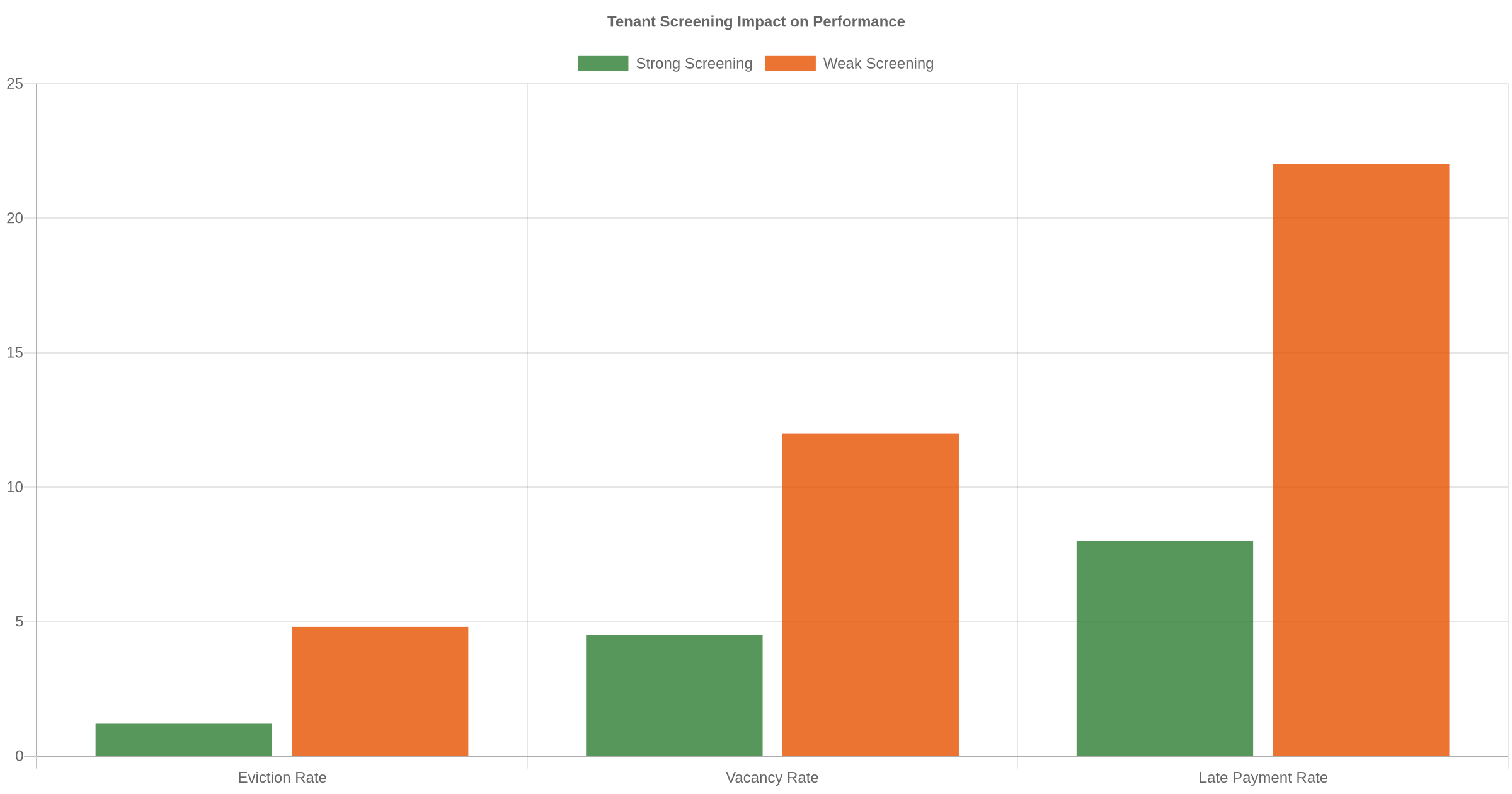
This is what matters most to investors: rigorous tenant screening directly affects asset value.
Consider a 100-lot mobile home park with $500/month lot rent:
- At 95% occupancy (strong screening): $57,000/month gross revenue
- At 88% occupancy (high turnover from poor screening): $44,000/month gross revenue
That’s a $156,000/year difference in gross revenue. At a 7% cap rate, that gap represents over $2.2 million in asset value. The spread between operators who screen rigorously and those who don’t is often measured in millions of dollars at exit.
Mobile home parks with documented screening policies, low eviction rates, and stable occupancy command better cap rates at sale — because buyers and lenders can underwrite them more confidently. If you’re evaluating a potential acquisition, ask to see the current operator’s screening policy and eviction history. What you find will tell you a lot about what you’re buying. Our mobile home park due diligence checklist walks through this and 24 other critical review items.
Building a Screening Process That Scales
If you manage one community, a solid screening policy is straightforward. If you’re scaling to 5, 10, or 20+ mobile home parks, consistency becomes the challenge — especially with on-site managers who may apply different subjective standards across locations.
Key elements of a scalable screening process include a written criteria document with published minimums for income, credit, and rental history; a standardized application form that collects the same information from every applicant; centralized screening approvals routed through a coordinator or property management platform; an audit trail in your property management software for every decision; and annual fair housing training for all managers.
Centralizing approval decisions — rather than leaving them to individual site managers — reduces fair housing liability and levels resident quality variance across the portfolio. This is one of the operational systems that separates institutional-quality operators from mom-and-pop management. See also our guide on mobile home park value-add strategies for how screening quality fits into a broader operational improvement plan.
Frequently Asked Questions About Mobile Home Park Tenant Screening
Can I charge an application fee to cover screening costs?
Yes, and you should. A standard fee of $35–$75 covers the cost of a credit and background check. Some states cap the fee amount — check your local regulations before setting a policy.
What happens if an applicant disputes their screening results?
Under the FCRA, if you take adverse action based on a consumer report, you must provide an adverse action notice that includes the reporting agency’s contact information and the applicant’s right to dispute the report. This is a legal requirement, not optional.
Can I reject applicants who receive housing vouchers (Section 8)?
It depends on your state. North Carolina currently has no state-level prohibition on source-of-income discrimination, but some cities and counties may have local ordinances. Consult a local real estate attorney before finalizing your policy.
How long should I keep screening records?
Best practice is a minimum of two years from the application date. This covers you in the event of a fair housing complaint, which must typically be filed within two years of the alleged discriminatory act.
What is the difference between a soft pull and a hard pull credit check for tenant screening?
Most consumer reporting agencies used for tenant screening conduct a soft inquiry that does not affect the applicant’s credit score. This is important because applicants may be applying to multiple communities simultaneously and should not be penalized for comparing their options.
10 video modules, a 55-page master checklist, and 9 ready-to-use templates that walk you through every step of evaluating a mobile home park deal — from the first site visit to closing day.
Get the top 20 lessons from two decades of mobile home park investing — free.