If you are looking for passive exposure to mobile home park real estate, you have two main paths: investing in a mobile home park syndication or buying shares in a real estate investment trust (REIT) that holds manufactured housing communities. Both let you participate in the mobile home park asset class without owning or managing a property yourself — but they are very different structures, with different risk profiles, liquidity, tax advantages, and return potential.
This guide breaks down exactly how mobile home park syndications and REITs compare so you can decide which makes more sense for your goals.
What Is a Mobile Home Park Syndication?
A mobile home park syndication is a private real estate investment where a group of investors pools capital to acquire, operate, and eventually sell one or more properties. Typically structured as a limited partnership or LLC, the deal has a general partner (GP) — the operator who manages everything — and limited partners (LPs) — passive investors who contribute capital and receive a share of cash flow and profits.
Syndications are usually structured as Regulation D private placements (most commonly 506(b) or 506(c) offerings). They have a defined hold period — typically 5-10 years — and a clear exit strategy, often a sale or refinance.
Investors in mobile home park syndications typically receive:
- Preferred returns (typically 7-9% annualized, paid quarterly)
- Profit splits upon sale (commonly 70/30 in favor of LPs)
- Pass-through tax benefits via depreciation and bonus depreciation
- K-1 tax forms at year-end for reporting purposes
For a full overview of how these deals are structured, see our complete guide to mobile home park syndication.
What Is a Mobile Home Park REIT?
A REIT is a publicly or privately traded company that owns a portfolio of real estate assets. A handful of large REITs focus specifically on manufactured housing communities — the most well-known being Sun Communities (SUI) and Equity LifeStyle Properties (ELS), which together own hundreds of communities across the country.
REIT investors can buy shares on public exchanges (for publicly traded REITs) or through broker-dealers (for non-traded REITs). Returns come from dividends and share price appreciation. By law, REITs must distribute at least 90% of taxable income to shareholders, making them reliable income producers — but also limiting their ability to retain capital for growth.
Head-to-Head: Mobile Home Park Syndication vs. REIT
1. Return Potential
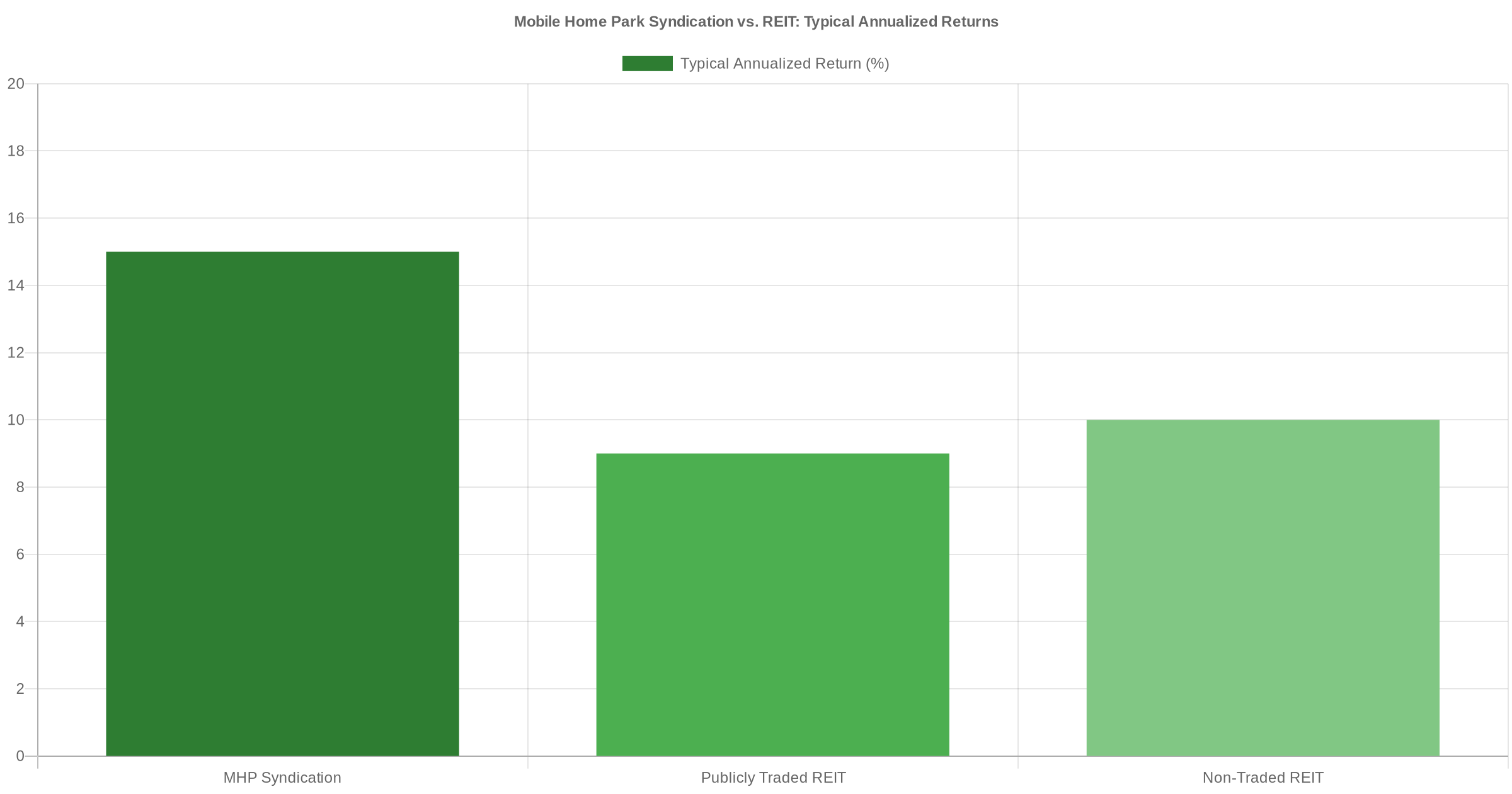
This is where syndications tend to shine. Private mobile home park syndications often target 12-18% annualized returns when you factor in preferred return distributions plus equity upside from the sale. Experienced operators who buy well, improve operations, and time their exits can deliver returns at the top of that range or beyond.
Publicly traded REITs like Sun Communities and Equity LifeStyle Properties have historically delivered 8-11% annualized total returns (dividends plus appreciation). That is a respectable figure, but it includes significant exposure to stock market volatility that has nothing to do with the underlying real estate. During a broad market sell-off, your REIT shares can drop even if every community in the portfolio is performing perfectly.
Non-traded REITs have similar or slightly better underlying returns than publicly traded REITs but often carry higher fees and limited redemption windows.
2. Liquidity
This is REITs biggest advantage. If you buy shares of Sun Communities or Equity LifeStyle Properties, you can sell them tomorrow on the NYSE. True liquidity with market pricing.
Mobile home park syndications are illiquid by nature. Your capital is locked up for the hold period — typically 5-10 years — with no secondary market for most private deals. You invest, and you wait for the business plan to play out.
This is not necessarily a disadvantage if you have capital you do not need immediate access to. But it is a real constraint to be aware of before you commit.
3. Tax Efficiency
Here, syndications win decisively. When you invest as a limited partner in a mobile home park syndication, you receive pass-through depreciation — including bonus depreciation under current tax law — that can offset your ordinary income. In many cases, early-year K-1 losses shelter not just your syndication income but other passive income streams as well.
REITs, by contrast, distribute most income as ordinary dividends, which are taxed at your marginal income tax rate. You do not get the depreciation pass-through that direct real estate ownership provides. For high-income investors, this difference in tax treatment is significant.
For a detailed breakdown of how these benefits work, see our post on the tax benefits of investing in mobile home parks as a limited partner.
Two decades of hard-won lessons distilled into one free guide. Whether you are evaluating your first deal or your fiftieth, these insights will sharpen your approach.
4. Minimum Investment
REITs are accessible to almost anyone. You can buy a single share of Sun Communities for well under $200. That kind of accessibility makes REITs ideal for smaller investors or those just starting to explore mobile home park exposure.
Mobile home park syndications typically require minimum investments of $50,000 to $100,000, and most are limited to accredited investors (those with net worth exceeding $1 million, excluding primary residence, or annual income above $200,000). This is not accessible to everyone, and that is a legitimate consideration when comparing the two vehicles.
5. Transparency and Control
With a REIT, you own shares in a large, diversified portfolio managed by professionals. You receive quarterly reports and SEC filings, but every operational decision is made by corporate management acting in the interest of shareholders broadly — not in your specific interest.
In a syndication, you are investing directly alongside a specific GP team in a specific property or small portfolio. You can underwrite the specific deal, review the business plan, tour the property, and ask detailed questions before committing a dollar. You know exactly what you are buying.
The trade-off: your returns are tied entirely to the performance of that specific deal and that specific operator. There is no portfolio-wide diversification to buffer you if things go sideways.
6. Fees
Publicly traded REITs have low fees — essentially just the management expense ratio, typically under 1% annually.
Mobile home park syndications have more fee layers: acquisition fees (1-3% of purchase price), ongoing asset management fees (1-2% of gross revenues), and disposition fees at exit. A well-structured deal might total 2-3% annually in fees — but you are getting hands-on active management by an experienced operator focused specifically on value creation in that asset.
Non-traded REITs often have the worst of both worlds: REIT-style returns combined with high upfront loads of 5-7%, plus ongoing fees that erode returns. They are generally the least attractive option of the three.
When a Mobile Home Park Syndication Makes More Sense
A private mobile home park syndication is likely the better fit if:
- You are an accredited investor with $50,000 or more to commit to a single deal
- You want higher return potential and can accept a 5-10 year illiquidity window
- Tax efficiency is a priority — you want depreciation pass-through to offset income
- You want direct exposure to a specific market and operator you have vetted personally
- You are willing to underwrite a specific deal rather than own a diversified, passive pool
Want to know what to look for before committing? Our guide on how to evaluate a mobile home park operator before you invest walks through the key questions to ask.
When a Mobile Home Park REIT Makes More Sense
REITs are the better fit if:
- You want immediate liquidity — you may need access to your capital within a few years
- You are investing smaller amounts in the $1,000-$50,000 range
- You prefer simplicity and diversification over higher potential returns
- You are not yet an accredited investor
- You want broad exposure to the mobile home park space as part of a diversified portfolio
Conclusion: Know What You Are Optimizing For
Neither mobile home park syndications nor REITs are categorically better — they serve genuinely different investor needs. But for accredited investors with longer time horizons and meaningful capital to deploy, private mobile home park syndications typically offer better return potential, superior tax treatment, and greater transparency than REIT alternatives.
REITs make sense for investors who prioritize liquidity and accessibility. For everyone else, the structural advantages of a well-run syndication are difficult to replicate through public markets.
If you are exploring what passive mobile home park investing could look like for your situation, we are happy to have an educational conversation. Reach out here and we will set up a call to walk through how mobile home park investing works.
10 video modules, a 55-page master checklist, and 9 ready-to-use templates that walk you through every step of evaluating a mobile home park deal — from the first site visit to closing day.
Get the top 20 lessons from two decades of mobile home park investing — free.