If you want to understand why mobile home park investing has attracted billions in institutional capital over the past decade, start with one metric: lot rent growth.
Lot rent — the monthly fee a resident pays to lease the land beneath their home — is the foundational revenue driver in any mobile home park. It’s not subject to dramatic swings based on the home’s condition, doesn’t evaporate when a unit turns over, and historically tracks well above inflation. Understanding how lot rent has grown, why it’s grown, and where it’s headed gives investors a significant edge when evaluating deals.
What Is Lot Rent and Why Does It Matter for Investors?
In a land-lease mobile home park, the operator owns the land and rents individual lots to residents who own (or are purchasing) their homes. The monthly lot rent is the primary income source for the park owner.
This structure creates a remarkably stable cash flow stream. Residents who own their homes are highly unlikely to move — the average cost to relocate a manufactured home ranges from $5,000 to $10,000 or more. That moving barrier translates directly into low vacancy and consistent rent collection. When operators increase lot rent, most residents absorb the increase rather than face the costly alternative of relocation.
For investors, this means mobile home park lot rent behaves more like a utility bill than a discretionary lease — which creates predictable, resilient revenue even during economic downturns. (For more on how this revenue feeds into property value, see our guide to mobile home park cap rates.)
A Decade of Lot Rent Growth: What the Data Shows
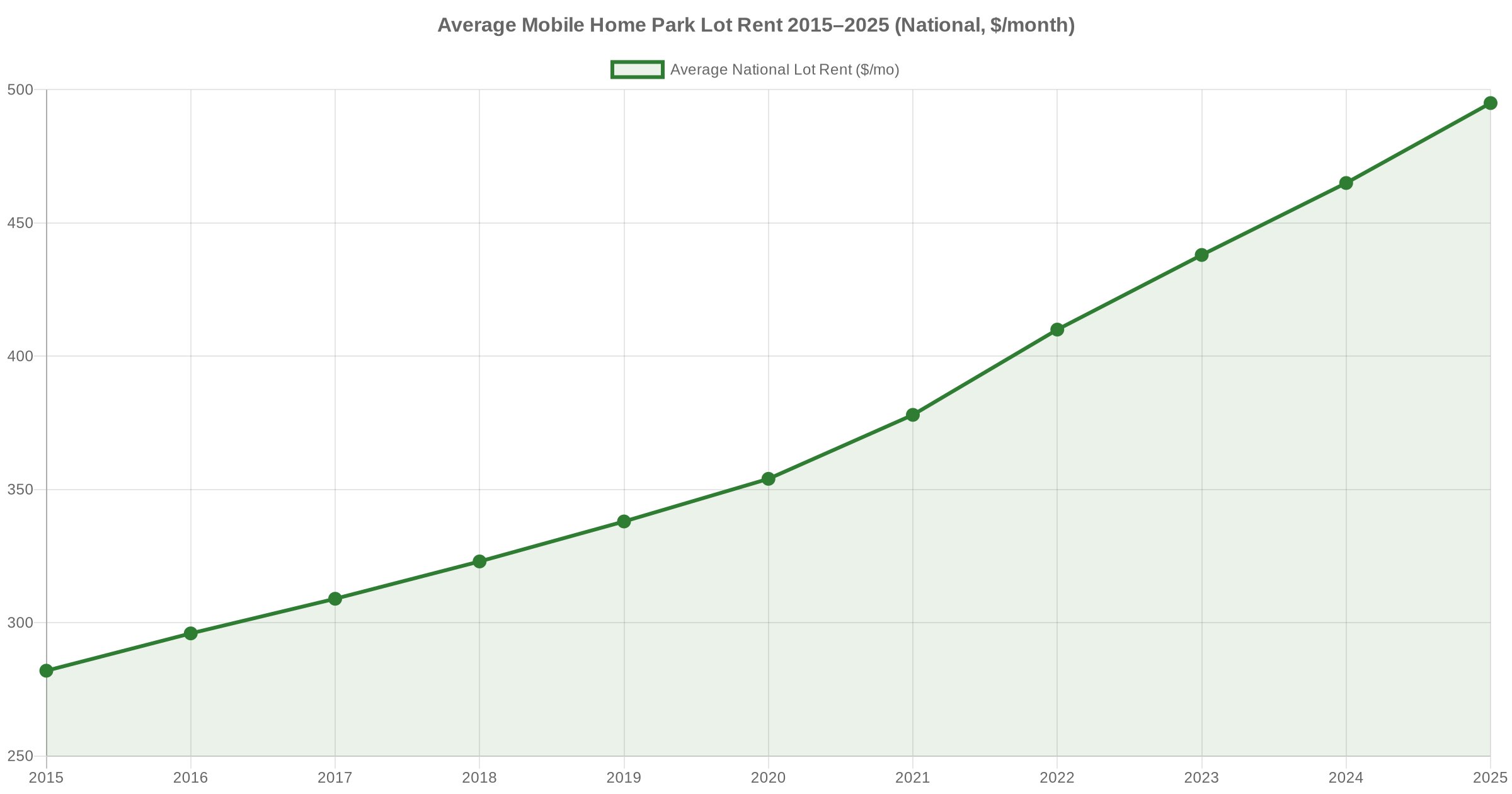
Based on data compiled from mobile home park transactions, broker reports, and industry surveys, average national lot rents have followed this trajectory:
- 2015: ~$282/month
- 2018: ~$323/month
- 2020: ~$354/month
- 2022: ~$410/month
- 2025: ~$495/month
That’s roughly 75% cumulative growth over 10 years — a compound annual growth rate (CAGR) of approximately 5.8%. For context, the Consumer Price Index increased about 36% over the same period. Mobile home park lot rent has outpaced inflation by a substantial margin.
Growth accelerated notably after 2020. Several forces converged: institutional capital flowed in and pushed market rents toward the affordable housing ceiling, the pandemic-era single-family housing surge made manufactured housing even more cost-competitive, and broad inflation gave operators more room to raise rents without losing residents to alternatives.
The Three Structural Drivers Behind Lot Rent Growth
1. Supply Is Fixed — and Won’t Change
You cannot manufacture new mobile home park land at scale. Zoning in most U.S. jurisdictions doesn’t permit new manufactured housing communities to be built — local governments have largely stopped approving new mobile home parks for the past 30+ years. The result is a fixed national supply of approximately 44,000 mobile home parks and 4.3 million lots, facing growing demand for affordable housing.
When demand rises against a fixed supply, prices go up. That’s not a temporary dynamic — it’s structural, and it’s been the foundation of lot rent growth for decades.
2. Affordable Housing Demand Is Accelerating
Manufactured housing is the largest source of unsubsidized affordable housing in America. The median monthly housing cost for a mobile home park resident is approximately 40–50% lower than comparable apartment rents in the same market. As single-family home prices and apartment rents have surged, that affordability gap has widened — making mobile home park residency even more compelling for cost-conscious households.
Residents don’t stay in mobile home parks because they have no options. They stay because the math is compelling. A $495/month lot rent plus a modest home payment is still far cheaper than a $1,400/month one-bedroom apartment in most secondary markets. This means operators can raise lot rents meaningfully and still deliver genuine value compared to alternatives.
3. Mom-and-Pop Under-Management Creates Rent Upside
Roughly 70% of mobile home parks in the U.S. are still owned by individual operators who have held their properties for 20–40 years. Many never raised lot rents aggressively — they kept rents flat or near-flat for years at a time, prioritizing long-standing resident relationships over market returns. This leaves substantial rent upside for operators who acquire these parks and move rents to fair market levels.
When an operator acquires a 150-lot mobile home park at $280/month average lot rent in a market where comparable parks rent at $450/month, the value-add is built into the deal from day one. Moving from $280 to $380 over three years — still well below market — creates a dramatic increase in net operating income and, by extension, property value. For a step-by-step breakdown of that math, see our mobile home park NOI calculation guide.
Two decades of hard-won lessons distilled into one free guide. Whether you’re evaluating your first deal or your fiftieth, these insights will sharpen your approach.
Lot Rent Growth by Region: Key Markets in 2025
National averages mask significant regional variation. Here’s a practical snapshot of mobile home park lot rent ranges across key investing markets as of 2025:
- Southeast — North Carolina, South Carolina, Georgia: $275–$450/month. These markets have historically run below the national average but have seen strong growth as population migrates south and affordable housing demand increases. North Carolina in particular — with rapid expansion in Charlotte, Raleigh, and the Research Triangle — has seen lot rents climb 6–8% annually in some submarkets.
- Mid-South — Tennessee: $280–$460/month. Nashville’s growth has pulled surrounding markets higher; Knoxville and Chattanooga have seen steady 5–6% annual lot rent growth in well-located communities.
- Upper Midwest — South Dakota, Wisconsin: $250–$380/month. More stable and less growth-driven, but these markets offer attractive entry pricing and yield characteristics for investors who prioritize current cash flow.
- Pacific Coast: $650–$1,200+/month. California, Washington, and Oregon have seen extreme appreciation driven by housing cost pressures, though entry prices reflect this.
- Northeast: $500–$800/month. Dense coastal markets with strong affordability tailwinds but higher basis and regulatory risk.
For investors focused on the Southeast and Mid-South — markets with a combination of population inflow, limited supply, and lot rents still below their national peers — the lot rent growth trajectory is particularly compelling. These markets offer room to run on rents without pricing residents out of the market.
How Experienced Operators Accelerate Lot Rent Growth
Passive market-driven rent appreciation is the floor, not the ceiling. Experienced mobile home park operators deploy deliberate strategies to outperform market trends:
Infill and Occupancy Improvement
A vacant lot earns nothing. Filling vacant lots — by financing home move-ins, partnering with manufactured home dealers, or converting park-owned homes to tenant-owned — immediately increases revenue and creates the occupancy base that makes future rent increases more feasible. A 150-lot mobile home park running at 70% occupancy has 45 lots of built-in upside before a single rent increase is necessary.
Utility Infrastructure Conversion
Mobile home parks with sub-metered utilities — where residents pay their own water and electricity — can charge higher lot rents than parks where utilities are bundled into rent and paid by the operator. Converting to resident-paid utilities reduces operator expense and creates room for lot rent increases without meaningfully impacting residents’ total housing cost.
Capital Improvements and Professional Management
Road paving, improved signage, maintained common areas, and responsive management all justify rent increases. When a mobile home park transitions from a neglected mom-and-pop operation to a professionally managed community, residents generally accept meaningful rent increases — because they’re receiving more value in return.
What Should Investors Expect Through 2030?
The structural tailwinds that have driven lot rent growth over the past decade remain firmly in place. Here’s a reasonable outlook:
- National average lot rent: From ~$495 in 2025 to roughly $625–$650 by 2030, assuming a 4.5–5.5% CAGR — in line with the past decade’s trend.
- Southeast and Sun Belt outperformance: Markets with strong population inflow — Charlotte metro, Nashville metro, Atlanta suburbs — could see 6–8% annual lot rent growth, outpacing the national average.
- Regulatory risk is real but contained: Several states are looking at mobile home park tenant protections. North Carolina’s Mobile Home Park Act imposes notice requirements and right-of-first-refusal provisions but does not cap rents. Monitoring regulatory developments in target markets is a standard part of diligence.
- Cap rate compression amplifies rent growth: As institutional buyers continue to push cap rates lower, lot rent growth becomes the primary return driver rather than acquisition yield. For both active and passive investors, this makes rent growth analysis even more central to underwriting.
For investors — both active operators and passive limited partners — lot rent trajectory is one of the most important variables in evaluating a mobile home park deal. A park with below-market lot rents in a growing metro area is a fundamentally different investment than a park already at market. Understanding how to model mobile home park cash flow from current rents to market rents is a core underwriting skill that separates experienced operators from first-time buyers.
Conclusion: Lot Rent Is the Engine of Mobile Home Park Returns
Mobile home park lot rent growth has consistently outpaced inflation over the past decade, and the structural drivers — supply constraints, affordable housing demand, and a massive stock of under-managed parks — are not going away. For investors who understand how to identify markets with rent growth tailwinds, underwrite deals to market rent rather than current rent, and execute on operational improvements, the path to strong returns is well-defined.
The best mobile home park investments aren’t just income producers today — they’re positioned to grow that income predictably, year after year, in ways that most other real estate asset classes simply can’t replicate.
For a deeper look at the full mobile home park investments landscape, explore our complete resource library.
10 video modules, a 55-page master checklist, and 9 ready-to-use templates that walk you through every step of evaluating a mobile home park deal — from the first site visit to closing day.
Get the top 20 lessons from two decades of mobile home park investing — free.