If you’ve ever explored passive investing in a mobile home park syndication, you’ve probably come across the term “accredited investor.” Most private real estate offerings — including the vast majority of mobile home park syndications — require participants to meet SEC-defined criteria before they can invest.
Understanding accredited investor requirements in 2026 isn’t just a legal checkbox. It’s a foundational step in knowing which opportunities are available to you and how to position yourself to participate in some of the most compelling private real estate deals on the market today.
What Is an Accredited Investor?
The term “accredited investor” is defined by the U.S. Securities and Exchange Commission under Rule 501 of Regulation D. The SEC created this standard to ensure that participants in unregistered private securities offerings have either the financial sophistication or the means to absorb potential losses.
The definition has evolved over time — most recently updated in 2020 — and now includes multiple pathways to qualify. Originally, accreditation was purely financial. The 2020 update added pathways based on professional knowledge and certifications, making it possible to qualify even if you don’t yet hit the income or net worth thresholds.
Accredited Investor Requirements in 2026: The Four Qualification Paths
Path 1: The Income Test
To qualify under the income test, you must have earned income of:
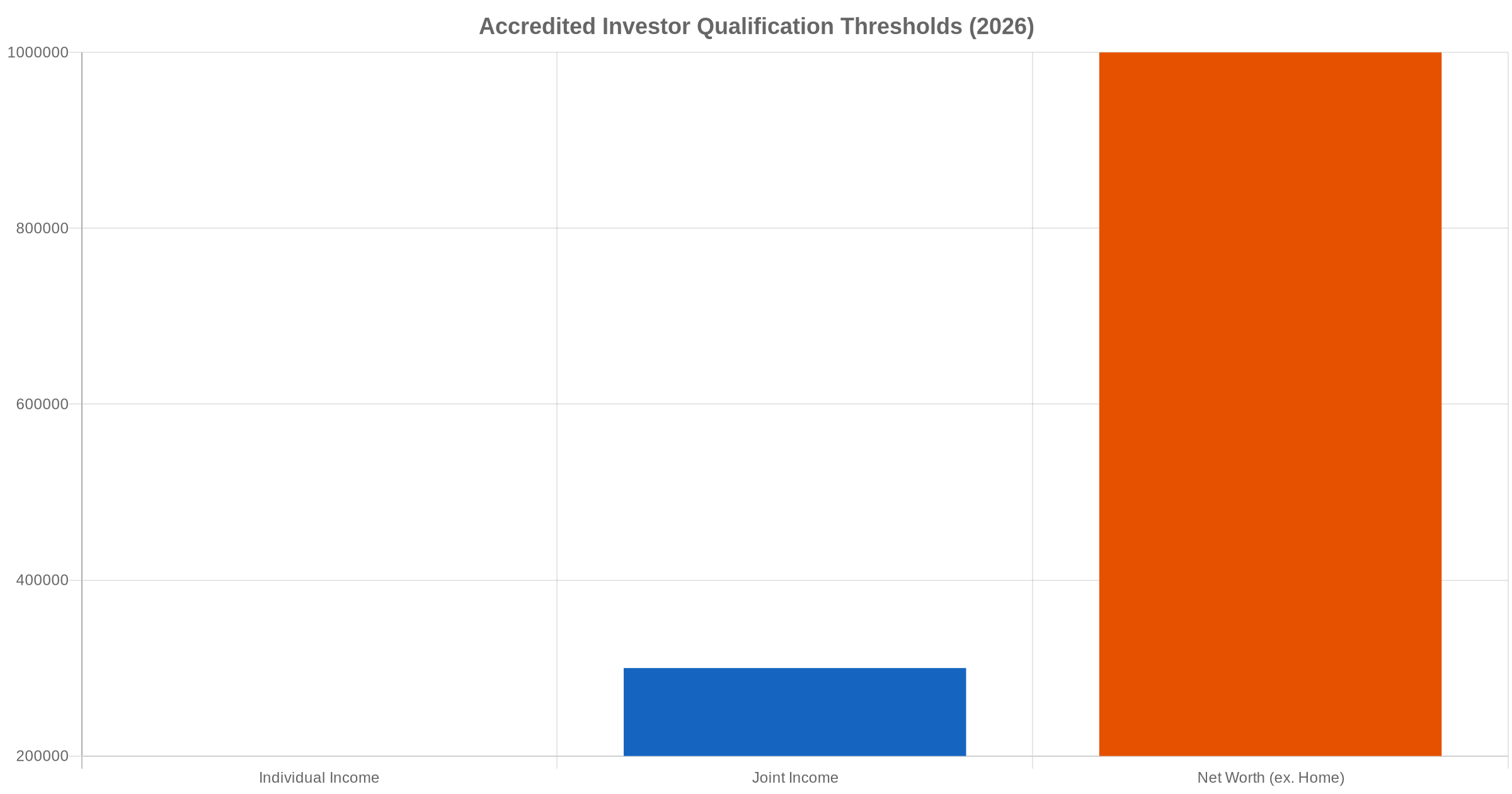
- $200,000 or more per year as an individual — in each of the two most recent years, with a reasonable expectation of reaching the same level in the current year
- $300,000 or more per year jointly with a spouse or spousal equivalent — under the same two-year lookback requirement
Earned income includes salary, bonuses, commissions, and self-employment income. Capital gains, rental income, and other passive investment income generally do not count toward this threshold.
Path 2: The Net Worth Test
To qualify under the net worth test, you (alone or together with a spouse or spousal equivalent) must have:
- A net worth exceeding $1,000,000, excluding the value of your primary residence
This exclusion matters. The equity in your home does not count. If your primary residence has a mortgage that exceeds its current market value, that negative equity actually reduces your net worth for this calculation. Qualifying assets include investment and brokerage accounts, retirement accounts, bank balances, non-primary real estate, business ownership interests, and other assets.
Path 3: Professional Certifications
Since the 2020 SEC update, individuals holding certain FINRA certifications automatically qualify as accredited investors, regardless of income or net worth. Qualifying licenses include:
- Series 7 — General Securities Representative
- Series 65 — Investment Adviser Representative
- Series 82 — Private Securities Offerings Representative
This pathway is relevant for financial advisors, registered investment advisers, and others working in securities and financial services who may not yet have reached the income or net worth thresholds.
Path 4: Knowledgeable Employees of Private Funds
If you are a “knowledgeable employee” of a private fund — meaning you have direct responsibility for investment decisions or access to detailed portfolio information — you may qualify for certain investments in that specific fund. This is a narrow pathway but worth knowing if you work in private equity or fund management.
506(b) vs. 506(c): Which Type of Investors Are Allowed?
Not all mobile home park syndications have the same investor requirements. How a deal is structured under Regulation D matters significantly:
506(b) Syndications (most common among experienced operators):
- May accept unlimited accredited investors
- May also accept up to 35 “sophisticated” non-accredited investors — meaning investors who have sufficient financial knowledge to evaluate the investment, even if they don’t technically meet the income or net worth thresholds
- Cannot involve general solicitation or advertising — the operator must have a pre-existing, substantive relationship with investors before accepting capital
506(c) Syndications:
- Allow general solicitation and public advertising
- Limited to accredited investors only — no sophisticated non-accredited exception
- Require operators to take reasonable steps to affirmatively verify accredited status (more documentation required from investors)
Most experienced mobile home park operators — including those who build long-term relationships with a consistent network of passive investors — operate under 506(b). This means that even if you don’t technically meet accreditation thresholds, you may still qualify to participate in a 506(b) deal as a sophisticated investor, at the operator’s discretion.
For a deeper look at how these two structures differ, see our guide on 506(b) vs. 506(c): What Mobile Home Park Investors Need to Know.
Two decades of hard-won lessons distilled into one free guide. Whether you’re evaluating your first deal or your fiftieth, these insights will sharpen your approach.
How Sponsors Verify Accredited Investor Status
In a 506(b) syndication, self-certification is typically acceptable. You’ll generally complete a questionnaire or subscription agreement confirming that you meet accredited investor requirements. You’re not usually required to submit tax returns or account statements in a 506(b) offering, but you should be truthful — providing false information is a legal violation with real consequences.
In a 506(c) syndication, the operator must take additional verification steps. This might include:
- Reviewing W-2s, tax returns, or pay stubs (for the income test)
- Reviewing bank statements, brokerage statements, or a certified net worth letter from a CPA, attorney, or registered investment adviser (for the net worth test)
- A written confirmation from a licensed professional who has already independently verified your accredited status
What If You’re Not Yet Accredited?
Not meeting the accreditation thresholds doesn’t automatically lock you out of all private mobile home park deals. Here are realistic paths forward:
Option 1: Invest as a sophisticated non-accredited investor (506(b) only)
If an operator is running a 506(b) deal and has a pre-existing relationship with you, they may accept you as one of the 35 allowed sophisticated non-accredited investors. This requires genuine investment knowledge to evaluate the deal — not just stated interest.
Option 2: Work toward the thresholds
If your income or net worth is close, it may be worth focusing on that milestone before pursuing private deals. Operators also generally prefer investors who can commit capital comfortably — not investors who are stretching their last available dollar.
Option 3: Explore publicly traded alternatives
Some real estate vehicles are available to non-accredited investors. Mobile home park-focused real estate investment trusts (REITs) like Sun Communities and Equity LifeStyle Properties are publicly traded. They operate quite differently from private syndications — less control, different fee structures, more liquidity — but they provide exposure to the manufactured housing sector without accreditation requirements.
Option 4: Earn your certifications
If you work in financial services, qualifying for a Series 65, Series 7, or Series 82 license may be a more achievable near-term path to accreditation than hitting the income or net worth thresholds.
How Many Americans Qualify as Accredited Investors?
According to SEC estimates, roughly 13% of U.S. households qualify as accredited investors — approximately 18–20 million households. That’s a meaningful number, but still a small fraction of the overall population. If you’re in that group, or getting close, you’re positioned to access private investment opportunities that are simply not available through public markets.
The combination of supply-constrained land, affordable housing demand, and low tenant turnover makes mobile home parks one of the more resilient private real estate asset classes — which is part of why accredited investors increasingly include them in their portfolios.
Getting Started with Passive Mobile Home Park Investing
If you’ve confirmed you qualify — or believe you may qualify as a sophisticated investor in a 506(b) deal — the next step is understanding how passive investment structures actually work from the limited partner’s perspective.
Mobile home park syndications typically offer:
- Preferred returns of 6–8% annually before the general partner participates in profits
- Total return targets of 12–18% IRR over a 5–7 year hold period
- Quarterly or annual cash distributions during the hold period
- Depreciation pass-throughs that can offset passive income on your taxes
To understand what passive mobile home park investing looks like in practice, read our complete guide to getting started as a limited partner. You can also explore our passive investing in mobile home parks overview for the full picture.
Conclusion: Know Where You Stand Before You Start
Accredited investor status is the gateway to most private mobile home park syndications. Whether you qualify through income, net worth, or professional certification, understanding exactly where you stand allows you to pursue opportunities confidently — and have the right conversations with operators when a deal does land in front of you.
The rules haven’t changed dramatically in 2026, but the mobile home park investing landscape has continued to mature. If you’re working toward accreditation or already there, it’s worth getting educated well before a specific deal crosses your desk.
If you’d like to learn more about mobile home park investing and how passive deals are structured, feel free to reach out and we’d be happy to set up a conversation.
10 video modules, a 55-page master checklist, and 9 ready-to-use templates that walk you through every step of evaluating a mobile home park deal — from the first site visit to closing day.
Get the top 20 lessons from two decades of mobile home park investing — free.