Updated June 2026: This post has been refreshed with current market data and a 2026 outlook section. The fundamentals described here remain as relevant as ever — and in several ways, more compelling.
As a busy sales executive, your time is precious. Between client meetings, sales calls, and managing your team, you likely have little bandwidth left over for hands-on real estate investing. However, there is one asset class worth carving out time for: mobile home park investments. Here are the top 5 reasons why mobile home parks should be on your radar as a passive investment in 2026:
1. Diversification and Better-Than-Average Returns
The majority of your income likely comes from your primary job. That concentration of risk in one income stream can be precarious — and that’s exactly why diversification matters.
Mobile home parks have historically outperformed many other real estate sectors and even the broader stock market. According to NAREIT data, the sector has delivered average annual total returns of over 13% over the past 20 years, compared to roughly 10% for the S&P 500.
The stable, recession-resistant nature of this asset class can drive those returns. People will always need affordable housing, and occupancy tends to hold even in economic downturns. As of mid-2026, national mobile home park occupancy sits near 94% — a figure that most commercial real estate asset classes would envy.
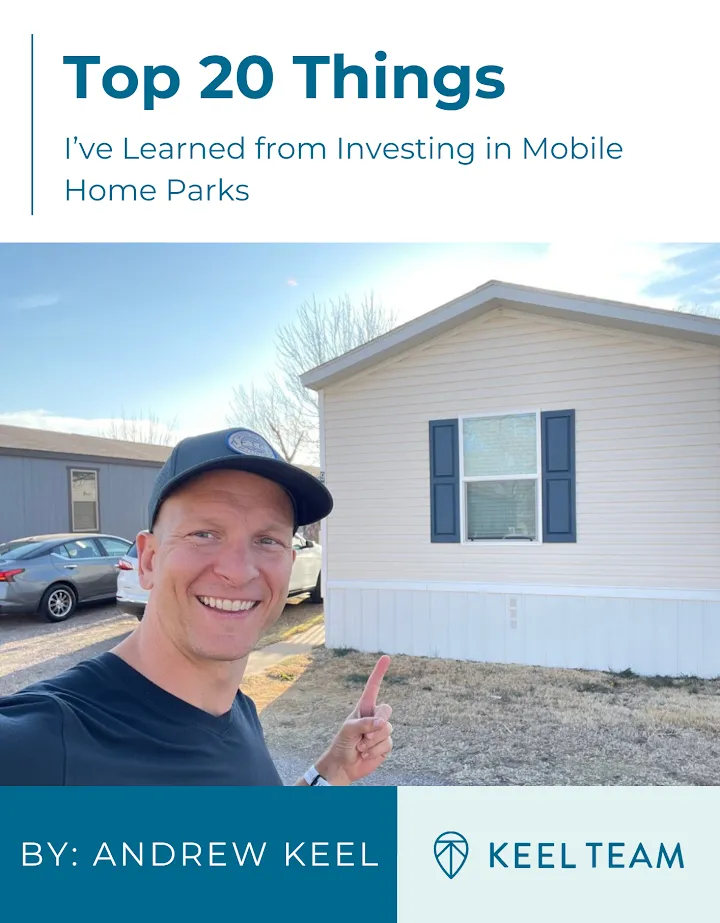
Two decades of hard-won lessons distilled into one free guide. Download it before your next deal review.
Download the Free eBook →
2. Passive Income and Tax Savings
As a sales executive, you’re likely already taxed at the highest marginal rate. Mobile home parks can help offset that burden.
They qualify for favorable tax treatment — including accelerated depreciation deductions — allowing investors to shelter a significant portion of rental income from taxes. Over time, those savings meaningfully boost overall returns.
On top of that, they can generate stable, predictable cash flow. With the right management team in place, day-to-day operations can be almost entirely hands-off. Most well-run mobile home park syndications target 6–10% annual cash-on-cash returns paid as quarterly distributions, with additional upside on the backend at sale.
3. You’re Solving a Real Problem
Mobile home parks play a critical role in providing affordable housing for lower-income families, the elderly, and other vulnerable populations. In many markets, they represent one of the last remaining sources of unsubsidized affordable housing.
And they’re disappearing. It’s estimated that over 20% of mobile home parks have been lost in the past two decades, as rising land values push owners to sell to developers.
Investing in this asset class means your capital does double duty — generating strong returns and helping preserve affordable housing in your community. Learn more about the structure of mobile home park syndications and how passive investors participate.
4. Recession Resilience
Economic downturns are inevitable. When the next one hits, your primary sales income may be at risk. Mobile home parks, however, have historically held steady — or even grown — during recessions.
Why? Because mobile homes are one of the most affordable housing options available. When times are tough, residents are far less likely to give up their home. In fact, many people move into mobile home parks during downturns, seeking more economical living arrangements.
Allocating a portion of your portfolio here can help insulate your overall wealth from the economic cycle. For a deeper look at the fundamentals, see our guide on why mobile home park investments are built to last.
5. Hands-Off Management
This is the big one for busy executives: you don’t have to run it yourself.
Mobile home parks can be effectively managed by a third-party property management company. These professionals handle everything — rent collection, maintenance, tenant screening, evictions — so you don’t have to.
By partnering with an experienced operator through a mobile home park syndication, you get attractive returns without sacrificing your focus on your core sales role. Explore what passive investing in mobile home parks looks like in practice.
Why 2026 Is a Particularly Strong Time for Sales Execs to Act
The case for mobile home park passive investing has only strengthened heading into the second half of 2026. A few key factors make this an opportune window:
Regulatory tailwind in high-growth states. States like North Carolina, Tennessee, Georgia, and South Carolina — where deal flow remains strong — have no state-level rent caps or right-of-first-refusal legislation as of mid-2026. That means operators in those markets can execute business plans with more predictability than in heavily regulated coastal markets.
Institutional validation. Institutional capital continues to flow into the asset class, which drives up valuations for well-run communities and validates the fundamentals for private investors. For context, institutional buyers accounted for roughly 23% of manufactured housing community purchases in recent peak years — and their continued interest signals long-term confidence in the asset class.
Stabilized cap rates create clarity. After a period of rate volatility, mobile home parks are trading at 5–7% cap rates for stabilized assets in 2026, giving underwriters a clear range to work within. Conservative rent growth assumptions of 3–4% annually still pencil to attractive returns given the low expense ratios these communities carry.
The Bottom Line
For busy sales executives looking to diversify their income streams, mobile home parks offer a compelling opportunity. Recession-resistant, tax-advantaged, socially impactful, and largely hands-off — this asset class checks a lot of boxes.
If you haven’t considered this as part of your long-term wealth-building strategy, 2026 is a great time to start. Begin with our in-depth mobile home park investing guide to understand the full landscape, then explore what the steps to invest in mobile home parks look like from first call to closing.
Frequently Asked Questions
How do sales executives typically invest passively in mobile home parks?
Most busy sales executives invest through mobile home park syndications — pooled investment vehicles where an experienced operator (the General Partner) acquires and manages the asset while passive investors (Limited Partners) contribute capital and receive distributions. This structure requires no day-to-day involvement from the investor. The GP handles acquisition, operations, and eventual sale, while LPs receive quarterly distributions and a share of the backend profits.
What kind of returns can I realistically expect from mobile home park passive investing?
Well-structured mobile home park syndications typically target 6–10% annual cash-on-cash returns during the hold period, plus additional upside at exit. Total returns over a 5–7 year hold often fall in the 15–20% IRR range depending on the deal, the operator’s execution, and exit cap rates. These figures are not guaranteed — underwriting assumptions, market conditions, and operational performance all affect actual outcomes.
How much time does a passive mobile home park investment actually require?
Very little. After the initial due diligence period — reviewing the operator’s track record, the offering documents, and the deal underwriting — most passive investors spend less than an hour per quarter reviewing investor reports and distribution statements. The entire point of the syndication structure is to separate capital deployment from operational responsibility.
Are mobile home parks risky investments for someone new to real estate?
All real estate carries risk, but mobile home parks have historically shown lower volatility than other commercial asset classes. The key risk factors to evaluate are operator quality (track record, team depth, capital alignment), infrastructure condition (private utilities carry more risk than city connections), and local market dynamics. Investing through a well-established operator with a transparent reporting track record significantly reduces execution risk for new investors.
What states are best for mobile home park investing right now?
As of 2026, operators tend to favor the Southeast — particularly North Carolina, Tennessee, Georgia, and South Carolina — for their combination of population growth, affordable housing demand, landlord-friendly regulation, and no state-level rent caps. These markets also benefit from proximity to major metros with 100,000+ populations, which supports strong occupancy and gradual lot rent growth over time.
10 video modules, a 55-page master checklist, and 9 ready-to-use templates. Everything you need to evaluate a deal from first look to closing day.
Get the Playbook →
Get the top 20 lessons from two decades of mobile home park investing — free.
Download the Free eBook →
Disclaimer:
The information provided is for informational purposes only and is not investment advice or a guarantee of any kind. We do not guarantee profitability. Make investment decisions based on your research and consult registered financial and legal professionals. We are not registered financial or legal professionals and do not provide personalized investment recommendations. This article was updated June 2026 and reviewed by Andrew’s team. Always consult a licensed professional before investing.