Manufactured Housing News Roundup — April 27, 2026
Welcome to Keel Team’s weekly manufactured housing news roundup — your fast-read digest of the most important stories shaping the industry this week. From a landmark credit scoring overhaul to an $830 million portfolio acquisition, April 2026 is closing out with a bang.
Before diving into the news, grab our free resource: Top 20 Things We’ve Learned from Mobile Home Park Investing. It covers the hard-won lessons that took us years to accumulate — yours for free.
🏗️ FHFA and HUD Overhaul Credit Scoring for Homebuyers — Does It Help Manufactured Housing?
In one of the biggest federal housing policy announcements in years, FHFA Director William “Bill” Pulte and HUD Secretary Scott Turner jointly announced on April 22, 2026 that Fannie Mae and Freddie Mac will immediately begin accepting two modernized credit scoring models: VantageScore 4.0 (available now) and FICO 10T (phased rollout to follow). Both models incorporate “trended” data — meaning your history of on-time rent payments, utility bills, and other recurring obligations will now count toward your creditworthiness for a federally backed mortgage.
“Today is a great day for American homebuyers,” Pulte said at the press conference. “Effective immediately, Fannie Mae and Freddie Mac are accepting new, modern credit scores that give American homebuyers the credit they deserve for paying their rent.” Twenty-one lenders are already participating in the expanded program, with more expected to join. Freddie Mac has already logged $10 million in activity under the new framework.
The catch for manufactured housing: roughly 70–80% of manufactured home purchases are financed through chattel loans (home-only financing), not GSE-backed mortgages. Critics like the Manufactured Housing Association for Regulatory Reform (MHARR) note the announcement does nothing to address the long-standing failure to enforce the Duty to Serve (DTS) mandate for manufactured housing chattel loans — first required under the Housing and Economic Recovery Act of 2008. Positive for housing broadly, but a partial win at best for the manufactured housing sector specifically.
Source: MHInsider — FHFA, HUD Hold Tandem Press Conference on Expanded Credit
Operator’s take: Any policy that increases the pool of eligible homebuyers is broadly positive for housing demand — but the manufactured housing industry needs chattel loan reform to move the needle at scale for mobile home park residents.
💰 RHP Properties Closes $830 Million Deal for 36-Community Portfolio
Michigan-based RHP Properties — the nation’s largest private owner of manufactured housing communities — just got bigger. The company secured $830 million in acquisition financing, arranged by Newmark Group and funded by Wells Fargo, to purchase and refinance a 36-asset portfolio comprising 8,340 home sites across supply-constrained markets. The deal was announced April 22, 2026.
RHP now controls over 375 communities and 80,582 home sites across 31 states. The company describes itself as a “$10+ billion asset value” operation that has invested $438 million in community improvements over the past six years. The targeted portfolio spans markets with “sustained population growth” and “high barriers to entry” — the same characteristics that make quality mobile home parks attractive to long-term investors.
The transaction underscores continued institutional appetite for land-lease manufactured housing communities. When private operators are willing to borrow $830 million in a single deal to acquire mobile home parks, it signals sustained conviction in the asset class’s fundamentals: predictable lot rent income, low tenant turnover, and near-irreplaceable land positions.
Source: MHProNews — RHP Properties Secures $830M Acquisition Financing
Operator’s take: This is the big-money signal operators watch — when institutional capital is deploying $830M into a single portfolio transaction, it confirms that mobile home parks remain one of the most desirable commercial real estate asset classes in the country.
Download our free guide: Top 20 Things We’ve Learned from Mobile Home Park Investing — the practical lessons, red flags, and deal criteria we’ve built from years in the field.
📉 HUD Code Production Still Declining Despite Affordability Crisis
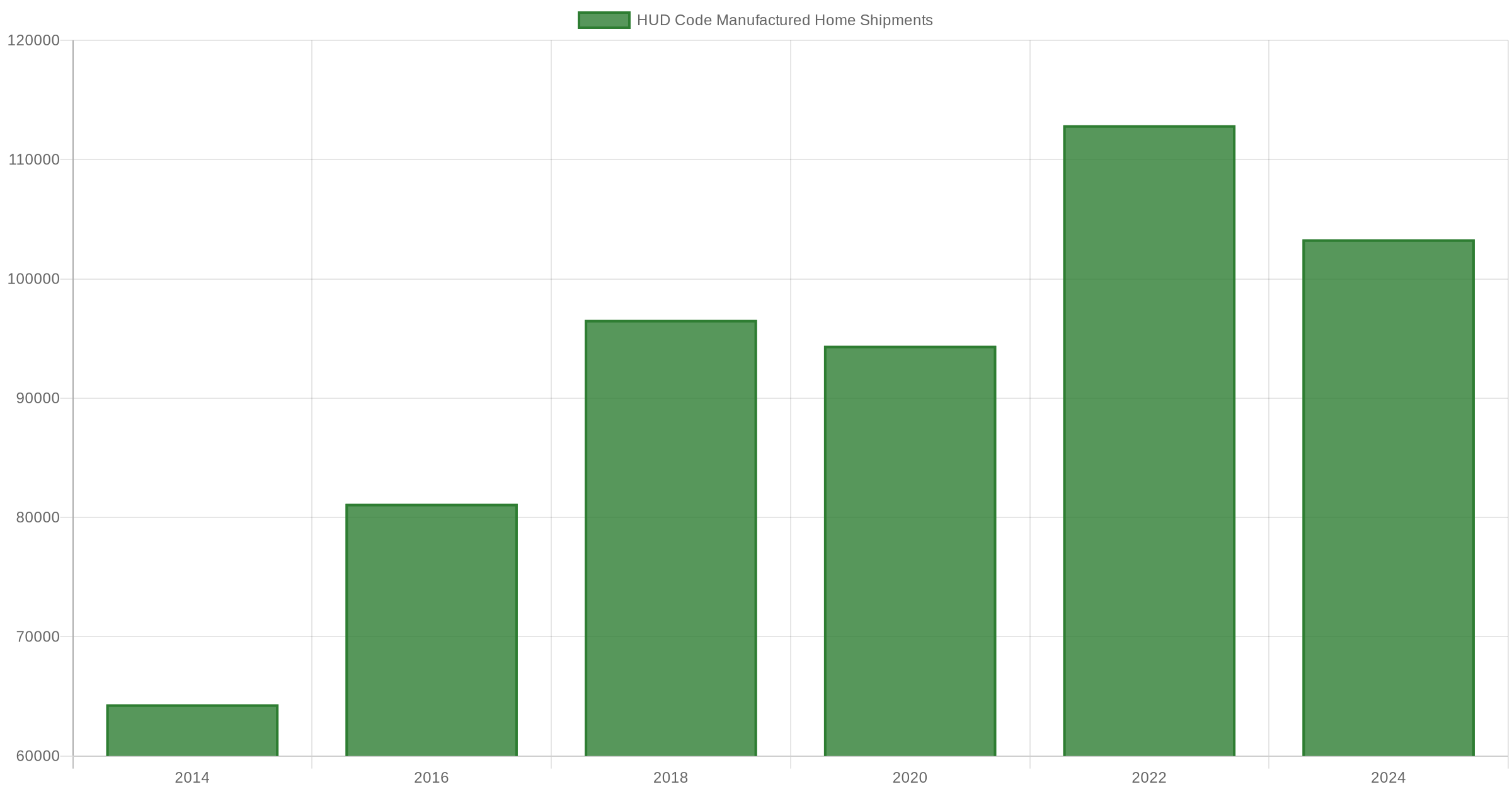
According to data released by the Manufactured Housing Association for Regulatory Reform (MHARR) on April 6, 2026, HUD code manufactured home production continues to decline even as the broader housing affordability crisis deepens. Industry shipments peaked at 112,882 units in 2022, fell to an estimated 96,000–103,000 range in 2024, and show no near-term signs of recovery. MHARR attributes the decline to unresolved “bottlenecks” — primarily the lack of zoning preemption enforcement and the absence of chattel lending support mandated under Duty to Serve.
The implications extend to publicly traded manufacturers. Both Cavco Industries (CVCO) and Champion Homes (SKY) — dominant players in HUD code production — face headwinds as long as these systemic constraints remain unaddressed. Critics note the Manufactured Housing Institute has been largely silent on the production decline, with no publicly visible press release on the trend as of early April.
The disconnect between a surging housing affordability crisis and declining manufactured home production is striking. Manufactured homes remain the most cost-effective path to homeownership in America — average prices roughly 50% below site-built homes — yet bureaucratic bottlenecks continue to suppress supply at the worst possible time.
Source: MHProNews — HUD Code Production Decline Continues per MHARR
Operator’s take: Constrained production of new manufactured homes isn’t just a manufacturer problem — it keeps supply of homes for mobile home parks tight, which affects infill strategies and community value-add potential.
🏗️ MHI 2026 Congress and Expo Wraps in Las Vegas with Record Attendance
The Manufactured Housing Institute’s (MHI) 2026 Congress and Expo wrapped up earlier this month at the MGM Grand in Las Vegas, drawing more than 1,500 manufactured housing professionals for three days of learning, deal-making, and product showcases. That’s nearly double the 778 attendees who showed up in 2019, reflecting the dramatic surge in industry interest over the past decade.
Key themes at this year’s event included AI integration in manufactured housing operations, new lending developments, and legal/regulatory track sessions covering fair housing compliance and resident protections. The new Professional Housing Consultant® Experience drew strong attendance from sales teams looking to sharpen closing skills. The NCC Spring Forum — targeted at community owners and operators of all sizes — ran concurrently and featured programming directly relevant to mobile home park operators.
The growth in Congress and Expo attendance mirrors broader market interest in manufactured housing. Lender activity in the space has surged dramatically — one commercial broker, Eastern Union, reported a 170% increase in manufactured housing transactions over the most recent five-year period versus the prior five-year period, with average deal sizes more than doubling.
Source: MHInsider — Manufactured Housing Industry Convenes for MHI’s 2026 Congress and Expo
Operator’s take: The conference growth reflects exactly what operators are seeing on the ground — more institutional capital competing for the same pool of quality mobile home park assets.
🏠 Champion Homes Partners on 67-Home Attainable Housing Village in Fresno, California
Champion Homes has completed a development partnership in Fresno, California to deliver a village of 67 attainable, off-site built homes in a constrained market. The project — Blythe Village — represents a growing trend of manufactured and modular home builders partnering directly with local developers and municipalities to address acute housing supply gaps in high-cost states like California.
California’s housing crisis has made it increasingly receptive to factory-built solutions that can be deployed faster and at lower cost than traditional site-built construction. The Fresno project is a smaller-scale example of what manufactured housing advocates have long argued: that HUD code and modular construction can help solve America’s housing shortage, if zoning and permitting barriers are reduced. Champion’s involvement highlights how the industry’s largest players are increasingly pursuing community-scale projects rather than just individual home retail sales.
Source: MHInsider — Champion Teams with Developer for Fresno, Calif., Village
Operator’s take: Manufactured housing communities partnered with single-source builders like Champion are becoming a viable model for new community development — worth watching as zoning reform spreads.
📊 What This Means for Mobile Home Park Investors
This week’s news paints a clear picture: institutional money is flowing into manufactured housing communities at scale (see: RHP’s $830M deal), lender appetite is stronger than it’s been in decades, and federal policy is — slowly — moving in the direction of expanded access. But the structural bottleneck of declining HUD code production and unresolved chattel loan reform remains the industry’s Achilles heel.
For operators and investors in the mobile home park space, the key takeaways are:
- Acquisitions are increasingly competitive. Institutional buyers with billion-dollar war chests are targeting the same supply-constrained markets you are. Off-market relationships matter more than ever.
- Financing is available — and active. The RHP deal and Eastern Union’s data confirm capital markets are fully open to the asset class. Quality parks with city utilities in growing markets are commanding premium terms.
- Production constraints protect existing community values. Declining manufactured home production tightens housing supply, which supports lot rents and occupancy for well-located mobile home parks.
- Policy momentum is building but incomplete. Credit score reform is a step forward, but chattel lending and zoning preemption enforcement remain the key regulatory unlocks for manufactured housing’s full potential.
❓ FAQ: This Week’s Top Questions About Manufactured Housing
Will the new FHFA/HUD credit scoring rules help manufactured home buyers?
Partially. The new FICO 10T and VantageScore 4.0 models will help buyers who have strong rent and utility payment histories but thin traditional credit files. However, since most manufactured home buyers use chattel loans — not GSE-backed mortgages — the full benefit of this reform will not reach the majority of the manufactured housing market until Duty to Serve requirements for chattel lending are enforced.
Why is institutional investment in mobile home parks accelerating?
Several converging factors: severe housing affordability constraints that make manufactured housing the most cost-effective option for millions of Americans, stable lot rent income with historically low vacancy rates, high barriers to entry (new mobile home parks are nearly impossible to permit in most jurisdictions), and a fragmented ownership landscape that still offers acquisition opportunities for well-capitalized buyers.
What is HUD code manufactured housing production, and why does it matter?
HUD code manufactured homes are factory-built homes constructed to federal building standards administered by the Department of Housing and Urban Development. Production levels reflect how many new manufactured homes are being built nationwide. When production declines — as it has since the 2022 peak — fewer homes are available to fill vacant lots in mobile home parks, which constrains operators’ ability to increase occupancy and community revenue through infill strategies.